Precise assembly of engines
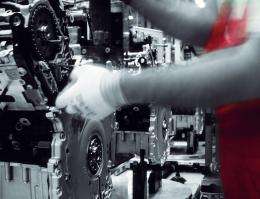
In the automotive industry, combustion engines are still assembled mostly manually. Researchers from Fraunhofer are developing procedures and methods to automate assembly processes to continuously improve the quality of the engines. The use of the latest technologies helps to eliminate uncertainties during engine assembly.
Valves, nozzles, pistons, spark plugs and camshafts – the heart of each car is its engine. It is a complex structure with many levels and individual parts and must therefore be assembled in a correspondingly precise way. Parts that are slightly damaged, malformed or assembled the wrong way can cause engine damage. The results would be an angry customer and damage to the reputation of the car manufacturer.
While assembly is mostly automated for the construction of the body, the engine is still assembled by hand over long stretches. The current methods for automating engine assembly have proven either useless or too expensive. The work of the project group “Resource-efficient mechatronic processing machines“ of the Fraunhofer Institute for Machine Tools and Forming Technology IWU under the management of Prof. Dr.-Ing. Gunther Reinhart shows greater promise. In cooperation with the car manufacturer Audi, the engineers initiated the project: “Forward-looking methods and processes for precision assembly and process monitoring for novel combustion engines.“ The objective is clearly defined: the quality of the engine assembly is to be optimized continuously, therefore increasing customer satisfaction further. The use of the latest technologies in the areas of robotics and sensor technology is intended to help eliminate uncertainties during engine assembly. “Monitoring the process throughout is not possible, since the engine continues to be assembled mostly manually. And engines are becoming more complex all the time. This can cause increased levels of rework,“ says graduated engineer Christoph Sieben from the IWU. The automated assembly technology of the IWU scientists would identify the defect early, during engine assembly, and forward the corresponding information or, for certain assembly processes, would not permit the defect to occur in the first place.
The researchers first catalogued the status quo, evaluating current data on documented, assembly-related engine problems for in-line and V-type engines over the past five years. The focus of the analysis was on the parts used and on the processes involved. “We generalized the engine assembly sequence and broke it down into eight blocks. The individual assembly functions are also recorded in a standardized way,“ declares Christoph Sieben. This makes it possible to assign errors during assembly to uniformly defined assembly sequences and assembly functions. As a result of this generalization of engine assembly, the analysis can be utilized for all kinds of engines. “We now know which assembly sequences require action,“ says Christoph Sieben. The project group wants to develop new automation solutions next. The core piece of the test facility is a new type of lightweight robot: it weighs only 16 kilograms but can lift up to seven kilograms. What is so special about the “KUKA robot“? It is very sensitive and flexible, unlike other traditional robots that can perform tasks only within certain parameters. The researchers are now looking for new ways to combine innovative sensor technology and robots. “For example, we are pondering how a transfer from medical sensor technology to industrial processing could be effected,“ elaborates Christoph Sieben.
A high-performance control technology can be developed by integrating sensor systems of many variations: ideally, the robot will not only detect the problem, it will also solve it. Camera systems that record the directional orientation of a part are a current example. If it does not correspond to the standard, the robot can decide whether the part will be used or if it has to be replaced. Christoph Sieben explains: “The process monitoring system that is to be developed further on this basis has the ability to automatically deduce the inspection criteria and the required tolerances during the entire assembly process and then to react.” The project will end in 2014. The plan is that the prototype will then be ready for series production.
Provided by Fraunhofer-Gesellschaft


