Invisibility carpet cloak can hide objects from visible light
June 15, 2011 by Lisa Zyga feature

Invisibility carpet cloak can hide objects from visible light

Enlarge

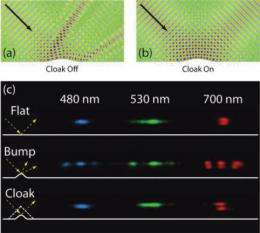
When an input beam (black arrow) reflects off (a) a bump without a cloak, the bump causes a perturbation. When the beam reflects off (b) a bump covered by a cloak, the cloak masks the bump, and the reflected beam is reconstructed as if the bump did not exist. (c) Light after reflection from a flat mirror, a bump without a cloak, and a cloaked bump, at three different wavelengths. Image credit: Majid Gharghi, et al. ©2011 American Chemical Society

(PhysOrg.com) -- Most of the invisibility cloaks that have been demonstrated to date conceal objects at frequencies that are not detectable by the human eye. Designing invisibility cloaks that can conceal objects from visible light has been more challenging due to the strict material requirements. But in a new study, researchers have fabricated a carpet cloak that can make objects undetectable in the full visible spectrum.

The researchers, led by Prof. Xiang Zhang at the University of California, Berkeley, and Lawrence Berkeley National Laboratory, have published their study in a recent issue of .

As the researchers explain, most previous invisibility cloaks have used metallic metamaterials for cloaking at . But at , the metal absorbs too much and leads to significant metallic loss, and Berkeley and other groups have had to design dielectric cloaks at infrared frequencies. More recently, researchers at University of Birmingham (UK) have experimented with using uniaxial as the cloak material, which can enable cloaking in visible frequencies, but only for a certain polarization of light.

In the current study, the researchers used a technique called quasi conformal mapping (QCM) to conceal an object with a height of 300 nm and a width of 6 µm underneath a reflective “carpet cloak.” The carpet itself has the appearance of a smooth optical mirror, so that the object and the bump that the object makes underneath the carpet are undetectable by .

“The carpet cloak means that you conceal the object under a layer, which we call carpet, but you see the carpet like a normal mirror, as if it is flat with no bump caused by putting the object underneath,” Zhang told PhysOrg.com. “This way, the observer won't recognize something is concealed underneath.”

In order to guide visible light around the concealed object, the researchers had to make light travel at different speeds while approaching the bump. They achieved this by designing the materials to have a variable , transforming them into , since they don’t appear in nature. The researchers placed a silicon nitride waveguide on a transparent nanoporous silicon oxide substrate that they specially developed to have a much lower refractive index than that of the waveguide. Using nanofabrication techniques, the researchers etched tiny holes into the nitride to make a desired pattern, giving the waveguide the cloaking refractive index profile.

“The concept of the carpet cloak was originally suggested so that you can design a certain pattern for a given size of the bump, and hide an object of arbitrary shape under that,” Zhang said. “If you need to make a bigger size bump to hide a bigger object, a new hole pattern will be required.”

With this refractive index profile, along with the transparency of both the waveguide and the substrate, the cloak could completely conceal an object by producing a light beam profile identical to a beam reflected from a flat carpet with no object underneath.

“This device is among the first cloak devices that operate at visible frequencies; the other very recent visible light cloaks operate based on a principle that relies on a certain polarization of light, whereas the quasi-conformal-based principle does not rely on the polarization,” Zhang said. “Of course, the waveguide geometry entails different operation for different polarizations, which is extrinsic to the QCM design.”

In addition to cloaking, the new technique provides an important step toward implementing optical transformation structures in the visible range. Using transformation optics (TO), researchers can manipulate light for applications such as powerful microscopes and computers.

“The carpet is an example of a wide family of devices that can be made based on transformation optics,” Zhang said. “Besides invisibility, all kinds of optical illusion schemes can be made based on the concept, where the observer receives a different impression when looking at an object. The capability to manipulate light propagation can be used in energy devices, optical computing devices, and beyond, wherever it is desired to have full control on the light path; TO lets us redirect light and re-route it.”

More information: Majid Gharghi, et al. “A Carpet Cloak for Visible Light.” Nano Letters. DOI: 10.1021/nl201189z

Copyright 2011 PhysOrg.com.
All rights reserved. This material may not be published, broadcast, rewritten or redistributed in whole or part without the express written permission of PhysOrg.com.

Filter


Move the slider to adjust rank threshold, so that you can hide some of the comments.


Display comments: newest first

kevinrtrs
Jun 15, 2011

Rank: 1.7 / 5 (12)
We DO live in a magical kingdom after all! Invisibility, instantaneous reaction at vast distances between entangled photons, tunneling thru barriers, time dilation and instantaneous, infinite light speed to name some off the top of my head. What more can one ask for? OK, telekinesis, telepathy, prediction of the lottery numbers - well then we'll all still be just as poor....
DavidMcC
Jun 15, 2011

Rank: 4.4 / 5 (8)
What's so "magical" about a relatively flat mirror, Kevin?
And since when has the speed of light been "infinite"?
bugmenot23
Jun 15, 2011

Rank: 3 / 5 (2)
Kevin, for the remainder of your wish list Google the below:
For telepathy, "Brain-computer-interface" experiments, for telekinesis try, "Mach effect", for prediction of lottery numbers, look up "quantum temporal entanglement" experiments.
NotAsleep
Jun 15, 2011

Rank: 3 / 5 (7)
And entangled photons don't interact with each other across vast distances. Their interaction with each other ends as soon as they're separated
emsquared
Jun 15, 2011

Rank: 5 / 5 (3)
I love that we're working on cloaking technology, but even if something is invisible to the visible spectrum, wouldn't we also have to be able to project the image of whatever is on the other side of the cloak to the visible side for it to truly be "invisible" as we think of sci-fi cloaking technology? I guess I just envision something that is invisible to the visible spectrum not reflecting light, so it would still appear as a silhouette unless what is on the other side is projected through... is this incorrect?
bugmenot23
Jun 15, 2011

Rank: 5 / 5 (1)
@emsquared: The cloak is described as a mirror. For eg, if this was scaled up and used as a tarpaulin to hide a tank on the ground, from satellites. The satellite would see ground,mirror,ground. Instead of ground,tank,ground. The mirror would reflect a portion of the sky, so it's not perfect yet. On the other hand if the tank was painted with the meta-materiel cloak, the satellite would see ground,ground,ground.
TombSyphon2317
Jun 15, 2011

Rank: 1 / 5 (1)
emsquared

I would say yes you are correct. But the answer to the problem is creating a material with quantum properties allowing the light to be absorbed, and emitted with out interference. Allowing the light to follow it's original trajectory. Having materials of said properties it would not be a far stretch to expand that into absorption of radiation, and any number of other harmful energies. Shielding for reactors that absorb the radiation, and convert directly to electricity. Maybe i'm just dreaming but someone has to have the idea for the first time.
mgb
Jun 15, 2011

Rank: 1 / 5 (2)
And entangled photons don't interact with each other across vast distances. Their interaction with each other ends as soon as they're separated

Wrong
Sinister1811
Jun 15, 2011

Rank: 3 / 5 (2)
So, this is basically just an illusion?
Davralon
Jun 16, 2011

Rank: 1 / 5 (1)
And entangled photons don't interact with each other across vast distances. Their interaction with each other ends as soon as they're separated

Wrong


You gotta love this guy, do you think he understands the principles of a BEC?
DavidMcC
Jun 16, 2011

Rank: not rated yet
I'm not sure it even means anything to talk about "separated photons". A photon is, properly speaking, an excitation of the EM field, and can be anywhere that that field is non-zero. That is why you can have interference patterns in light even when there is only "one photon present at a time" (due to low light intensity) - they do not interfere with each other, it is the effect of the Hamiltonian that makes it seem that way.
NotAsleep
Jun 16, 2011

Rank: 2.3 / 5 (3)
And entangled photons don't interact with each other across vast distances. Their interaction with each other ends as soon as they're separated

Wrong

Are you suggesting that you have the ability to change a property of a particular particle and have its entangled twin somewhere else instantaneously change properties? Is there any evidence of this ever happening anywhere? I would honestly enjoy seeing that
alysdexia
Jun 16, 2011

Rank: not rated yet
travel -> fare
bigger -> greater
it's -> its
i -> I

Entanglement is no more interaction than a pair of socks; it's conjugation.
mgb
Jun 16, 2011

Rank: not rated yet
Really? I always understood that the do interact across vast distances. Isn't that why Einstien called it "spooky..." and didn't like it?
Wiki says...
"when the spin of only one of the two entangled electrons is measured, the spin of the other immediately becomes determinate. Before the measurement, it is impossible to describe the spins of the electrons independently, and only the combined spin of the two-electron system is known. After the measurement of one of the electrons, the correlated spins of the two electrons become determinate. Measuring the value of the spin of one disentangles the particles, and forces the other to take on its own, separate spin value. This occurs even though the particles are now separated by arbitrarily large distances."

Please enlighten me...
Zak_Mc_Kee
Jun 18, 2011

Rank: 1 / 5 (3)
What's so "magical" about a relatively flat mirror, Kevin?
And since when has the speed of light been "infinite"?


The constant speed of light that you know of is the slowest speed light travels, light travels faster in a vacuum.
seb
Jun 19, 2011

Rank: 4.5 / 5 (2)

Are you suggesting that you have the ability to change a property of a particular particle and have its entangled twin somewhere else instantaneously change properties? Is there any evidence of this ever happening anywhere? I would honestly enjoy seeing that


Einstein called it "Spooky action at a distance" and refused to believe in it. Yet later experimentation has confirmed the effect.

This is very counter-intuitive, and many theories have been proposed to try to explain it. It's as if, even if separated, the particles were still a single item. One theory even proposes that there is a kind of back-propagation in time between quantum "particles".. Hmm.
SincerelyTwo
Jun 20, 2011

Rank: 4.3 / 5 (3)
"Are you suggesting that you have the ability to change a property of a particular particle and have its entangled twin somewhere else instantaneously change properties?"

No. Not change properties.

Entangled particles are said to have indefinite properties until one or the other is interfered with (measured). The perceived natural phenomena is that once one of the pair is measured, you can with certainty infer the properties of the other particle. There's debate on whether or not the real values are actually determined at the moment of entanglement and a question if the maths meaning is properly interpreted.

Regardless, the inference is reliable at arbitrary distances.

Personally, I think physicists take statistics to literally, a consequence of the nature of physics education. Physicists seem to always forget that maths is abstract representations of ideas.
SincerelyTwo
Jun 20, 2011

Rank: 4.7 / 5 (3)
Just to make it clear, the way I ended my reply means to infer that I'm siding with the argument promoting that the real values of entangled particles are objectively set at the moment of entanglement, we just don't know what the values are until we measure it.

That situation can easily be exploited to argue something more fantastical, and I hear people say they're right just because you can't prove them wrong. Except that relativity works at large distances, and when you separate particles by large distances the speed of light applies, then finally from there it becomes obvious what the truth must be.

There's only one way to show the fantastical interpretation of entanglement is true; measure particle A in a pair of entangled particles, entangle particle A and measure it again. This requires being able to keep track of which particle is A, which you can't, and it would require A to acquire different properties at random.
NotAsleep
Jun 20, 2011

Rank: 3.5 / 5 (2)
@ seb, Is this in reference to quantum entanglement or another theory? I think the term "quantum entanglement" and the definition given to explain it sometimes throw people for a loop, which is a perfect segue to:

@ MGB, the definition you grabbed is correct but you're interpreting it wrong. A very simplified example of this theory would be to take two similar objects with different colors, red and blue, and put them in a bowl. Close your eyes, grab one of the objects, and walk into another room. When you get there, you have no idea which object is in your hand. However, when you open your eyes and see the color, suddenly you have brand new information that was unknown before you opened your eyes. Instantaneously, you know the exact color of the object you left in the bowl. "Info" is the key word. It appears to travel faster than light, although you no longer have the ability to CHANGE the info of the other object (continued)
NotAsleep
Jun 20, 2011

Rank: 5 / 5 (1)
As SincerelyTwo points out, the speed of light is currently the limitation. As far as I know (I'm an engineer, not a quantum physicist), there's no known particle and no known phenomenon that indicates there's anything that travels faster than light, although the Trekky in me hopes some existing theories become law at some point...

I've got a really good book on "Information." If anyone is intersted, I can dig it out of my boxes and give you the name. It does a really good job of breaking down the semantic barriers of terms like "information" and "quantum entanglement". It explains why things like the tachyon don't exist but that they might suddenly exist in huge quantities if we find a way to measure them...
mgb
Jun 21, 2011

Rank: 5 / 5 (2)
@NotAsleep
Thanks for your elaboration on the issue. Intuitively, your explanation feels better than the one I understand. If you are correct in your analogy, however, the effect becomes simple and a child could understand that. Why then did Einstein find such an issue "spooky"? And why does Wiki go out-of-their-way to state "This occurs even though the particles are now separated by arbitrarily large distances."? My question is definitely rhetorical, but I'd really appreciate an answer if you have time. Cheers.
SincerelyTwo
Jun 21, 2011

Rank: 5 / 5 (3)
mqb,

It comes down to how individuals of different disciplines interpret mathematical statements. Some read equations too literally, other's more realistically, other in between. Interpreting a maths statement can be a challenge.

My immediate intuition of the concept of an 'observer' in physics, after understanding that observation was always associated with interaction, leads me to understand that all matter and energy is an "observer." The term itself was a terrible choice, causes my intepretation to seem to not make sense. Which is why the earth didn't spontaneously transform in to a ball of yarn before life evolved.

I'm sure you think that is ridiculous, but then again you may not have seen the quantum mechanics documentary called "What the Bleep Do We Know!? & What the Bleep!? - Down the Rabbit Hole". See that to understand the consequences of ridiculous interpretations.

You don't need a correct interpretation of a statement to correctly manipulate the terms.
Rank 5 /5 (20 votes)
Relevant PhysicsForums posts
  • [Drift velocity] Factors affecting velocity
    created3 hours ago
  • does cold gasoline have less energy
    created3 hours ago
  • distribution of molecules throughout the atmosphere
    created5 hours ago
  • The Global Positioning System !
    created6 hours ago
  • A Question relating Power
    created7 hours ago
  • Writing a book so im learning about things, i have some general questions please read
    created10 hours ago
  • More from Physics Forums - General Physics

More news stories

Is a classical electrodynamics law incompatible with special relativity?

(Phys.org) -- The laws of classical electromagnetism that were developed in the 19th century are the same laws that scientists use today. They include Maxwell’s four equations along with the Lorentz la ...

Physics / General Physics

created May 24, 2012 | popularity 4.7 / 5 (17) | comments 42 | with audio podcast feature

Landmark calculation clears the way to answering how matter is formed

(Phys.org) -- An international collaboration of scientists, including Thomas Blum, associate professor of physics, is reporting in landmark detail the decay process of a subatomic particle called a kaon – ...

Physics / General Physics

created May 25, 2012 | popularity 4.2 / 5 (21) | comments 47 | with audio podcast

Lying in wait for WIMPs: Researchers seek to dramatically increase sensitivity of Large Underground Xenon detector

Although it's invisible, dark matter accounts for at least 80 percent of the matter in the universe. No one knows what it is, but most scientists would bet on weakly interacting massive particles, or WIMPs.

Physics / General Physics

created May 23, 2012 | popularity 4 / 5 (7) | comments 15 | with audio podcast

Hawaii lab turns laser-powered bubbles into microrobots

(Phys.org) -- A team of scientists from the University of Hawaii are working on microrobots created from bubbles of air in a saline solution. The bubbles take on their title of “robots” as a laser ...

Physics / General Physics

created May 23, 2012 | popularity 5 / 5 (4) | comments 2 | with audio podcast weblog

Sound increases the efficiency of boiling

Scientists at the Georgia Institute of Technology achieved a 17-percent increase in boiling efficiency by using an acoustic field to enhance heat transfer. The acoustic field does this by efficiently removing vapor bubbles ...

Physics / Soft Matter

created May 24, 2012 | popularity 5 / 5 (2) | comments 2


Nvidia trumpets Tegra 3 phone design wins for 2012

(Phys.org) -- Nvidia’s competitive war paint has a name, Tegra 3. On the heels of Nvidia announcements about lowering costs of its Tegra 3 processors and Nvidia-enabled tablets running Android Ice Cream ...

Browser wars flare in mobile space

The browser wars are heating up again, but this time the fight is for dominance of the mobile Internet.

Scientist: Evolution debate will soon be history

(AP) -- Richard Leakey predicts skepticism over evolution will soon be history. Not that the avowed atheist has any doubts himself.

Dell tablet leak: 10.1-inch display, two-battery choice

(Phys.org) -- Headline after headline talks about vendors’ tablets in the wings as likely number-one contenders for the iPad. Such claims have justifiably been taken with a grain of salt, considering ...

Keep food safety in mind this memorial day weekend

(HealthDay) -- Picnics, parades and cookouts are as much a part of Memorial Day weekend as tributes to the United States' war veterans.

Social welfare cuts ultimately come with heavy price, researchers say

(Phys.org) -- Slashing government funding for Medicaid, food stamps and other programs that serve the poor – while politically popular with some lawmakers and many conservatives – may do more harm ...