Inkjet printing could change the face of solar energy industry
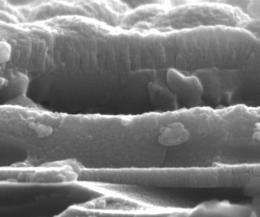
This scanning electron microscope, cross-sectional image shows the various compounds of a new chalcopyrite solar cell only a few microns thick, which can be created much less expensively with inkjet printing. (Image courtesy of Oregon State University)
Inkjet printers, a low-cost technology that in recent decades has revolutionized home and small office printing, may soon offer similar benefits for the future of solar energy.
Engineers at Oregon State University have discovered a way for the first time to create successful "CIGS" solar devices with inkjet printing, in work that reduces raw material waste by 90 percent and will significantly lower the cost of producing solar energy cells with some very promising compounds.
High performing, rapidly produced, ultra-low cost, thin film solar electronics should be possible, scientists said.
The findings have been published in Solar Energy Materials and Solar Cells, a professional journal, and a patent applied for on the discovery. Further research is needed to increase the efficiency of the cell, but the work could lead to a whole new generation of solar energy technology, researchers say.
"This is very promising and could be an important new technology to add to the solar energy field," said Chih-hung Chang, an OSU professor in the School of Chemical, Biological and Environmental Engineering. "Until now no one had been able to create working CIGS solar devices with inkjet technology."
Part of the advantage of this approach, Chang said, is a dramatic reduction in wasted material. Instead of depositing chemical compounds on a substrate with a more expensive vapor phase deposition wasting most of the material in the process inkjet technology could be used to create precise patterning with very low waste.
"Some of the materials we want to work with for the most advanced solar cells, such as indium, are relatively expensive," Chang said. "If that's what you're using you can't really afford to waste it, and the inkjet approach almost eliminates the waste."
One of the most promising compounds and the focus of the current study is called chalcopyrite, or "CIGS" for the copper, indium, gallium and selenium elements of which it's composed. CIGS has extraordinary solar efficiency a layer of chalcopyrite one or two microns thick has the ability to capture the energy from photons about as efficiently as a 50-micron-thick layer made with silicon.
In the new findings, researchers were able to create an ink that could print chalcopyrite onto substrates with an inkjet approach, with a power conversion efficiency of about 5 percent. The OSU researchers say that with continued research they should be able to achieve an efficiency of about 12 percent, which would make a commercially viable solar cell.
In related work, being done in collaboration with Greg Herman, an OSU associate professor of chemical engineering, the engineers are studying other compounds that might also be used with inkjet technology, and cost even less.
Some approaches to producing solar cells are time consuming, or require expensive vacuum systems or toxic chemicals. OSU experts are working to eliminate some of those roadblocks and create much less costly solar technology that is also more environmentally friendly. New jobs and industries in the Pacific Northwest could evolve from such initiatives, they say.
If costs can be reduced enough and other hurdles breached, it might even be possible to create solar cells that could be built directly into roofing materials, scientists say, opening a huge new potential for solar energy.
"In summary, a simple, fast, and direct-write, solution-based deposition process is developed for the fabrication of high quality CIGS solar cells," the researchers wrote in their conclusion. "Safe, cheap, and air-stable inks can be prepared easily by controlling the composition of low-cost metal salt precursors at a molecular level."
Provided by
Oregon State University
-
From lemons to lemonade: Reaction uses carbon dioxide to make carbon-based semiconductor,
32 comments
-
Thioridazine kills cancer stem cells in human while avoiding toxic side-effects of conventional cancer treatments,
3 comments
-
SpaceX private rocket blasts off for space station (Update),
42 comments
-
Climate scientists say they have solved riddle of rising sea,
31 comments
-
SpaceX capsule has 'new car' smell, astronauts say (Update),
2 comments
-
Gibbs Free Energy Change/Entropy
5 hours ago
-
What's the rule to covalent character
6 hours ago
-
Schwartz reagent-- NMR/MS/IR
May 26, 2012
-
High school chemistry EEI
May 25, 2012
-
oxidation of I- by KMnO4
May 25, 2012
-
Inversion temp
May 25, 2012
- More from Physics Forums - Chemistry
More news stories
New CO2-removing catalyst can take the heat
(Phys.org) -- The current method of removing the greenhouse gas carbon dioxide (CO2) from the flues of coal-fired power plants uses so much energy that no one bothers to use it. So says Roger Aines, principal ...
May 24, 2012 |
5 / 5 (9) |
9
|
High-speed method to aid search for solar energy storage catalysts
Eons ago, nature solved the problem of converting solar energy to fuels by inventing the process of photosynthesis.
May 25, 2012 |
5 / 5 (3) |
4
|
Researchers demonstrate possible primitive mechanism of chemical info self-replication
(Phys.org) -- When scientists think about the replication of information in chemistry, they usually have in mind something akin to what happens in living organisms when DNA gets copied: a double-stranded molecule ...
May 25, 2012 |
5 / 5 (4) |
2
|
Building a better solar panel -- one molecule at a time
(Phys.org) -- One of the fundamental building blocks in modern chemistry, an organometallic chemical compound called ferrocene, has never been structurally defined - until now.
May 25, 2012 |
5 / 5 (3) |
0
|
Discarded data may hold the key to a sharper view of molecules
(Phys.org) -- There's nothing like a new pair of eyeglasses to bring fine details into sharp relief. For scientists who study the large molecules of life from proteins to DNA, the equivalent of new lenses have come in the ...
May 24, 2012 |
4.7 / 5 (3) |
0
|
Nvidia trumpets Tegra 3 phone design wins for 2012
(Phys.org) -- Nvidias competitive war paint has a name, Tegra 3. On the heels of Nvidia announcements about lowering costs of its Tegra 3 processors and Nvidia-enabled tablets running Android Ice Cream ...
Browser wars flare in mobile space
The browser wars are heating up again, but this time the fight is for dominance of the mobile Internet.
Scientist: Evolution debate will soon be history
(AP) -- Richard Leakey predicts skepticism over evolution will soon be history. Not that the avowed atheist has any doubts himself.
Dell tablet leak: 10.1-inch display, two-battery choice
(Phys.org) -- Headline after headline talks about vendors tablets in the wings as likely number-one contenders for the iPad. Such claims have justifiably been taken with a grain of salt, considering ...
Keep food safety in mind this memorial day weekend
(HealthDay) -- Picnics, parades and cookouts are as much a part of Memorial Day weekend as tributes to the United States' war veterans.
Social welfare cuts ultimately come with heavy price, researchers say
(Phys.org) -- Slashing government funding for Medicaid, food stamps and other programs that serve the poor while politically popular with some lawmakers and many conservatives may do more harm ...
Jun 28, 2011
Rank: 5 / 5 (1)
Jun 28, 2011
Rank: not rated yet
Jun 28, 2011
Rank: 1.8 / 5 (5)
It will be cheaper just to replace the whole machine every few years (And get the included starter iridium tanks), rather than replace those expensive cartridges.
They should develope a laser printing method for the solar cells. It will be cheaper in the long run.
Jun 28, 2011
Rank: 5 / 5 (5)
It's pretty amazing how versatile this "inkjet" technology is. Too bad HP didn't foresee all these different uses for it's printer.
Jun 28, 2011
Rank: 1 / 5 (1)
Jun 28, 2011
Rank: 5 / 5 (2)
Jun 28, 2011
Rank: 3.2 / 5 (6)
Jun 29, 2011
Rank: 2.3 / 5 (4)
Jun 29, 2011
Rank: not rated yet
Most of research is funded by private corporations. Source:
http://en.wikiped..._science
That said, funding of science is one of the best uses for taxpayers money there is, and I would be glad to pay more taxes if was directed to this end.
Jun 29, 2011
Rank: not rated yet
I beg to differ...actually I'll let Ray Kurzweil do my talking for me. Here is what he has to say:
Jun 29, 2011
Rank: not rated yet
I found this, too...dated 2008:
http://inhabitat....strated/
This one dated 2003:
http://www.nrel.g...3594.pdf
...so I guess the REAL news is the gained efficiency?
Jul 05, 2011
Rank: not rated yet