Wet spring seriously delays planting and harvesting for Pa. farmers
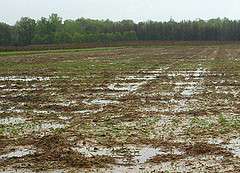
Spring was so wet this year in parts of Pennsylvania that eventual crop yields may be in jeopardy due to delayed planting, according to experts in Penn State's College of Agriculture Sciences.
"Everyone has planted later than normal," said Marvin Hall, professor of forage management. "Most were two to three weeks late, some still were planting in early June and many forage crops never got planted at all."
As a result of the delays, extension grain-crops specialist Gregory Roth is concerned that some corn in the central and northern parts of the state may not mature on time, leading to late harvest and lower grain quality.
"Ideal planting conditions are warm, dry soils in late April and early May when, in a normal year, the majority of the state's corn is planted," said Roth, a professor of agronomy. "Farmers are unable to use their equipment on wet soil without the risk of compacting it and ruining the soil structure.
"The delayed planting of corn and soybeans could result in lower yield potential, depending on temperature and precipitation conditions throughout the summer."
Rainfall was 4 to 6 inches above normal in most of the state just in April, according to Bryan Swistock, water resources extension specialist. "Some places had the wettest spring on record," he said.
The U.S. Department of Agriculture confirmed that Pennsylvania farmers were behind schedule with their planting. At the end of the week of June 5, soybeans were just 50 percent planted, the department reported. Last year at the same time, they were 83 percent planted.
"Most years the corn is waist high by the Fourth of July," said Roth. "Some fields will easily make mid-thigh, but some may only be at the calf level. When the first frost of the year comes, it could cause harm to those crops that are two or three weeks behind schedule."
The state is facing a similar problem with hay and alfalfa quality, Hall pointed out. Normally harvested in May, some of these crops were harvested this year in early June, resulting in less-than-ideal feed for cattle and horses.
"Just about all of our crops have been affected," he said. "Perhaps the only crop that has done well is our pastures, where the spring grass growth has benefited from the frequent rain."
The rain and humidity also has put wheat and barley crops at greater risk for head scab, a plant disease that causes part of the wheat head to die and kernels to be infected with fungus.
"Farmers try to combat the head scab with fungicides, but this often is only partially successful," said Hall. "Head scab can cause the grains to be of lower quality or unmarketable."
Both Hall and Roth spoke positively about the prospects for the state's sweet corn crop, which takes less time to mature. "Sweet corn growers mostly are able to cope," said Roth. "Although it may be delayed somewhat, the main downside is there may not be as much early corn available this summer."
Penn State Extension has been helping to guide farmers through this season's problems by advising them on various topics through the Field Crop Newsletter and by monitoring the head scab situation as part of a national, online effort at www.wheatscab.psu.edu . On the website, plant pathologists use weather data to predict the potential severity of the disease in relation to the flowering date of the wheat.
The summer will hopefully not provide more problems for farmers, Swistock predicted. "The three-month outlook from the National Weather Service -- June, July and August -- temperatures should be near normal to slightly below normal," he said. "And precipitation is predicted to be near normal as well."
For crops and farmers, better late than never, Hall said. "We got a late start, but if the weather is perfect, we still can have some good yields. However, if anything goes wrong, we might not be able to harvest in time to beat the cold weather."
Provided by Pennsylvania State University


