Elephant numbers halved
Jun 28, 2011 By Pete Wilton
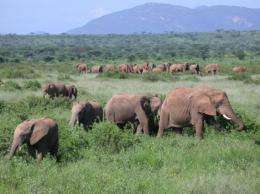
Elephant family group in Samburu, Kenya. Credit: Iain Douglas-Hamilton.

(PhysOrg.com) -- Half the elephants from West and Central African savannahs have vanished in the past 40 years, scientists report in PLoS One.

A team, including Iain Douglas-Hamilton of Oxford University’s Department of Zoology, estimate that around 7,750 remain in the Sudano-Sahelian zone, which covers 20% of the continent, a 50% decline in four decades.

Of the 23 elephant populations studied half are now thought to number less than 200 animals and so are unlikely to survive. The survey covered protected areas so populations in unprotected regions are likely to have fared even worse.

A reduction in rainfall and increasing competition with humans for land and water resources used for livestock and agriculture are, the researchers believe, the main factors behind the decline. Warfare and the illegal trade in ivory have also helped to drive some elephant populations to the brink of extinction.

The loss of these elephant populations would affect many other species which rely on the habitat created by these giant herbivores as they browse, clear the brush and disperse seeds.

To protect the remaining animals the researchers propose that eight new protective corridors be established as soon as possible to connect the main elephant populations.

They also recommend working with private sector wildlife initiatives and channelling more wildlife revenues to local communities as a way of securing the future for elephants on Africa’s northern savannahs.

Explore further: Climate change may have little impact on tropical lizards

add to favorites email to friend print save as pdf

Related Stories

Panel: India must secure elephant reserves

Sep 01, 2010

(AP) -- India should protect its elephant population by securing its wildlife reserves, curbing poaching and restricting development in the corridors they use to travel between forested areas, a panel recommended.

Elephants avoid costly mountaineering

Jul 24, 2006

Using global-positioning system data corresponding to the movements of elephants across the African savannah, researchers have found that elephants exhibit strong tendencies to avoid significantly sloped terrain, and that ...

Elephant highways of death

Apr 03, 2007

A new study coordinated by the New York-based Wildlife Conservation Society and other groups found that Central Africa’s increasing network of roads – which are penetrating deeper and deeper into the wildest areas of ...

Study: Elephants might seek revenge

Feb 16, 2006

An increasing number of incidents involving African elephants attacking humans is leading some scientists to believe the animals may be seeking revenge.

Vietnam War Technology Could Aid Elephant Conservation

Jun 20, 2005

Seismic sensors developed to track enemy troop movements during the Vietnam war could help ecologists monitor and conserve elephant populations, according to new research published in the British Ecological Society's Journal ...

Jumbo-sized discovery made in Malaysia

Jan 14, 2009

New data released today by the Wildlife Conservation Society and Malaysia's Department of Wildlife and National Parks (DWNP) reveals that a population of endangered Asian elephants living in a Malaysian park ...

Recommended for you

Climate change may have little impact on tropical lizards

21 hours ago

A new Dartmouth College study finds human-caused climate change may have little impact on many species of tropical lizards, contradicting a host of recent studies that predict their widespread extinction in a rapidly warming ...

Wetlands: value to locals matters most

21 hours ago

A new way of valuing ecosystem services, incorporating the local perspective, is the driving force behind a project assessing aquatic ecosystems in highland areas of Asia

Symbolic saviour of an endangered species

May 16, 2013

In 2006 Berlin Zoo saw the birth of their first polar bear cub in 33 years. A retired circus polar bear gave birth to two cubs at the zoo. One of them died soon after, but Knut survived. At only a month old he became the ...

User comments : 1

Adjust slider to filter visible comments by rank

Display comments: newest first

TheGhostofOtto1923
1.7 / 5 (3) Jun 28, 2011
I was thinking that some enterprising ex-mercs could make some good money leading safaris to hunt poachers. How many wealthy idealistic young earth-firsters are there out there who would enjoy this kind of sport?

Some payoffs to local officials would help to offset their loss of graft from the poachers who were killed, and wildlife of all sorts would benefit. Time for activists to get serious I say.

'String of ears...'

More news stories

Front-row seats to climate change

By day, insects provide the white noise of the South, but the night belongs to the amphibians. In a typical year, the Southern air hangs heavy from the humidity and the sounds of wildlife.

Climate change may have little impact on tropical lizards

A new Dartmouth College study finds human-caused climate change may have little impact on many species of tropical lizards, contradicting a host of recent studies that predict their widespread extinction in a rapidly warming ...

US seizes Bitcoin operator accounts

US authorities seized the accounts of a Bitcoin digital currency exchange operator, claiming it was functioning as an "unlicensed money service business," court documents showed Friday.

Alaska volcano shoots ash 15,000 feet into the air

(AP)—One of Alaska's most restless volcanoes has shot an ash cloud 15,000 feet into the air in an ongoing eruption that has drawn attention from a nearby community but isn't expected to threaten air traffic.

Chinese, Indian airlines face EU pollution fines

Eight Chinese and two Indian airlines face fines of up to several million euros for not paying for their greenhouse gas emissions during flights within the bloc, the European Commission said on Friday.