A new, distant arm of the Milky Way galaxy
June 13, 2011

A new, distant arm of the Milky Way galaxy

Enlarge

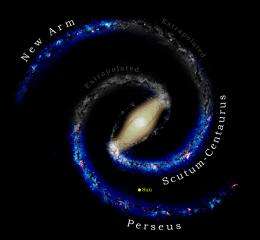
The Milky Way's basic structure is believed to involve two main spiral arms emanating from opposite ends of an elongated central bar. But only parts of the arms can be seen - gray segments indicate portions not yet detected. Other known spiral arm segments--including the Sun's own spur--are omitted for clarity. Credit: T. Dame

(PhysOrg.com) -- Our Milky Way galaxy, like other spiral galaxies, has a disk with sweeping arms of stars, gas, and dust that curve around the galaxy like the arms of a huge pinwheel.

The Sun, Earth, and solar system are located in a spur of material that lies between two of the spiral arms, collectively orbiting around the galaxy about 25,000 light-years from its center. Because the Milky Way contains copious amounts of dust that blocks our optical views, it is extremely difficult to study the galaxy from our vantage point within the disk.

Thus the details of the spiral arms in our own galaxy are much less certain than is the structure of external such as Andromeda, which is a few million light-years away but sits well above the plane of obscuring dust. can peer through the dust, however, and molecules like carbon monoxide that emit in the radio and concentrate in the galaxy's spiral arms are particularly good tracers of their structure.

Using a small 1.2-meter radio telescope on the roof of their science building in Cambridge, CfA astronomers Tom Dame and Pat Thaddeus used carbon monoxide emission to search for evidence of spiral arms in the most distant parts of the galaxy, and discovered a large new peppered with dense concentrations of molecular gas. The CfA scientists suggest that the new spiral is the far end of the Scutum-Centaurus Arm, one of the two main thought to originate from opposite ends of our galaxy's central bar (see figure). If their proposal is confirmed, it will demonstrate that the Milky Way has a striking symmetry, with the new arm being the symmetric counterpart of the nearby Perseus Arm.

Provided by Harvard-Smithsonian Center for Astrophysics search and more info website

4.8 /5 (21 votes)  

Filter


Move the slider to adjust rank threshold, so that you can hide some of the comments.


Display comments: newest first

rwinners
Jun 21, 2011

Rank: not rated yet
Well, it isn't really new... just new to us. And looking at it, our galaxy looks pretty puny when compared to Andromeda. She is going to EAT us!
Rank 4.8 /5 (21 votes)
Relevant PhysicsForums posts
  • revamping general concept and cosmological principle
    createdMay 25, 2012
  • Transiting Exoplanet Light Curve
    createdMay 25, 2012
  • Math behind Theoretical Physics
    createdMay 24, 2012
  • Do we know whats at the center of galaxies yet?
    createdMay 23, 2012
  • Structure of the Milky Way?
    createdMay 20, 2012
  • What would it take to terraform Pluto and Charon?
    createdMay 19, 2012
  • More from Physics Forums - General Astronomy

More news stories

Sophisticated simulations predict future warming

The chances of our planet being hit by a global warming of 3 degrees Celsius by 2050 is as likely as it being hit by an increase of 1.4 degrees, new research shows. Presented in the journal Nature Geoscience, the British study ...

Space & Earth / Earth Sciences

created May 22, 2012 | popularity 4.4 / 5 (9) | comments 51

Dragon arrives at space station in historic 1st (Update 2)

The privately bankrolled Dragon capsule made a historic arrival at the International Space Station on Friday, triumphantly captured by astronauts wielding a giant robot arm.

Space & Earth / Space Exploration

created May 25, 2012 | popularity 5 / 5 (10) | comments 19

Kyoto Protocol architect 'frustrated' by climate dialogue

UN climate talks are going nowhere, as politicians dither or bicker while the pace of warming dangerously speeds up, one of the architects of the Kyoto Protocol told AFP.

Space & Earth / Environment

created May 23, 2012 | popularity 3.7 / 5 (7) | comments 39

Aliens don't want to eat us, says former SETI director

Alien life probably isn’t interested in having us for dinner, enslaving us or laying eggs in our bellies, according to a recent statement by former SETI director Jill Tarter.

Space & Earth / Space Exploration

created May 25, 2012 | popularity 4.4 / 5 (13) | comments 37

What's the big deal about private space launches?

(AP) -- The first private spaceship is headed to the International Space Station. Some questions and answers about the cargo mission by Space Exploration Technologies, known as SpaceX:

Space & Earth / Space Exploration

created May 22, 2012 | popularity 5 / 5 (6) | comments 32


Nvidia trumpets Tegra 3 phone design wins for 2012

(Phys.org) -- Nvidia’s competitive war paint has a name, Tegra 3. On the heels of Nvidia announcements about lowering costs of its Tegra 3 processors and Nvidia-enabled tablets running Android Ice Cream ...

Browser wars flare in mobile space

The browser wars are heating up again, but this time the fight is for dominance of the mobile Internet.

Scientist: Evolution debate will soon be history

(AP) -- Richard Leakey predicts skepticism over evolution will soon be history. Not that the avowed atheist has any doubts himself.

Dell tablet leak: 10.1-inch display, two-battery choice

(Phys.org) -- Headline after headline talks about vendors’ tablets in the wings as likely number-one contenders for the iPad. Such claims have justifiably been taken with a grain of salt, considering ...

Keep food safety in mind this memorial day weekend

(HealthDay) -- Picnics, parades and cookouts are as much a part of Memorial Day weekend as tributes to the United States' war veterans.

Family history of Alzheimer's affects functional connectivity

(HealthDay) -- Cognitively normal individuals with a family history of late-onset Alzheimer's disease (AD) may display lower resting state functional connectivity in the default mode network (DMN) of the brain, ...