Zebrafish regrow fins using multiple cell types, not identical stem cells
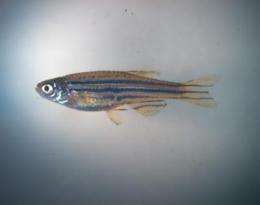
Zebrafish are a type of minnow widely used in scientific research and home aquariums. Small, semi-transparent freshwater fish, they reproduce rapidly and their transparent embryos develop outside the body. Such traits are helpful for viewing biological processes within the embryo or adult tissues. Credit: Shu Tu
What does it take to regenerate a limb? Biologists have long thought that organ regeneration in animals like zebrafish and salamanders involved stem cells that can generate any tissue in the body. But new research suggests that multiple cell types are needed to regrow the complete organ, at least in zebrafish.
Researchers at Washington University School of Medicine in St. Louis have shown that cells capable of regenerating a zebrafish fin do not revert to stem cells that can form any tissue. Instead, the individual cells retain their original identities and only give rise to more of their own kind.
The findings support a recent shift in how biologists understand organ regeneration in organisms such as salamanders and zebrafish. Understanding regeneration in model organisms gives hope that it may one day be possible for amputees to regrow limbs or for heart attack patients to regrow healthy heart muscle.
"Limb regeneration has long captured people's imaginations," says Stephen L. Johnson, PhD, associate professor of genetics at the School of Medicine. "Traditionally, when people have looked at how a limb regenerates, they see a group of cells forming at the amputation site and the cells all look the same. So they've imagined that these cells have lost their identities and can become anything else. Our results show that this is not the case in the zebrafish fin. And there is mounting evidence that this is not the case in the salamander limb."
The study appears online May 16 in Developmental Cell.
When a zebrafish loses its fin, a special group of cells forms on the remaining stump. These cells, which appear identical to one another, regrow the entire limb, complete with all cell types required for a complex organ. This has suggested that these cells may be "pluripotent" stem cells, capable of forming almost every tissue in the body.
To determine if this was indeed the case, Johnson and postdoctoral research associate Shu Tu, PhD, who did this work for her doctoral thesis, used genetic techniques to label individual cells in the stump with a fragment of DNA that makes the cells glow green.
When a cell divides, it copies its DNA so that each daughter cell has a complete set of genetic material. Since Johnson and Tu's label is inserted into the cell's DNA, the cells also duplicate the label and pass it on to each daughter cell. By simply observing which cells glow green, Johnson and Tu could track the subsequent daughter cells and determine what cell types they become.
For example, they saw that when they had glowing skin cells in the stump, only skin cells glowed in the regenerated limb. Likewise, when a nerve cell glowed in the stump, only nerve cells glowed in the regenerated limb. In other words, they saw no evidence that a skin cell glowing in the stump could give rise to a nerve cell glowing later in the fin's development or regeneration.
Using this technique, Johnson and Tu identified nine separate cell lineages present at the end of the stump that contribute to forming the fin's skin, nerves, pigment, blood vessels, bone and immune cells.
Johnson points out possible implications for future regenerative medicine in humans.
"This is evidence that we can't necessarily do regenerative medicine by plopping in generalized stem cells," he says. "The key may be to induce the cells that are already there to grow again. We need to understand and account for every cell lineage and then convince them to play ball together."
More information: Tu S, Johnson SL. Fate restriction in the growing and regenerating zebrafish fin. Developmental Cell. May 17, 2011.
Provided by
Washington University School of Medicine
-
From lemons to lemonade: Reaction uses carbon dioxide to make carbon-based semiconductor,
32 comments
-
Thioridazine kills cancer stem cells in human while avoiding toxic side-effects of conventional cancer treatments,
3 comments
-
SpaceX private rocket blasts off for space station (Update),
42 comments
-
Climate scientists say they have solved riddle of rising sea,
31 comments
-
SpaceX capsule has 'new car' smell, astronauts say (Update),
2 comments
-
What would stain as translucent on light-coloured fabric?
16 hours ago
-
How do I identify different bacteria on culture plates?
May 26, 2012
-
Why Do Dogs do Strange things...
May 25, 2012
-
What does exophillic and endophillic mean in terms of mosquito and their control?
May 24, 2012
-
Semen stains glows under black lights (uv light)?
May 23, 2012
-
Question on Human Chromosome 2
May 23, 2012
- More from Physics Forums - Biology
More news stories
Scientist: Evolution debate will soon be history
(AP) -- Richard Leakey predicts skepticism over evolution will soon be history. Not that the avowed atheist has any doubts himself.
16 hours ago |
3.3 / 5 (17) |
48
More plant species responding to global warming than previously thought
(Phys.org) -- Far more wild plant species may be responding to global warming than previous large-scale estimates have suggested.
May 22, 2012 |
4.6 / 5 (14) |
18
|
Thousands of shellfish found dead in Peru
Thousands of crustaceans were found dead off the coast of Lima following the mystery mass death of dolphins and pelicans, the Peruvian Navy said Friday.
May 26, 2012 |
4.8 / 5 (4) |
7
For monogamous sparrows, it doesn't pay to stray (but they do it anyway)
It's quite common for a female song sparrow to stray from her breeding partner and mate with the male next door, but a new study shows that sleeping around can be costly.
May 22, 2012 |
5 / 5 (2) |
7
|
Study uncovers secret to speedy burrowing by razor clams
(Phys.org) -- If you look at a razor burrowing clam sitting in a bucket, youd never guess that it could burrow itself down into the soil, much less do it with any speed. Razor clams look like fat straws, ...
Nvidia trumpets Tegra 3 phone design wins for 2012
(Phys.org) -- Nvidias competitive war paint has a name, Tegra 3. On the heels of Nvidia announcements about lowering costs of its Tegra 3 processors and Nvidia-enabled tablets running Android Ice Cream ...
Browser wars flare in mobile space
The browser wars are heating up again, but this time the fight is for dominance of the mobile Internet.
Dell tablet leak: 10.1-inch display, two-battery choice
(Phys.org) -- Headline after headline talks about vendors tablets in the wings as likely number-one contenders for the iPad. Such claims have justifiably been taken with a grain of salt, considering ...
Keep food safety in mind this memorial day weekend
(HealthDay) -- Picnics, parades and cookouts are as much a part of Memorial Day weekend as tributes to the United States' war veterans.
Social welfare cuts ultimately come with heavy price, researchers say
(Phys.org) -- Slashing government funding for Medicaid, food stamps and other programs that serve the poor while politically popular with some lawmakers and many conservatives may do more harm ...
Is a classical electrodynamics law incompatible with special relativity?
(Phys.org) -- The laws of classical electromagnetism that were developed in the 19th century are the same laws that scientists use today. They include Maxwell’s four equations along with the Lorentz la ...