Superior sound for telephones, mobile and related devices
Telephone calls and video conferences with a sound quality that approaches that of direct communication are now possible with a new audio coding technology -- it is almost as if the discussion participants are sitting across from one another.
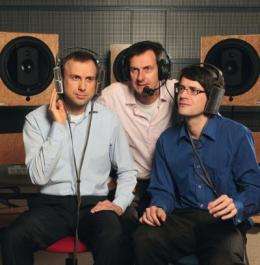
mp3 for phone calls – Considering the poor sound quality of many phone calls, this is a great idea. Videoconference phone calls in particular can be unintentionally awkward because the participants start to speak at the same time due to the time delay in the transmission. The reasons for this are long delay times and the poor quality of today's video calls. Fraunhofer's task was therefore to improve the quality and simultaneously minimize the delay time. The technology that makes this possible is called Enhanced Low Delay Advanced Audio Coding, in short, AAC-ELD. It was developed by Manfred Lutzky, Marc Gayer, Markus Schnell and their team from the Fraunhofer Institute for Integrated Circuits IIS in Erlangen.
Fraunhofer IIS is known as the main inventor of mp3, the audio codec that made it possible to greatly reduce the size of music or other audio files without impairing the sound. To implement something similar for the telephone and other devices was easier said than done. "The algorithm requires a certain amount of time to encode the data and to decode it again at the other end of the line. The process requires data that is still in the future, as it must wait for the data to arrive. This can result in a situation where interactive communication is very difficult," explained Markus Schnell.For several years, the IIS team continued to improve the algorithm even further to shorten the delay and not impair the quality at the same time. The solution, "We attempted to further minimize the area that is forward-looking and to only process current data. We did that until we found an optimum balance between quality and delay," said Schnell.
One technology – many applications
The results are audibly good as the delay with Enhanced Low Delay AAC is only about 15 milliseconds. During this extremely short timespan, the algorithm manages to reduce the audio data to less than one-thirtieth of its original volume without major losses of sound quality. Due to its enormous performance capacity, the coding process has already prevailed in many areas. Marc Gayer explains, "Currently, AAC Low Delay, the forerunner of AAC-ELD, is the actual standard for many video-conferencing systems. But the process is also increasingly applied in radio broadcasts, for example for live sports reports."
The advantage of improved speech transmission is also heard in mobile devices, such as the iPhone4 and in the iPad2, for example. Video telephone transmissions in particular are supported in these devices. The developers created a very special application was to promote the communication between groups that are socially close to each other. A system was created that makes it possible to play games across the borders of cities or countries. "Thanks to the optimized image and sound quality, there is the impression that game partners who are far apart from each other are not in front of screens, but actually sitting across from one another," said Manfred Lutzky.
Currently, more than 120 scientists and engineers are working on audio and multimedia technologies at IIS. Marc Gayer, Manfred Lutzky and Markus Schnell are receiving the 2011 Joseph von Fraunhofer Prize on behalf of the entire team.
Provided by Fraunhofer-Gesellschaft


