Solar inverters: Losses are cut in half
May 26, 2011

Solar inverters: Losses are cut in half

Enlarge

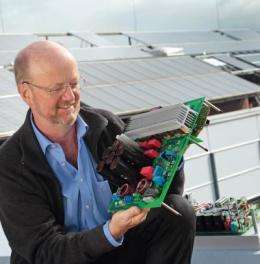
Dr.-Ing. Heribert Schmidt invented a new circuit for the inverter: he achieved a world record for inverters with his HERIC® topology. Credit: Dirk Mahler

A switching trick makes it possible to cut the losses of a series-production inverter in half and increase the efficiency from 96 to 98 percent. The HERIC-topology makes it possible to achieve a world-record efficiency of more than 99 percent.

"It was a matter of minutes," Dr. Heribert Schmidt remembers the day in spring of 2002. To find opportunities for improvement, he had often pondered about the switching plan of an inverter while in his office at the Fraunhofer Institute for Energy Systems ISE in Freiburg, Germany. A sudden flash of inspiration – and a solution that was ingeniously simple came to his mind. He immediately went to get an inverter from the laboratory, laid a few new strips and installed two additional semiconductor switches. "Then it required only a little bit of work on the controls - and we already had the proof!" This is how the electrical engineer, who holds a doctorate in electrical engineering, described the revolutionary step in brief: the losses could be halved and the degree of effectiveness could be increased from 96 to 98 percent.

Key component for electricity feed

After the solar generator, the inverter is the second key component of a grid-linked photovoltaics system. Solar modules generate direct current. If the current is to be fed into the public grid, then it must be converted into grid-compatible alternating current. The inverter handles this task. Single-phase feed inverters consist of three essential parts: the buffer capacitor at the input which provides intermediate storage for the direct current from the solar generator; the inverter bridge with four semiconductor switches that »chop up« the by rapidly switching on and off and as a third component, the inductor at the output that converts the alternating current into a perfect sinus current.

In a short time from the idea to the product

Heribert Schmidt knew: A large portion of the losses are caused by the return of current between the output inductor and the input capacitor. The question therefore was how to prevent this. "That's easy," said Heribert Schmidt after a sudden inspiration: "If I decouple the capacitor and the inductors completely from each other at certain intervals, then it is impossible for a return current to flow, and electro-magnetic disturbances cannot occur at the input as a result of voltage spikes." He immediately had his invention patented as HERIC topology and began to develop a new series of devices with the SUNWAYS company in Konstanz, Germany. Experts were astonished, and awards and recognition followed quickly: "By far the best device in this performance category." In the meantime, an encompassing patent has been awarded to the basic idea and the Fraunhofer-Gesellschaft is in negotiations with additional licensees.

The director of the institute, Prof. Eicke Weber, emphasizes, "In 2009, a of more than 99 percent was set for inverters." Heribert Schmidt – who has been with the Fraunhofer Institute for ISE since 1988 – is an experienced inventor with more than 20 awarded patents. The HERIC patent provided the institute with lucrative licensing agreements – and Heribert Schmidt with the Fraunhofer Prize.

Provided by Fraunhofer-Gesellschaft search and more info website

Filter


Move the slider to adjust rank threshold, so that you can hide some of the comments.


Display comments: newest first

spectator
May 26, 2011

Rank: not rated yet
This is a pretty big deal, even though 2 or 3 percent doesn't initally look like much.

Say if you were selling power to the grid, and you calculate that with a 96% inverter you would have a 10% profit margin, then with a 99% inverter you would increase your profit margin to 12.7%.

Arbitrary numbers, but shows how significant that is. In this arbitrary example, every 1 dollar at 96% would become $1.27 at 99%.

But again profit margins are too arbitrary and location specific.

In absolutes, every "net" kilowatter hour you had produced previously would become:

99/96 * 1kwh = 1.03125kwh

1kw/h = 3600000joules
1.03125kwh = 3712500

So a net gain of 112,500 Joules per hour per net kilowatt hour previously produced.

Which in power equivalent is 31.25 watts gained per kilowatt.
Rank 5 /5 (3 votes)
Relevant PhysicsForums posts

More news stories

Browser wars flare in mobile space

The browser wars are heating up again, but this time the fight is for dominance of the mobile Internet.

Technology / Software

created 1 hour ago | popularity not rated yet | comments 0

SpotterRF debuts Radar Backpack Kit (w/ Video)

(Phys.org) -- SpotterRF has announced a special radar backpack kit designed to enhance situational awareness for soldiers on the ground. The company says its special radar is designed for warfighters as part ...

Technology / Hi Tech & Innovation

created 22 hours ago | popularity 5 / 5 (5) | comments 12 | with audio podcast report

Probability of contamination from severe nuclear reactor accidents is higher than expected: study

Catastrophic nuclear accidents such as the core meltdowns in Chernobyl and Fukushima are more likely to happen than previously assumed. Based on the operating hours of all civil nuclear reactors and the number ...

Technology / Energy & Green Tech

created May 22, 2012 | popularity 3.6 / 5 (21) | comments 56 | with audio podcast

HyperSolar shows dirty water no barrier to power world

(Phys.org) -- The Santa Barbara, California, company, HyperSolar, is set to transparently share the ups and downs of its research experiences toward the company’s ultimate vision, successfully producing ...

Technology / Energy & Green Tech

created May 24, 2012 | popularity 4.8 / 5 (15) | comments 17 | with audio podcast report

Tesla to launch electric sedan in US on June 22

Tesla Motors said Tuesday it would begin deliveries of "the world's first premium electric sedan" on June 22, slightly ahead of schedule.

Technology / Energy & Green Tech

created May 22, 2012 | popularity 4.5 / 5 (11) | comments 18


Nvidia trumpets Tegra 3 phone design wins for 2012

(Phys.org) -- Nvidia’s competitive war paint has a name, Tegra 3. On the heels of Nvidia announcements about lowering costs of its Tegra 3 processors and Nvidia-enabled tablets running Android Ice Cream ...

Scientist: Evolution debate will soon be history

(AP) -- Richard Leakey predicts skepticism over evolution will soon be history. Not that the avowed atheist has any doubts himself.

Dell tablet leak: 10.1-inch display, two-battery choice

(Phys.org) -- Headline after headline talks about vendors’ tablets in the wings as likely number-one contenders for the iPad. Such claims have justifiably been taken with a grain of salt, considering ...

SpaceX capsule has 'new car' smell, astronauts say (Update)

SpaceX's Dragon cargo vessel smells like a new car, said astronauts at the International Space Station after opening the hatches Saturday following the spacecraft's landmark mission to the orbiting lab.

Thousands of shellfish found dead in Peru

Thousands of crustaceans were found dead off the coast of Lima following the mystery mass death of dolphins and pelicans, the Peruvian Navy said Friday.

Australia hails surprise super-telescope decision

Australia has hailed a surprise decision giving it a role in a radio telescope project aimed at revolutionising astronomy, vowing to draw on its decades of experience in space science.