May 12, 2011 report
Serotonin and heat play a role in leeches abilities
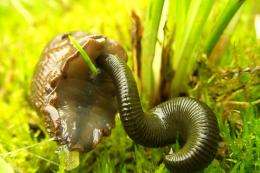
(PhysOrg.com) -- In two new studies published in Biology Letters, researchers have looked at the blood-sucking leeches and how serotonin and heat play a role in their ability to move and digest food after eating.
Leeches, similar to worms, are soft-bodied and use their muscles to contract and expand to move. When they eat, they gorge themselves, bloating up to as much as 10 times their normal size, leaving researchers to wonder how they were able to move with the muscles stretched.
In the first study, led by Shannon Gerry and David Ellerby from Wellesley College, the team fed the leeches sheep’s blood while they measured the segments length changes as they ate, as well as how they changed when they crawled.
They then chopped leeches into small segments and placed the segments into serotonin or saline. They stretched these segments to a length equal to that as if they were crawling after eating. Using electrical wires to cause muscle contraction, the researchers found that the segments in the serotonin exerted more force, suggesting that the serotonin, which stimulates feeding in leeches, was relaxing the muscle molecules and allowing them to move easier.
In comparison to human muscles which change by 20% when going from extended to contracted, a leech is capable of a 300% change in length.
In the second study, researchers looked at the temperature in which leeches prefer to be in, both before and after a meal. They placed leeches in a tube with varying temperatures. In the days before a feeding, they found the leeches to like the colder areas of the tube. In contrast, for the first five days after they were fed, they looked for the much warmer areas of the tube. Chemical processes can move faster under warmer conditions, suggesting to the researchers that the leeches move to warmer temperatures after eating in order to aid in the digestion process and leave more energy for the leeches to use in other activities.
More information: Serotonin modulates muscle function in the medicinal leech Hirudo verbana, Biology Letters, Published online before print May 11, 2011, doi: 10.1098/rsbl.2011.0303
Abstract
The body wall muscles of sanguivorous leeches power mechanically diverse behaviours: suction feeding, crawling and swimming. These require longitudinal muscle to exert force over an extremely large length range, from 145 to 46 per cent of the mean segmental swimming length. Previous data, however, suggest that leech body wall muscle has limited capacity for force production when elongated. Serotonin (5-HT) alters the passive properties of the body wall and stimulates feeding. We hypothesized that 5-HT may also have a role in allowing force production in elongated muscle by changing the shape of the length–tension relationship (LTR). LTRs were measured from longitudinal muscle strips in vitro in physiological saline with and without the presence of 10 µM 5-HT. The LTR was much broader than previously measured for leech muscle. Rather than shifting the LTR, 5-HT reduced passive muscle tonus and increased active stress at all lengths. In addition to modulating leech behaviour and passive mechanical properties, 5-HT probably enhances muscle force and work production during locomotion and feeding.
Leeches run cold, then hot, Biology Letters, Published online before print May 6, 2011, doi: 10.1098/rsbl.2011.0320
Abstract
Food processing is costly, potentially limiting the energy and time devoted to other essential functions such as locomotion or reproduction. In ectotherms, post-prandial thermophily, the selection of a warm environmental temperature after feeding, may be advantageous in minimizing the duration of this elevated cost. Although present in many vertebrate taxa, this behaviour had not previously been observed in invertebrates. Sanguivorous leeches ingest large blood meals that are costly to process and limit mobility until excess fluid can actively be expelled to reduce body volume. When presented with a temperature gradient from 10°C to 30°C, leeches select a temperature that is significantly warmer (24.3 ± 0.9°C, n = 6) than their acclimation temperature (Ta, 21°C). Unfed leeches preferred temperatures that were significantly cooler than ambient (12.8 ± 0.9°C, n = 6). This behavioural strategy is consistent with minimizing the time course of elevated post-feeding energy costs and reducing energy expenditure during fasting. Our observations raise the possibility that thermoregulatory behaviour of this type is an unrecognized feature of other invertebrate taxa.
© 2010 PhysOrg.com


