Science can't design away tornadoes' deadly threat
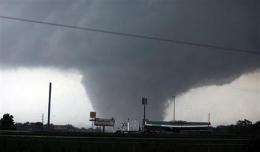
(AP) -- Storm science has greatly improved tornado warnings in recent years. But if that's led anyone into a sense of security, that feeling has taken a beating in recent weeks.
Super Outbreak 2011, on April 25-28, killed more than 300 people in the South and Midwest. Less than a month later, a devastating tornado took more than 130 lives around Joplin, Mo. This is now the deadliest year for tornadoes since 1950, based on an assessment of National Weather Service figures.
This despite warnings of as much as 20 minutes, thanks to improved weather radar installed across the country in the 1990s. Before that, tornado warnings often weren't issued until a twister was sighted on the ground.
Scientists see a variety of factors that helped make this year's twisters deadlier - from La Nina to public complacency, from global warming to urban sprawl.
"We thought for the longest time physical science could get us by ... that we could design out of disaster," said meteorology professor Walker Ashley of Northern Illinois University. Now scientists are finding they need to take human nature into account.
What is clear is that certain factors add to the risk of death. The most vulnerable folks are those living in mobile homes and houses without basements. For a variety of reasons, a lot of homes don't have basements.
Twisters occurring on weekends - like the Joplin tornado - and at night tend to be greater killers because they catch people at home. At night, twisters are harder to see and sleeping people may not hear a warning.
Those less likely to be killed in a storm tend to be more educated and to have a plan in place beforehand.
In Sedalia, Mo., 30-year-old Sean McCabe had the right idea when the tornado struck, heading to the basement. He said the storm shoved him down the final flight of steps. He had scrapes and cuts on his hands, wrists, back and feet. Blood was visible in the house, and much of the roof of the house was gone.
"I saw little debris and then I saw big debris, and I'm like OK, let's go," said McCabe.
Having a plan was a lifesaver for Tuscaloosa's LaRocca Nursing Home in Alabama. As the storm howled, four dozen residents massed in the hallways as trees crashed down and a cloud of dust rained upon them. When the dust settled, the staff realized their drills had paid off. Not one patient was killed, and the worst injury among them was a bruise.
Hundreds have not been so lucky, with more than 500 deaths and counting so far this year, a toll not seen in more than a half-century.
The toll for 2011 is now at least 520 people, exceeding the previous highest recorded death toll in a single year of 519 in 1953. There were deadlier storms before 1950, but those counts were based on estimates and not on precise figures.
The National Weather Service said 58 tornadoes touched down in Alabama on April 27, killing 238 people in that state alone and injuring thousands. Scores died in other states from twisters spawned by the same storm system. Put together, emergency management officials say the twisters left a path of destruction 10 miles wide and 610 miles long, or about as far as a drive from Birmingham to Columbus, Ohio.
Statewide, Alabama officials estimate there was enough debris to stack a football field a mile high with rubble.
Contributing to the massive loss of life is the growth of urban areas, suggested Marshall Shepherd, a professor of atmospheric science at the University of Georgia.
"Historically, the central business districts of cities have not been hit that frequently," he explained. But as you increase the land area covered by homes and businesses, he said, "you're increasing the size of the dartboard."
An expanding population does increase exposure to the danger, agreed Ashley, who fears deaths could begin to rise in the future as a result of sprawl and more people living in vulnerable residences such as mobile homes.
If the Tuscaloosa and Joplin tornadoes had each been a few miles to the south, on farmland, little would be heard about them, Ashley said, but when extremely violent tornadoes mingle with urban sprawl "you're going to have a disaster."
"I hope this will be an outlier year, very much like Katrina was to hurricanes," he said in a telephone interview from a field trip to chase tornadoes.
But no one can guarantee that, and weather experts are becoming increasingly concerned about how people respond to tornado warnings.
"A lot of it is complacency," Ashley said. "The population seems to be becoming desensitized to nature. I don't know why."
Studies have shown that 15 to 20 minutes is the most effective amount of warning time, and longer warning times can increase deaths. Weather experts aren't sure why, but worry that people think that if a twister hasn't appeared in a certain amount of time, it must have been a false alarm.
Yet a long-track tornado can be on the ground for 30 miles.
"If you have a basement, you don't need 20 minutes warning, but if you are in a mobile home park you may need more than 20 minutes to find a shelter," commented Alan W. Black, a University of Georgia doctoral student and co-author with Ashley of a recent study of tornado and wind fatalities.
Jerry Brotzge, a research scientist at the Center for Analysis & Prediction of Storms, University of Oklahoma, said many people who hear warnings will look outside to see if they can see the tornado - "they need some kind of confirmation, they want to see it."
But the Joplin tornado was at least partly rain-wrapped, meaning that a powerful rainstorm obscured it from some directions and "they wouldn't have seen it coming."
"Even when people are sheltered in their homes, if they are not underground they can die," Brotzge added.
But asking people to evacuate an area is also a difficult decision, he said, "what if you have a traffic jam and the tornado hits that."
Ashley concluded: "The take-home is, people have to take personal responsibility for their lives."
Why there have been so many tornado threats this year is harder to say.
Viewing pictures of the tornado aftermath it's hard to overestimate the power of such storms, and records bear out how strong they can be.
"You see pictures of World War II, the devastation and all that with the bombing. That's really what it looked like," said Kerry Sachetta, the principal of a flattened Joplin High School. "I couldn't even make out the side of the building. It was total devastation in my view. I just couldn't believe what I saw."
And that movie image a few years ago was no joke: A cow was transported 10 miles by a twister in Iowa in 1878 and a tornado in Minnesota moved a headstone three miles in 1886.
One Joplin resident said a picture that was sucked off his house's wall was found in Springfield, 70 miles away. An insurance policy was found more than 40 miles from its original residence in Oklahoma in 1957 and a 210-mile trip was taken by a canceled check in Nebraska in 1915, according to a study several years ago by researchers at the University of Oklahoma and St. Louis University.
Typically, tornadoes spawn in the clash between warm, moist air from the Gulf of Mexico and cooler, dry air from the north and west - conditions that mark Tornado Alley in the Midwest and South, the most common breeding grounds for twisters.
Factors in this year's excess may include La Nina, a periodic cooling of the tropical Pacific Ocean which can affect weather worldwide. In a La Nina year there tend to be more tornadoes than average. If that is a factor, the good news is that La Nina is weakening and is expected to end in a month or so.
The meandering jet stream high in the atmosphere that directs the movements of weather also has been in a pattern that encourages warm Gulf air to move in and clash with drier air masses.
While studies of global warming have suggested it could cause more and stronger storms, National Weather Service Director Jack Hayes isn't ready to blame climate change - at least not yet - saying it's too soon to link individual events with the ongoing warming.
Tornado researcher Howard B. Bluestein of the University of Oklahoma says his best guess is this unusual outburst of twisters is due to natural variability of the weather.
"Sometimes you get a weather pattern in which the ingredients for a tornado are there over a wide area and persist for a long time. That's what we're having this year," he said.
"If we see this happen next year and the following year and the following year," then maybe climate change could be to blame, he said.
Whatever the reasons it's an extraordinary year for tornadoes and the worst may not be over. May is usually the peak month, but June traditionally gets lots of twisters, and they can occur in any month.
"You can never completely breathe easy," concluded Russell Schneider, director of the government's Storm Prediction Center in Norman, Okla.
©2011 The Associated Press. All rights reserved. This material may not be published, broadcast, rewritten or redistributed.


