Reusable templates for the production of nanowires
May 23, 2011
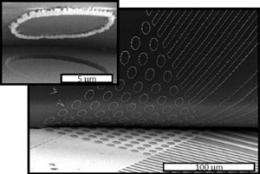
Scanning electron micrograph image showing platinum wires being lifted away from the surface of the UNCD electrode. Inset: Higher magnification image showing a single ring of platinum removed from the UNCD surface.

Scientists from Argonne National Laboratory CNM's Nanofabrication and Electronic and Magnetic Materials and Devices groups, working with users from the University of Wisconsin-Stevenson Point, discovered a fast, simple, scalable technique for solution-based, electrochemical synthesis of patterned metallic and semiconducting nanowires from a reusable, non-sacrificial, ultrananocrystalline diamond (UNCD) template.

The process involves fabrication of wafer-level electrochemical cells consisting of alternating insulating and conducting UNCD .

Unique electrochemical properties of electrically conducting nitrogen incorporated UNCD not only provide a robust electrode platform for electro-deposition of micro/ of various materials, but also facilitate easy peeling-off of deposited micro/nanowires for repeat use.

This bench-top technique is easy and quickly produces patterned nanowires on a large scale with diameters that are not predefined by the template, and do not require vacuum or clean-room processing. This offers a path for studying nanoscale phenomena and allows for process-scale development of a new generation of nanowire-based devices.

Explore further: Engineers' nanoantennas improve infrared sensing

More information: D.B. Seley et al., “Electroplate and Lift Lithography for Patterned Micro/Nanowires Using Ultrananocrystalline Diamond (UNCD) as a Reusable Template,” ACS Appl. Mater. Interfaces, 3(4), 925-930 (2011) DOI: 10.1021/am101226w

Abstract
A fast, simple, scalable technique is described for the controlled, solution-based, electrochemical synthesis of patterned metallic and semiconducting nanowires from reusable, nonsacrificial, ultrananocrystalline diamond (UNCD) templates. This enables the repeated fabrication of arrays of complex patterns of nanowires, potentially made of any electrochemically depositable material. Unlike all other methods of patterning nanowires, this benchtop technique quickly mass-produces patterned nanowires whose diameters are not predefined by the template, without requiring intervening vacuum or clean room processing. This technique opens a pathway for studying nanoscale phenomena with minimal equipment, allowing the process-scale development of a new generation of nanowire-based devices.

add to favorites email to friend print save as pdf

Related Stories

Diamond technology to revolutionize mobile communications

Aug 07, 2006

The U. S. Department of Energy's Argonne National Laboratory has teamed with industrial and academic partners under a DARPA Phase II research and development program to develop a new technology based on Ultrananocrystalline ...

New Method Creates Nanowire Detectors Exactly Where Needed

Sep 25, 2006

There seems to be little doubt among cancer researchers that new detection systems using nanowires and microfluidics hold the promise of providing a quantum leap in the detection of cancer-related molecules and genes. However, ...

Scientists grow 'sea urchin'-shaped structures

Jul 29, 2010

Swiss researchers have succeeded in growing sea-urchin shaped nanostructures from minute balls of polystyrene beads using a simple electrochemical process. The spines of the sea urchin consist of zinc oxide ...

Self-organized, one-dimensional Pt nanowires on Ge(001)

May 19, 2004

Oguzhan Gurlu and a group of scientists from University of Twente, Netherlands report about formation of Pt nanowires on Ge (001). Pt atoms adsorbed onto Ge(001) surface form extremely well-ordered nanowire arrays ...

Recommended for you

Engineers' nanoantennas improve infrared sensing

May 20, 2013

(Phys.org) —A team of University of Pennsylvania engineers has used a pattern of nanoantennas to develop a new way of turning infrared light into mechanical action, opening the door to more sensitive infrared ...

Stacking 2-D materials produces surprising results

May 16, 2013

(Phys.org) —Graphene has dazzled scientists, ever since its discovery more than a decade ago, with its unequalled electronic properties, its strength and its light weight. But one long-sought goal has proved ...

User comments : 0

More news stories

How gold nanoparticles can help fight ovarian cancer

Positively charged gold nanoparticles are usually toxic to cells, but cancer cells somehow manage to avoid nanoparticle toxicity. Mayo Clinic researchers found out why, and determined how to make the nanoparticles effective ...

Radioactive nanoparticles target cancer cells

Cancers of all types become most deadly when they metastasize and spread tumors throughout the body. Once cancer has reached this stage, it becomes very difficult for doctors to locate and treat the numerous tumors that can ...

Reducing caloric intake delays nerve cell loss

Activating an enzyme known to play a role in the anti-aging benefits of calorie restriction delays the loss of brain cells and preserves cognitive function in mice, according to a study published in the May ...