J-2X test series proves part integrity
May 16, 2011 By Jennifer Stanfield
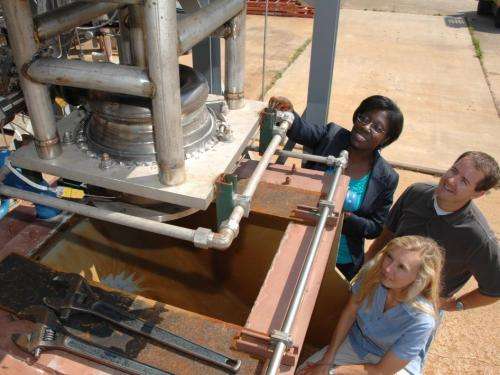
Engineers, from left, Lakiesha V. Hawkins, David C. Reynolds, and Cynthia L. Sprader inspect the J-2X fuel turbopump first stage nozzle after a successful test series in Marshall's Test Stand 116. Credit: NASA/MSFC/D. Olive

Engineers at NASA's Marshall Space Flight Center gave a key component of the J-2X engine a brisk workout to ensure it can withstand its extreme operating environment. The engine's fuel turbopump first stage nozzle passed the test, performing even better than expected.

The J-2X is a highly efficient and versatile upper stage that can stop and restart in space to support a variety of mission requirements. Full-scale testing begins later this summer but before then, engineers examined the longevity and durability of the engine's fuel turbopump first stage nozzle. The nozzle directs hot gas flow onto the .

The entire operates at extremes, but the fuel turbopump's first stage nozzle really takes a beating. Drastic thermal changes, being super chilled and then immediately super heated, stresses the metal nozzle causing it to rapidly expand and contract which eventually causes it to crack. During engine operations, this turbine nozzle is exposed to cryogenic hydrogen at -422 degrees Fahrenheit and less than two seconds after the start sequence it is hit with hot gases at 1000 degrees Fahrenheit.

Apollo-era rocket scientists studied this same issue on the original J-2 engine. After a battery of tests, Apollo engineers discovered the fuel turbopump first stage nozzle cracked after dozens of starts and stops. While the part cracked, additional tests proved the engine performance and safety were not compromised.

Modeling and simulation for the J-2X suggested the same issue would emerge, so designers selected a new type of nickel metal alloy for the turbopump nozzle which is less brittle and was predicted to hold up better under extreme .

"We did a lot of design and analysis work on this issue to show required part life before we finalized design," said Gary Genge, J-2X turbomachinery manager at NASA's Marshall Center in Huntsville, Ala. "We looked at making dramatic design alterations but changing the geometry of the part would have had a downstream effect we wanted to avoid. Also, the historic data hinted that wiith the improved material and minor changes, the new design might be acceptable."

In total, 43 tests were conducted which simulated the actual engine start and shutdown environment. Non-destructive evaluations were performed at the beginning of every test day and no detrimental condition was ever found.

"By taxing the same part over and over and carefully inspecting frequently, we know with confidence the part is very durable," said Genge. "This knowledge will save time and money in the long run because we can't inspect this area on the actual J-2X engines without disassembling the engine. This thorough test series shows we should be safe throughout the planned test series and we now have a better understanding of its longevity and structural integrity."

Assembly of J-2X Engine 10001, the first engine off the production line, is in full swing at NASA's Stennis Space Center. Full-scale engine testing will begin in June.

The J-2X is designed and built by Pratt & Whitney Rocketdyne of Canoga Park, Calif., for NASA's in Huntsville, Ala.

Explore further: NASA head views progress on asteroid lasso mission

add to favorites email to friend print save as pdf

Related Stories

Image: Witch's brew aids J-2X engine hardware assembly

Nov 01, 2010

Manufacturing of NASA's J-2X rocket engine includes a Halloween plunge into an icy cauldron of liquid nitrogen. Key components of the J-2X fuel turbopump were assembled at Pratt & Whitney Rocketdyne’s ...

J-2X turbomachinery complete

Dec 23, 2010

(PhysOrg.com) -- NASA and Pratt & Whitney Rocketdyne have successfully completed the heart of the J-2X upper stage rocket engine -- the turbomachinery assemblies -- for the first development engine off the ...

NASA Engineers Complete Engine Test Series For Ares I Rocket

Aug 19, 2008

(PhysOrg.com) -- Engineers at NASA's Marshall Space Flight Center in Huntsville, Ala., have completed a series of tests on a key component of the J-2X engine. The J-2X powers the upper stage of the Ares I rocket, which will ...

NASA to begin developing Ares rockets

Dec 17, 2007

The U.S. space agency said it will begin testing core rocket engine components from the Apollo era this month to help build the Ares rocket.

Recommended for you

NASA head views progress on asteroid lasso mission

4 hours ago

Surrounded by engineers, NASA chief Charles Bolden inspected a prototype spacecraft engine that could power an audacious mission to lasso an asteroid and tow it closer to Earth for astronauts to explore.

Ecuador satellite collides with Russian space junk

4 hours ago

A small Ecuadoran satellite collided in orbit with the remains of a Russian rocket, but it is too soon to know how much damage it might have sustained, Quito's space agency said Thursday.

Forecast for Titan: Wild weather could be ahead

May 22, 2013

(Phys.org) —Saturn's moon Titan might be in for some wild weather as it heads into its spring and summer, if two new models are correct. Scientists think that as the seasons change in Titan's northern hemisphere, ...

SDO observes mid-level solar flare

May 22, 2013

UPDATE 16:30 p.m. EDT: The M7-class flare was also associated with a coronal mass ejection or CME, another solar phenomenon that can send billions of tons of particles into space. While this CME was not Ea ...

User comments : 0

More news stories

Hubble reveals the ring nebula's true shape

(Phys.org) —The Ring Nebula's distinctive shape makes it a popular illustration for astronomy books. But new observations by NASA's Hubble Space Telescope of the glowing gas shroud around an old, dying, ...

NASA head views progress on asteroid lasso mission

Surrounded by engineers, NASA chief Charles Bolden inspected a prototype spacecraft engine that could power an audacious mission to lasso an asteroid and tow it closer to Earth for astronauts to explore.

A hidden population of exotic neutron stars

(Phys.org) —Magnetars – the dense remains of dead stars that erupt sporadically with bursts of high-energy radiation - are some of the most extreme objects known in the Universe. A major campaign using ...

Controlling mood through the motions of mitochondria

(Medical Xpress)—Regulating the distribution of power in neurons is done by a system that makes the national electric grid look simple by comparison. Each neuron has several thousand mitochondria confined ...

Google Drive sports new view and scan enhancements

(Phys.org) —Google Drive has a new look and functions. The makeover in Google Drive features scanning and interface enhancements that put the user into "card" mode. The enhancements make it easy for the ...