Finger on the pulse of the pulsars
May 6, 2011

Finger on the pulse of the pulsars

Enlarge

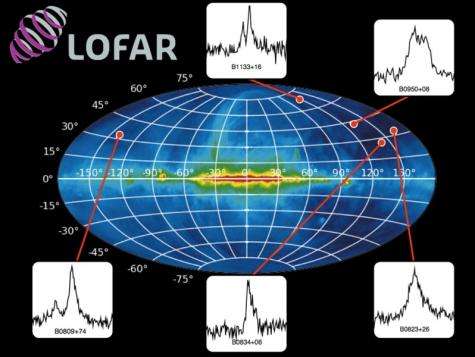
Its unique design allows Lofar to simultaneously detect radio emission from different directions. This image was obtained with Lofar by simultaneously observing five pulsars distributed across the whole sky. Credit: Tom Hassall / U.Man. / ASTRON

(PhysOrg.com) -- An international team of astronomers including German scientists has succeeded in recording the most sensitive observations to date of pulsars at low frequency. The measurement was undertaken with the European Lofar radio telescope network. Pulsars are fast-rotating neutron stars that are formed in the explosion of very massive stars (supernovae).

Lofar, the European low frequency radio telescope, is the first of a whole series of new types of to investigate the at the lowest frequencies which are actually accessible from the ground. One of the key projects is to find and study new pulsars in this "radio window". The German Glow (German Long ) consortium, whose membership includes the group of Michael Kramer, Director at the Max Planck Institute for in Bonn, is also involved.

“We are returning here to the radio frequencies where the pulsars were originally discovered in the 1960s,” says Ben Stappers from the University of Manchester, the lead author of the publication, which will be published soon in the scientific journal Astronomy & Astrophysics. “Except that with Lofar we now have a telescope with abilities that we could not have dreamed of back then.”

The chance finding of the first pulsar in 1967 is one of the great discoveries of astronomy. The astronomers found the first pulsar signals with a radio telescope at the low frequency of 81 megahertz, quite close to the radio frequencies in the VHF range.

Finger on the pulse of the pulsars
Enlarge

The Lofar station Effelsberg. In the foreground, the dipole field for low frequencies (30 to 80 megahertz, corresponding to between 3.8 and 10-metre wavelength); at the back, the “tile field” for higher frequencies (110 to 240 megahertz or 1.3 to 2.7-metre wavelength. Credit: Max Planck Institute for Radio Astronomy / Wolfgang Reich

With Lofar, the astronomers have now returned to the frequency range of the first measurements – but they are now using the latest computer technology and linking up the individual telescopes via high-speed fibre optic cables, which increase the power of the telescopes many times over. Lofar will make it possible to investigate the radio pulses in detail and also to study effects of gravitational physics and properties of the interstellar medium in our Milky Way. “Even if these are only early test results, they nevertheless already demonstrate the spectacular possibilities offered by Lofar,” says Stappers.

Lofar operates with the aid of thousands of small antennas that are distributed across various European countries and networked via high-speed Internet connections. The evaluation is done using a powerful supercomputer near the central Lofar station at ASTRON in the Netherlands.

The telescopes have no movable parts; instead, they are directed at the sky using digital time delay components. This provides much greater flexibility for the data analysis. Totally different directions in the sky can be covered simultaneously, for example, the only limiting factor being the computing capacity of the computer. This allows the sky to be surveyed much faster in the search for new pulsars.

“The imaging methods with Lofar differ greatly from those of conventional radio telescopes,” says Ralf-Jürgen Dettmar from the Ruhr University of Bochum and Chairman of the German Glow consortium. “With conventional systems, only quite small areas of the sky can be covered in a short time. Lofar, on the other hand, makes it possible to take snapshots of vast regions of the sky in the same time, and thus enables us to monitor these regions to discover new pulsars and possibly other rare phenomena.”

For the next stages in the investigation of pulsars the research team wants to use the special abilities of this radio telescope to get on the trail of the radiation mechanism of the neutron stars. “Lofar is a fantastic telescope to complement our current observation instruments to study pulsars at long wavelengths,” says Max Planck Director Michael Kramer. The system has the potential to find a large number of previously undiscovered pulsars in the vicinity of our sun. “We want to use them to detect gravitational waves.”

Lofar enables scientists to investigate radio waves across a very extensive frequency range – across more than one order of magnitude from 10 to 240 megahertz. Apart from searching for pulsars, the system is used for sky surveys in the long-wave radio range, and also for cosmological studies, as well as to monitor solar activity and study planets. additionally acts as the forerunner project for the Square Kilometre Array (SKA), the planned global radio telescope of the next generation.

More information: B. W. Stappers et al. Observing pulsars and fast transients with LOFAR. Astronomy & Astrophysics, DOI: 10.1051/0004-6361/201116681 astro-ph

Provided by Max-Planck-Gesellschaft search and more info website

Filter


Move the slider to adjust rank threshold, so that you can hide some of the comments.


Display comments: newest first

Donutz
May 06, 2011

Rank: 5 / 5 (1)
Perspective is great, isn't it? The pic looks like someone's patio, until you realize that the little white box at bottom right is a *building*. :-)
FrankHerbert
May 06, 2011

Rank: 0.7 / 5 (47)
I thought the same thing except I noticed the walkway :)
Bob_B
May 06, 2011

Rank: 3 / 5 (2)
An international team of astronomers including German scientists.

What Germans usually are not on the teams? Or Germans are not usually astronomers? Or Germans usually are not international? Or the writer assumes we know Germans are always on teams, astronomers and International and need to be reminded? Or, it's about time Germans are included. Or, the editor doesn't read English? Or....???
LKD
May 06, 2011

Rank: not rated yet
What Germans usually are not on the teams? Or Germans are not usually astronomers? Or Germans usually are not international? Or the writer assumes we know Germans are always on teams, astronomers and International and need to be reminded? Or, it's about time Germans are included. Or, the editor doesn't read English? Or....???


I thought that exactly and starting laughing aloud. Happy I'm not the only one to raise an eyebrow at that.
omatumr
May 06, 2011

Rank: 1 / 5 (3)
Thanks for this report and congratulations to the research team for the study of pulsars!

Neutron repulsion is the energy source that powers pulsars in the cores of the Sun, other ordinary stars, and galaxies [Neutron Repulsion, The APEIRON Journal, in press (2011) 19 pages]:

http://arxiv.org/...2.1499v1

Another paper, "Is the Universe Expanding?" [Journal of Cosmology 20 (2011) 4187-4190] shows that:

a.) The universe is cyclic and infinite.

b.) The current expansion will be followed by contraction.

c.) The universe and every atom in it consists of two forms of one fundamental particle:

Neutron <=> Hydrogen Atom
Compact <=>Expanded forms
Nuclear <=> Atomic forms


http://journalofc...g102.htm

With kind regards,
Oliver K. Manuel
Former NASA Principal
Investigator for Apollo

omatumr
May 08, 2011

Rank: 1 / 5 (2)
http://journalofc...102.html Correct link to
"Is the Universe Expanding?" [Journal of Cosmology 20 (2011) 4187-4190]
Rank 5 /5 (2 votes)
Relevant PhysicsForums posts
  • revamping general concept and cosmological principle
    createdMay 25, 2012
  • Transiting Exoplanet Light Curve
    createdMay 25, 2012
  • Math behind Theoretical Physics
    createdMay 24, 2012
  • Do we know whats at the center of galaxies yet?
    createdMay 23, 2012
  • Structure of the Milky Way?
    createdMay 20, 2012
  • What would it take to terraform Pluto and Charon?
    createdMay 19, 2012
  • More from Physics Forums - General Astronomy

More news stories

SpaceX capsule has 'new car' smell, astronauts say (Update)

SpaceX's Dragon cargo vessel smells like a new car, said astronauts at the International Space Station after opening the hatches Saturday following the spacecraft's landmark mission to the orbiting lab.

Space & Earth / Space Exploration

created 22 hours ago | popularity 4.5 / 5 (20) | comments 2

Australia hails surprise super-telescope decision

Australia has hailed a surprise decision giving it a role in a radio telescope project aimed at revolutionising astronomy, vowing to draw on its decades of experience in space science.

Space & Earth / Astronomy

created 22 hours ago | popularity 5 / 5 (4) | comments 2

Astronomers seize last chance in lifetime for Venus Transit

Astronomers are gearing for one the rarest events in the Solar System: an alignment of Earth, Venus and the Sun that will not be seen for another 105 years.

Space & Earth / Astronomy

created 22 hours ago | popularity 5 / 5 (3) | comments 2

Astronauts enter world's 1st private supply ship

(AP) -- Space station astronauts floated into the Dragon on Saturday, a day after its heralded arrival as the world's first commercial supply ship.

Space & Earth / Space Exploration

created 22 hours ago | popularity 5 / 5 (6) | comments 0

Sophisticated simulations predict future warming

The chances of our planet being hit by a global warming of 3 degrees Celsius by 2050 is as likely as it being hit by an increase of 1.4 degrees, new research shows. Presented in the journal Nature Geoscience, the British study ...

Space & Earth / Earth Sciences

created May 22, 2012 | popularity 4.4 / 5 (9) | comments 51


Nvidia trumpets Tegra 3 phone design wins for 2012

(Phys.org) -- Nvidia’s competitive war paint has a name, Tegra 3. On the heels of Nvidia announcements about lowering costs of its Tegra 3 processors and Nvidia-enabled tablets running Android Ice Cream ...

Browser wars flare in mobile space

The browser wars are heating up again, but this time the fight is for dominance of the mobile Internet.

Scientist: Evolution debate will soon be history

(AP) -- Richard Leakey predicts skepticism over evolution will soon be history. Not that the avowed atheist has any doubts himself.

Dell tablet leak: 10.1-inch display, two-battery choice

(Phys.org) -- Headline after headline talks about vendors’ tablets in the wings as likely number-one contenders for the iPad. Such claims have justifiably been taken with a grain of salt, considering ...

SpotterRF debuts Radar Backpack Kit (w/ Video)

(Phys.org) -- SpotterRF has announced a special radar backpack kit designed to enhance situational awareness for soldiers on the ground. The company says its special radar is designed for warfighters as part ...

Thousands of shellfish found dead in Peru

Thousands of crustaceans were found dead off the coast of Lima following the mystery mass death of dolphins and pelicans, the Peruvian Navy said Friday.