Looking beyond English
May 05, 2011 by Emily Finn
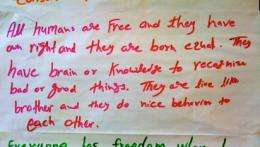
One of the student's reverse translations from Hindi into English of Article 1 of the U.N.’s Universal Declaration of Human Rights. Photo courtesy of Wayne O'Neil

In fall 2008, Daniel Ginsberg, an English as a Second Language teacher at a public high school in Malden, Mass., approached MIT professor Wayne O’Neil asking about incorporating linguistics into his curriculum to allow students to compare and contrast English with their native languages. O’Neil’s answer? Such a curriculum doesn’t exist for ESL students — but he’d be happy to help design one.

O’Neil, an MIT linguist who has been an advocate of linguistics education in secondary schools since the 1960s, has had plenty of experience developing curricula for both English and science classrooms. But he had never heard of an attempt to introduce linguistics to an ESL classroom — where backgrounds can be highly varied — so as to help them develop an English vocabulary for talking about language.

In Ginsberg’s class, students’ home languages included Cantonese, French, Haitian Creole, Hindi, Mandarin, Punjabi, Spanish and Tibetan — just a fraction of the 67 languages represented in the schools of Malden, just north of Boston. O’Neil worked with Ginsberg as well as his long-time collaborator, Wheelock College associate professor Maya Honda, to develop lessons plans that would take into account the ESL students’ abilities and needs. By teaching the scientific study of language, the three hoped to tap into the rich linguistic resources represented in the classroom to show students “just how valuable their language skills really are,” O’Neil says.

In a paper appearing in the May issue of the journal Language and Linguistics Compass, Ginsberg, Honda and O’Neil outline the theory, practice and impact of their pedagogical approach.

The science of language

O’Neil is quick to emphasize that the study of linguistics is very different from the grammar traditionally taught in English classrooms. Rather than prescription — i.e., set rules to be learned and followed — linguistic inquiry follows the scientific process of gathering and analyzing data, formulating hypotheses, and testing and revising those hypotheses.

According to Ginsberg, introducing linguistics methods into an ESL classroom is interesting because “the primary data is intuitions that students have in their heads.” He says, “In linguistics, if you’re starting with native-speaker intuitions, you can start people at a fairly young age asking fairly sophisticated questions.”

The Malden students worked collaboratively on problem sets designed by O’Neil, Ginsberg and Honda, and later, on data provided by their classmates themselves. The material proved engaging, as students were drawn into exploring the similarities and differences between languages.

“We tried to steer students away from purely ‘right’ and ‘wrong’ answers, and had them looking for answers scientifically, in the data,” O’Neil says.

‘Do you have –s?’

The curriculum developed for the Malden class included four main modules: noun pluralization, language acquisition, writing systems and translation.

In the unit on noun pluralization, students were asked to reflect on how their native language expresses the concept of “more than one” and compare it with English and other students’ languages. In English, the regular plural is formed by adding the suffix –s to a noun. As O’Neil tells it, after discovering that regular plurals were formed in much the same way in both French and Spanish, one student raised her hand following a presentation on Hindi pluralization and said, “I have a question. Do you have –s?” The Hindi speaker replied, “No, my language is different.”

A unit on writing systems stemmed from student interest following presentations by the Chinese-, Hindi- and Tibetan-speaking students. Many students were surprised to learn that not all languages have a writing system, and that some, like Chinese, use symbols based on units of meaning rather than sound.

The final unit had students translate Article 1 of the United Nations’ Universal Declaration of Human Rights from their native language into English, demonstrating the nuances and subjectivity of translation. “A lot of ESL students are in a position of having to translate for their parents, which can be difficult,” O’Neil says. Because they were already familiar with the challenges of translation, when it came time for this exercise, “they really got into it.”

‘What they didn’t know they knew’

Linguistics is rarely taught in high schools — never mind in ESL classrooms, where differences in students’ native languages and English abilities can often pose additional challenges. But Howard Williams, an applied linguist and ESL specialist at the Teachers College of Columbia University who was unaffiliated with the work, says the idea is “novel, and perfectly sensible.” He believes the project has the potential to “be a real spark” in the field, and the main hurdle will be giving teachers adequate preparation to implement such a curriculum.

According to O’Neil, Honda and Ginsberg, teaching linguistics in the ESL context has an important added benefit: It is a way to empower students whose home languages are often actively pushed aside in English-only school environments.

“One of the greatest affective benefits of using students’ home languages as classroom content is that it authentically puts students in the role of expert,” the team writes in the paper. O’Neil adds, “It is empowering to have an adult say, ‘I don’t know how your language works; please teach me.’”

In this approach, O’Neil says, students tap into “what they didn’t know they knew” about both their native language and language in general.

By showing students that their bilingualism is an asset, not a hindrance, in the scientific study of language as well as more generally, O’Neil and his colleagues are hoping to contribute to the creation of a new generation of linguists — or at least, young people who are able to engage in critical inquiry to better understand the world around them.


This story is republished courtesy of MIT News (web.mit.edu/newsoffice/), a popular site that covers news about MIT research, innovation and teaching.

Explore further: Challenging the public's view of gender and science

add to favorites email to friend print save as pdf

Related Stories

Bilinguals get the blues

Mar 15, 2011

(PhysOrg.com) -- Learning a foreign language literally changes the way we see the world, according to new research.

Modern society made up of all types

Nov 04, 2010

Modern society has an intense interest in classifying people into ‘types’, according to a University of Melbourne Cultural Historian, leading to potentially catastrophic life-changing outcomes for those typed – ...

Recommended for you

Challenging the public's view of gender and science

May 24, 2013

According to She Figures 2012, which analyses gender equality in research, in 2010 women accounted for only 10 % of university rectors in Europe and 15.5 % were heads of institutions of the higher education ...

New study offers insight into how to best manage workaholics

May 22, 2013

(Phys.org) —Workaholics tend to live in extremes, with great job satisfaction and creativity on the one hand and high levels of frustration and exhaustion on the other hand. Now, a new Florida State University study offers ...

The tea party and the politics of paranoia

May 22, 2013

Members of tea party claim the movement springs from and promotes basic American conservative principles such as limited government and fiscal responsibility.

The new retirement: No retirement?

May 22, 2013

For growing numbers of Americans, the new retirement may really mean no retirement. That's the conclusion of an article in the current issue of the ISR Sampler, the annual magazine of the University of Michigan Institute ...

User comments : 7

Adjust slider to filter visible comments by rank

Display comments: newest first

hush1
not rated yet May 05, 2011
Learning experts will replace teaching experts.
The birth of a learning expert is
the birth of a learning expert.

Experience a learning expert.

What does a learning expert (newly-born) do?
Is breathing one of the many 'firsts' in the long line of 'firsts' in the learning curve of a learning expert?
And even if this was so, how on earth can you remember your first breath and how you felt at the time?

You might even feel such questions are unanswerable.
You were the "teacher" at the time. And we both know you took a first breath. So you answered a question. Or not?

Some will say: There is no question at that stage of life!
Some will say: Sure, and you remember this?!
Some will say: A neuro-biological, physiological response to external stimulus is not a question!

You get the idea - a 'strange' dialogue.

You see. Learning has not been researched.

I leave you Wittgenstein's Adage - translated, no less!!:

"The limits of your languages are the limits of your world"

cont...
hush1
not rated yet May 05, 2011
...cont.

At lastly, with a question:
Do you know the language of the learning expert?
frajo
5 / 5 (1) May 06, 2011
It's a great idea to tap into multicultural wealth. I envy future generations for this experience.
hush1
5 / 5 (1) May 06, 2011
With languages, I am reminded of the visual difference between a black-and-white world and a world of color.

You can actually read the different between monolingual comments and multilingual comments.

Both sets of comments are sentences, free from grammatical errors. It is the choice of words to express the same idea that bears witness to the person in procession of the richer meaning through multilingualism.

We have both agreed music approaches universal language.
A language that has more meaning to more people with the least translation than any other human language we know.
(Assuming music needs translation)

I envy future generations for this experience as well.

Despite our days being numbered, I take comfort in knowing, that someone will profit from our efforts to preserve language diversity and at the same time profit from our efforts to communicate with perfect understanding about the differences language diversity offers.

That language will be music and more.
hush1
not rated yet May 06, 2011
The language of future generations.
That language will be music and more.
The infinities of a finite set.

Yes. We are envious. We will lack their understanding.
To dispel that envy, their language will convey their understanding to us. And we will be lacking no more.

And the effort to learn and understand from them and the effort to show the lesser of us this,
will be child's play for them.

:)
Modernmystic
5 / 5 (1) May 06, 2011
When I started learning Japanese one of the things I was struck with was the lack of general usage of pronouns. They get along just fine without them and think all the addition of them in English is tedious...and it really is :)
hush1
not rated yet May 07, 2011
That is a good comment about your learning (a language).
Of course, without exception, all readers will conjecture about the word "tedious" and what it meant to you during learning and if that adjective stood the test of time. "...really is..." awakes the impression in this reader as if "tedious" - I'm assuming the amount of effort to express an expression - is an amount of effort that never changes with amount of use or over time. You know. Vague is "tedious", the word describing what you go through.

I was posting on another (Physics)thread and quoted Bertrand Russell to an Italian speaking person speaking English:

"Everything is vague to a degree you do not realize till you have tried to make it precise."

This seems appropriate and vague enough for learning, language and your comment.

More news stories

Submerged structure stumps Israeli archaeologists

The massive circular structure appears to be an archaeologists dream: a recently discovered antiquity that could reveal secrets of ancient life in the Middle East and is just waiting to be excavated.

Mais non! French universities may teach in English

In France, there's a brewing debate over whether to speak anglais in universite. The National Assembly on Wednesday was taking up an education reform bill that would allow public universities to hold some courses—like science ...

Yahoo, pay-TV operators among Hulu bidders

Online video site Hulu is again up for sale, with Yahoo and pay TV operators DirecTV and Time Warner Cable among the seven bidders, according to a person with direct knowledge of the matter.