Cosmic magnetic fields
May 2, 2011 By Steve Nerlich, Universe Today
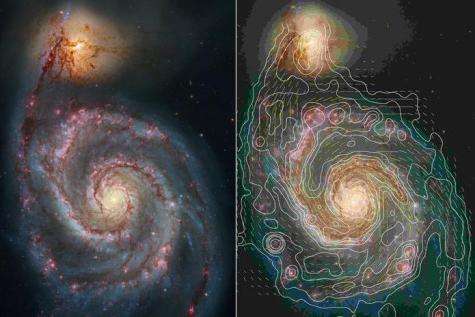
Magnetic field data from the Whirlpool Galaxy, M51. Credit: MPIfR Bonn.
The mention of cosmic-scale magnetic fields is still likely to met with an uncomfortable silence in some astronomical circles and after a bit of foot-shuffling and throat-clearing, the discussion will be moved on to safer topics. But look, theyre out there. They probably do play a role in galaxy evolution, if not galaxy formation and are certainly a feature of the interstellar medium and the intergalactic medium.
It is expected that the next generation of radio telescopes, such as LOFAR (Low Frequency Array) and the SKA (Square Kilometre Array), will make it possible to map these fields in unprecedented detail so even if it turns out that cosmic magnetic fields only play a trivial role in large-scale cosmology its at least worth having a look.
At the stellar level, magnetic fields play a key role in star formation, by enabling a protostar to unload angular momentum. Essentially, the protostars spin is slowed by magnetic drag against the surrounding accretion disk which allows the protostar to keep drawing in more mass without spinning itself apart.
At the galactic level, accretion disks around stellar-sized black holes create jets that inject hot ionised material into the interstellar medium while central supermassive black holes may create jets that inject such material into the intergalactic medium.
Within galaxies, seed magnetic fields may arise from the turbulent flow of ionised material, perhaps further stirred up by supernova explosions. In disk galaxies, such seed fields may then be further amplified by a dynamo effect arising from being drawn into the rotational flow of the whole galaxy. Such galactic scale magnetic fields are often seen forming spiral patterns across a disk galaxy, as well as showing some vertical structure within a galactic halo.
Similar seed fields may arise in the intergalactic medium or at least the intracluster medium. Its not clear whether the great voids between galactic clusters would contain a sufficient density of charged particles to generate significant magnetic fields.
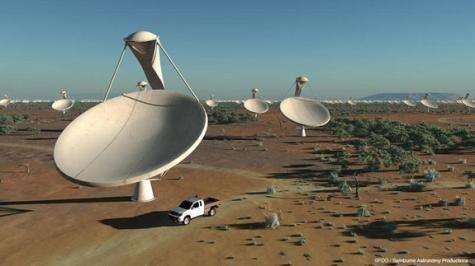
It is anticipated that next generation radio telescopes like the Square Kilometre Array will significantly enhance cosmic magnetic field research. Credit Swinburne AP.
Seed fields in the intracluster medium might be amplified by a degree of turbulent flow driven by supermassive black hole jets but, in the absence of more data, we might assume that such fields maybe more diffuse and disorganised that those seen within galaxies.The strength of intracluster magnetic fields averages around 3 x 10⁻⁶ gauss (G), which isnt a lot. The Earths magnetic fields averages around 0.5 G and a refrigerator magnet is about 50 G. Nonetheless, these intracluster fields offer the opportunity to trace back past interactions between galaxies or clusters (e.g. collisions or mergers) and perhaps to determine what role magnetic fields played in the early universe, particularly with respect to the formation of the first stars and galaxies.
Magnetic fields can be indirectly identified through a variety of phenomena:
Optical light is partly polarised by the presence of dust grains which are drawn into a particular orientation by a magnetic field and then only let through light in a certain plane.
At a larger scale, Faraday rotation comes into play, where the plane of already polarised light is rotated in the presence of a magnetic field.
Theres also Zeeman splitting, where spectral lines which normally identify the presence of elements such as hydrogen may become split in light that has passed through a magnetic field.
Wide angle or all-sky surveys of synchrotron radiation sources (e.g. pulsars and blazars) allow measurement of a grid of data points, which may undergo Faraday rotation as a result of magnetic fields at the intergalactic or intracluster scale. It is anticipated the high resolution offered by the SKA will enable observations of magnetic fields in the early universe back to a redshift of about z =5, which gives you a view of the universe as it was about 12 billion years ago.
Source: Universe Today
-
From lemons to lemonade: Reaction uses carbon dioxide to make carbon-based semiconductor,
32 comments
-
Thioridazine kills cancer stem cells in human while avoiding toxic side-effects of conventional cancer treatments,
3 comments
-
SpaceX private rocket blasts off for space station (Update),
42 comments
-
Climate scientists say they have solved riddle of rising sea,
31 comments
-
SpaceX capsule has 'new car' smell, astronauts say (Update),
2 comments
-
revamping general concept and cosmological principle
May 25, 2012
-
Transiting Exoplanet Light Curve
May 25, 2012
-
Math behind Theoretical Physics
May 24, 2012
-
Do we know whats at the center of galaxies yet?
May 23, 2012
-
Structure of the Milky Way?
May 20, 2012
-
What would it take to terraform Pluto and Charon?
May 19, 2012
- More from Physics Forums - General Astronomy
More news stories
SpaceX capsule has 'new car' smell, astronauts say (Update)
SpaceX's Dragon cargo vessel smells like a new car, said astronauts at the International Space Station after opening the hatches Saturday following the spacecraft's landmark mission to the orbiting lab.
Space & Earth / Space Exploration
23 hours ago |
4.5 / 5 (21) |
2
Australia hails surprise super-telescope decision
Australia has hailed a surprise decision giving it a role in a radio telescope project aimed at revolutionising astronomy, vowing to draw on its decades of experience in space science.
23 hours ago |
5 / 5 (4) |
2
Astronomers seize last chance in lifetime for Venus Transit
Astronomers are gearing for one the rarest events in the Solar System: an alignment of Earth, Venus and the Sun that will not be seen for another 105 years.
23 hours ago |
5 / 5 (3) |
2
Astronauts enter world's 1st private supply ship
(AP) -- Space station astronauts floated into the Dragon on Saturday, a day after its heralded arrival as the world's first commercial supply ship.
Space & Earth / Space Exploration
23 hours ago |
5 / 5 (6) |
0
Sophisticated simulations predict future warming
The chances of our planet being hit by a global warming of 3 degrees Celsius by 2050 is as likely as it being hit by an increase of 1.4 degrees, new research shows. Presented in the journal Nature Geoscience, the British study ...
Space & Earth / Earth Sciences
May 22, 2012 |
4.4 / 5 (9) |
51
Nvidia trumpets Tegra 3 phone design wins for 2012
(Phys.org) -- Nvidias competitive war paint has a name, Tegra 3. On the heels of Nvidia announcements about lowering costs of its Tegra 3 processors and Nvidia-enabled tablets running Android Ice Cream ...
Browser wars flare in mobile space
The browser wars are heating up again, but this time the fight is for dominance of the mobile Internet.
Scientist: Evolution debate will soon be history
(AP) -- Richard Leakey predicts skepticism over evolution will soon be history. Not that the avowed atheist has any doubts himself.
Dell tablet leak: 10.1-inch display, two-battery choice
(Phys.org) -- Headline after headline talks about vendors tablets in the wings as likely number-one contenders for the iPad. Such claims have justifiably been taken with a grain of salt, considering ...
SpotterRF debuts Radar Backpack Kit (w/ Video)
(Phys.org) -- SpotterRF has announced a special radar backpack kit designed to enhance situational awareness for soldiers on the ground. The company says its special radar is designed for warfighters as part ...
Thousands of shellfish found dead in Peru
Thousands of crustaceans were found dead off the coast of Lima following the mystery mass death of dolphins and pelicans, the Peruvian Navy said Friday.

May 02, 2011
Rank: 4 / 5 (1)
and just athought u may wanna make it alittle bit easier to understand to simple people like my self thank u
May 02, 2011
Rank: 1.7 / 5 (6)
Sadly, for most people, complicated ideas can't be made simpler and simpler without losing touch with reality.
May 02, 2011
Rank: not rated yet
Which part did you not get?
May 02, 2011
Rank: 4.6 / 5 (9)
May 02, 2011
Rank: 0.9 / 5 (53)
May 02, 2011
Rank: 2.4 / 5 (5)
May 03, 2011
Rank: 1 / 5 (3)
May 03, 2011
Rank: 4 / 5 (4)
May 03, 2011
Rank: 1.7 / 5 (6)
I hope the next generation of radio telescopes will be able to map magnetic fields.
The results should be able to confirm or deny our conclusion that ordinary stars like the Sun form on highly magnetic pulsars and that galaxies of stars are produced by fragmentation of a massive, central, highly magnetic neutron star:
Video: www.youtube.com/w...e_Qk-q7M
Manuscript: Neutron Repulsion, The APEIRON Journal, in press, 19 pages:
http://arxiv.org/...2.1499v1
With kind regards,
Oliver K. Manuel
May 03, 2011
Rank: 1 / 5 (5)
May 03, 2011
Rank: 3.7 / 5 (3)
Actually, neutron stars have been observed, and black holes were first predicted by theory. All theories are fabrications without experimental validation.
May 04, 2011
Rank: 4 / 5 (4)
This is such a great travesty. Far too often I hear that magnetism is irrelevant.
May 04, 2011
Rank: 2.6 / 5 (5)
Actually, no they haven't. Not once.
What has been observed are various effects which have been attributed to neutron stars as having been the source. And to save you the time, yes, I'm including pulsars in that statement.
I'm not sure what you mean when you say that black holes were first predicted by theory, when I'm saying is all they've ever been is predicted by theory. We might be in violent agreement here, except that I'll carry it further and state that they're not real.
May 05, 2011
Rank: 5 / 5 (1)
May 05, 2011
Rank: 2 / 5 (4)
May 05, 2011
Rank: 2 / 5 (4)
http://thunderbol...oids.htm
May 06, 2011
Rank: 1 / 5 (4)
Thanks, frajo.
If you know mainstream theoreticians, please ask them to comment on the nuclear rest mass data shown here:
www.omatumr.com/D...Data.htm
And discussed in these manuscripts:
1. Super-fluidity in the solar interior: Implications for solar eruptions and climate, Journal of Fusion Energy 21, 193-198 (2002):
http://arxiv.org/.../0501441
2. Neutron Repulsion [The APEIRON Journal, in press (2011), 19 pages]
http://arxiv.org/...2.1499v1
3. "Is the Universe Expanding?" [Journal of Cosmology 13 (2011) 4187-4190]
http://journalofc...102.html
With kind regards,
Oliver K. Manuel
Former NASA Principal
Investigator for Apollo
May 06, 2011
Rank: 4 / 5 (4)
There seems to be a large intersection. E.g. the Einstein Professor at Princeton is a member of both sets.
Everybody knows that the mathematical concept of a singularity is unphysical. Unfortunately, however, nobody knows what happens to the matter of a star surpassing the TolmanOppenheimerVolkoff limit if we dismiss the concept of a Black Hole. It's just a placeholder term waiting for a sound physical explanation. There's evidence enough for Black Holes, even if we don't know their inner structure.
May 07, 2011
Rank: 1.5 / 5 (8)
May 08, 2011
Rank: 2 / 5 (8)
Those spiral arms are winding up way too fast for any kind of billions of years theory to be applied. At most you have something like 1.3 Ga before the spirals get meshed into un-recognizable clouds of stars. So since those spiral arms are still out there, it's not possible to categorically apply the "fact" of galaxies being billions of years old.
Those pesky magnetic fields make it even MORE difficult to account for the existence of the spiral arms after the supposed evolutionary billions of years. They are however, an even stronger testament to the fact that the universe was made by the Creator and definitely not according to man's un-wisdom.
May 09, 2011
Rank: not rated yet
May 09, 2011
Rank: 3 / 5 (2)
He was excessively boastful and was creating abject lies towards the end of his life. I would take anything theoretical from Tesla with a grain of salt.
May 12, 2011
Rank: 1 / 5 (1)
A magnetic field requires an electric current, at all times, everywhere. Not just at an origin. But hey, don't take my word for it:
". . .all magnetic fields encountered in nature are generated by circulating currents."
Ffrom: "Origin of Permanent Magnetism", http://farside.ph...e77.html
-With a great big hat tip and many thanks to "DustyDevil"