Chemotherapy resistance: A new lead?
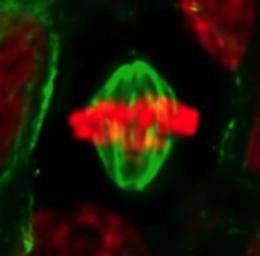
Untreated cell undergoing division. (Green: microtubules. Red: chromosomes)Credit: Sergey Tcherniuk
UA62784: that is the name of a molecule capable of preventing the proliferation of cancerous cells in vitro, and thus causing their cellular death. Its effects appear to amplify that of other anticancer agents currently used clinically, according to the work of the team headed by Ariane Abrieu, Inserm researcher at the Center de Recherche en Biochimie Macromoléculaire. This discovery could make it possible to overcome the phenomenon of resistance developed during certain chemotherapy treatments. The results are published in Chemistry and Biology on 26 May 2011.
Cancerous cells have the particularity of dividing in an uncontrolled manner. To prevent this happening, many of the anticancer drugs currently used clinically target microtubules. By destabilizing them, they block the division and thus the propagation of cancerous cells. However, these treatments are not effective on all cancers and, over time, come up against the phenomenon of resistance in certain tumors.
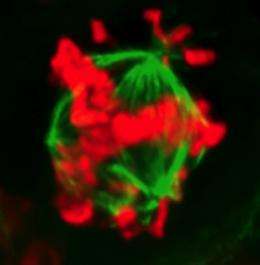
UA62784 treated cell undergoing division (Green: microtubules. Red: chromosomes) Credit: Sergey Tcherniuk
Sergey Tcherniuk, a member of Abrieu's team at the Centre de Recherche en Biochimie Macromoléculaire, has been able to demonstrate, in vitro, that the molecule UA62784 affects the way microtubules normally work. In fact, UA62784 blocks the division of cancerous cells, which for the main part causes cell death. Complementary experiments have shown that, when combined with other anticancer agents already used clinically in chemotherapy, UA62784 is able to boost their effect. Last but not least, effective doses of UA62784 are much lower than those administered with current medicines. Treating patients with this molecule could thus reduce the occurrence of chemotherapy resistance.Although this discovery is still only at the experimental stage, it makes it possible to envisage significant advances in chemotherapy-based clinical treatments, not just for tumors that have been totally resistant until now, but also those liable to relapse. The researchers are currently conducting in vitro tests in order to collect further data on the efficacy of UA62784 and find out how to optimize its effect, coupled or not with other conventional anticancer agents.
More information: UA62784 is a cytotoxic inhibitor of microtubules, not Cenp-E. S.Tcherniuk, et al. Chemistry and Biology, 26 May 2011.
Provided by
CNRS
-
From lemons to lemonade: Reaction uses carbon dioxide to make carbon-based semiconductor,
32 comments
-
Thioridazine kills cancer stem cells in human while avoiding toxic side-effects of conventional cancer treatments,
3 comments
-
SpaceX private rocket blasts off for space station (Update),
42 comments
-
Climate scientists say they have solved riddle of rising sea,
31 comments
-
SpaceX capsule has 'new car' smell, astronauts say (Update),
2 comments
-
What's the rule to covalent character
3 hours ago
-
Schwartz reagent-- NMR/MS/IR
21 hours ago
-
High school chemistry EEI
May 25, 2012
-
oxidation of I- by KMnO4
May 25, 2012
-
Inversion temp
May 25, 2012
-
Hybridization of SnCl3 -
May 25, 2012
- More from Physics Forums - Chemistry
More news stories
New CO2-removing catalyst can take the heat
(Phys.org) -- The current method of removing the greenhouse gas carbon dioxide (CO2) from the flues of coal-fired power plants uses so much energy that no one bothers to use it. So says Roger Aines, principal ...
May 24, 2012 |
5 / 5 (7) |
7
|
High-speed method to aid search for solar energy storage catalysts
Eons ago, nature solved the problem of converting solar energy to fuels by inventing the process of photosynthesis.
May 25, 2012 |
5 / 5 (3) |
4
|
Researchers demonstrate possible primitive mechanism of chemical info self-replication
(Phys.org) -- When scientists think about the replication of information in chemistry, they usually have in mind something akin to what happens in living organisms when DNA gets copied: a double-stranded molecule ...
May 25, 2012 |
5 / 5 (4) |
2
|
Building a better solar panel -- one molecule at a time
(Phys.org) -- One of the fundamental building blocks in modern chemistry, an organometallic chemical compound called ferrocene, has never been structurally defined - until now.
May 25, 2012 |
5 / 5 (3) |
0
|
Discarded data may hold the key to a sharper view of molecules
(Phys.org) -- There's nothing like a new pair of eyeglasses to bring fine details into sharp relief. For scientists who study the large molecules of life from proteins to DNA, the equivalent of new lenses have come in the ...
May 24, 2012 |
4.7 / 5 (3) |
0
|
Nvidia trumpets Tegra 3 phone design wins for 2012
(Phys.org) -- Nvidias competitive war paint has a name, Tegra 3. On the heels of Nvidia announcements about lowering costs of its Tegra 3 processors and Nvidia-enabled tablets running Android Ice Cream ...
Browser wars flare in mobile space
The browser wars are heating up again, but this time the fight is for dominance of the mobile Internet.
Scientist: Evolution debate will soon be history
(AP) -- Richard Leakey predicts skepticism over evolution will soon be history. Not that the avowed atheist has any doubts himself.
Dell tablet leak: 10.1-inch display, two-battery choice
(Phys.org) -- Headline after headline talks about vendors tablets in the wings as likely number-one contenders for the iPad. Such claims have justifiably been taken with a grain of salt, considering ...
SpotterRF debuts Radar Backpack Kit (w/ Video)
(Phys.org) -- SpotterRF has announced a special radar backpack kit designed to enhance situational awareness for soldiers on the ground. The company says its special radar is designed for warfighters as part ...
SpaceX capsule has 'new car' smell, astronauts say (Update)
SpaceX's Dragon cargo vessel smells like a new car, said astronauts at the International Space Station after opening the hatches Saturday following the spacecraft's landmark mission to the orbiting lab.
