Toshiba develops 7.0-inch LTPS TFT LCD panel
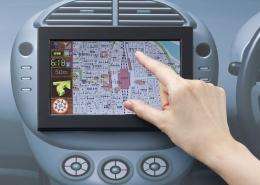
Toshiba Mobile Display has developed a 7.0-inch low-temperature poly-silicon (LTPS) thin-film transistor (TFT) liquid crystal display (LCD) for vehicle-mounted and industrial uses that enables multi-touch input on the display screen without the need for additional installation of a touch panel as a demonstration of its new touch panel technology.
The technology enables an integrated touch panel function by forming the display pixel electrodes and TFT within the LCD panel using LTPS TFT technology and creating a detecting circuit for electrostatic capacitance changes between the electrodes and the peripheral object. Compared to conventional LCDs with an external touch panel, the thickness is reduced by 57 percent to approximately 1 millimeter, the weight is reduced by 48 percent to 225 grams and the surface reflection ratio is reduced by 10 percent. Its smaller size enables the design of more compact products for mobile applications, reduces the impact on the environment by saving resources and power, provides crisp and clear images with minimal reflection of natural light even in a bright environment, and features intuitive multi-touch input.
Recently, an increasing number of smartphones, cellular phones, in-vehicle car navigation systems, tablet-type PCs and other equipment for mobile applications have been designed around a capacitive-type touch panel1 integrated LCD, thereby facilitating the rapid spread of products that feature a low-profile and reduced-weight design, and intuitive, easy and simple touch input. TMD has developed this technology in response to the increasing demand for in-cell touch panel2 LCDs with the touch panel function integrated in the LCD panel for further reduction of thickness, weight and environmental impact.
The capacitive-type touch panel is designed to form transparent electrodes on the touch panel and detect changes in electrostatic capacitance between the electrodes and the users fingers with high accuracy, thereby enabling the screen panel to respond easily to light finger touches. To integrate this feature in the LCD panel it is essential to suppress possible interference with various signals in the LCD panel. To address the problem, TMD has developed a proprietary sensor circuit, taking advantage of LTPS TFT technology. Specifically, an amplifier circuit is formed in the pixels to amplify the signals, which are then detected by the sensor for output, providing a configuration to precisely transmit sensor signals to the outside of LCD panel. This helps achieve consistent and fast-responding touch panel operation.
This technology will be exhibited in the Toshiba booth #1119 at SID 2011 International Symposium, Seminar and Exhibition to be held from May 17 to May 19, 2011 in Los Angeles, Calif., USA.
Provided by Toshiba Corporation
-
From lemons to lemonade: Reaction uses carbon dioxide to make carbon-based semiconductor,
32 comments
-
Thioridazine kills cancer stem cells in human while avoiding toxic side-effects of conventional cancer treatments,
3 comments
-
SpaceX private rocket blasts off for space station (Update),
42 comments
-
Climate scientists say they have solved riddle of rising sea,
30 comments
-
Research team claims to have found evidence Lake Cheko is impact crater for Tunguska Event,
18 comments
-
Statistics of random processes passed through an LTI system
3 hours ago
-
Drawing energy band diagrams
11 hours ago
-
Using multiple 555 timers in astable
14 hours ago
-
PCB design/fabrication quote - online or offline?
15 hours ago
-
PCB Design / Fab / Assembly start up experience?
15 hours ago
-
Half-wave rectification
19 hours ago
- More from Physics Forums - Electrical Engineering
More news stories
SpotterRF debuts Radar Backpack Kit (w/ Video)
(Phys.org) -- SpotterRF has announced a special radar backpack kit designed to enhance situational awareness for soldiers on the ground. The company says its special radar is designed for warfighters as part ...
Probability of contamination from severe nuclear reactor accidents is higher than expected: study
Catastrophic nuclear accidents such as the core meltdowns in Chernobyl and Fukushima are more likely to happen than previously assumed. Based on the operating hours of all civil nuclear reactors and the number ...
Technology / Energy & Green Tech
May 22, 2012 |
3.6 / 5 (21) |
56
|
Delphi gasoline-injection engine technique rivals hybrid's edge
(Phys.org) -- Running a diesel like engine on gasoline is something Delphi is doing in notable fashion. They claim they are on to a promising way to enjoy an engine that gives the vehicle owner high efficiency ...
HyperSolar shows dirty water no barrier to power world
(Phys.org) -- The Santa Barbara, California, company, HyperSolar, is set to transparently share the ups and downs of its research experiences toward the companys ultimate vision, successfully producing ...
Tesla to launch electric sedan in US on June 22
Tesla Motors said Tuesday it would begin deliveries of "the world's first premium electric sedan" on June 22, slightly ahead of schedule.
Technology / Energy & Green Tech
May 22, 2012 |
4.5 / 5 (11) |
18
Scientist: Evolution debate will soon be history
(AP) -- Richard Leakey predicts skepticism over evolution will soon be history. Not that the avowed atheist has any doubts himself.
Dell tablet leak: 10.1-inch display, two-battery choice
(Phys.org) -- Headline after headline talks about vendors tablets in the wings as likely number-one contenders for the iPad. Such claims have justifiably been taken with a grain of salt, considering ...
SpaceX capsule has 'new car' smell, astronauts say (Update)
SpaceX's Dragon cargo vessel smells like a new car, said astronauts at the International Space Station after opening the hatches Saturday following the spacecraft's landmark mission to the orbiting lab.
Thousands of shellfish found dead in Peru
Thousands of crustaceans were found dead off the coast of Lima following the mystery mass death of dolphins and pelicans, the Peruvian Navy said Friday.
Astronomers seize last chance in lifetime for Venus Transit
Astronomers are gearing for one the rarest events in the Solar System: an alignment of Earth, Venus and the Sun that will not be seen for another 105 years.
Australia hails surprise super-telescope decision
Australia has hailed a surprise decision giving it a role in a radio telescope project aimed at revolutionising astronomy, vowing to draw on its decades of experience in space science.