Scientists engineer a surface to trap a rainbow
April 27, 2011

Scientists engineer a surface to trap a rainbow

Enlarge

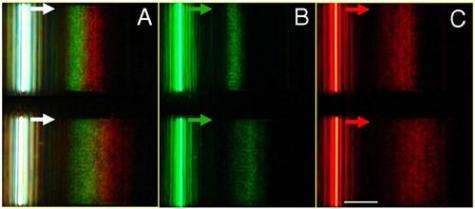
Microscope images of graded gratings with different gradients employing different filters for a, b and c.

(PhysOrg.com) -- The development promises significant improvements in optical data processing and transmission and other technologies.

A group of electrical engineers and chemists at Lehigh has experimentally verified the “rainbow” trapping effect, demonstrating that plasmonic structures can slow down light waves over a broad range of wavelengths.

The results of the study, says Qiaoqiang Gan, hold promise for significant improvements in the processing and transmission capacity of optical data, and also in data storage, solar cells, biosensors and other technologies. Gan earned a Ph.D. in electrical engineering from Lehigh in 2010 and is now an assistant professor of electrical engineering at the State University of New York in Buffalo.

The Lehigh researchers described their work in an article titled “Experimental verification of the rainbow trapping effect in adiabatic plasmonic gratings,” which was published in March by the Proceedings of the National Academy of Sciences (PNAS), one of the world’s most frequently cited multidisciplinary science journals.

Filbert J. Bartoli, department chair and professor of electrical and computer engineering, was principal investigator on the project, which was funded by the National Science Foundation. Gan was lead author on the PNAS article.

The idea that a rainbow of broadband light could be slowed down or stopped using plasmonic structures has only recently been predicted in theoretical studies.

Scientists engineer a surface to trap a rainbow
Enlarge

An image of a graded grating obtained with atomic force microscopy. The groove depth (a) increases from approximately 6nm to 100nm. Images b, c and d show emission from the structure with different filters. Images e, f and g are emission images with the SPP modes coupled and propagating in a direction opposite to that for images b, c and d.

Controlling photons, interpreting light signals

While the notion of trapping a rainbow sounds like ad speak, finding ways to control photons—the particles that makes up light—could greatly improve the capacity of data storage systems and speed the processing of .

“At the moment, processing data with optical signals is limited by how quickly the signal can be interpreted,” Gan said. “If the signal can be slowed, more information could be processed without overloading the system.”

The Lehigh group used focused ion beams to mill a series of increasingly deeper, nanosized grooves into a thin sheet of silver. This technique, called Surface Dispersion Engineering, alters the optical properties of a metallic surface.

By focusing light along this plasmonic structure, the series of grooves, or nano-gratings, slowed each wavelength of optical light. The individual colors of the visible spectrum were captured at different groove depths along the grating, resulting in a trapped rainbow of light.

Through direct optical measurements, the team showed that wavelengths of light in the 500-700nm region were “trapped” at different positions along the grating, consistent with computer simulations.

“Metamaterials, which are man-made materials with feature sizes smaller than the wavelength of light, offer novel applications in nanophotonics, photovoltaic devices, and biosensors on a chip,” says Bartoli.

“Creating such nanoscale patterns on a metal film allows us to control and manipulate light propogation. The findings of this paper present an unambiguous experimental demonstration of rainbow trapping in plasmonic nanostructures.”

“This technology for slowing light at room temperature can be integrated with other materials and components, which could lead to novel platforms for optical circuits,” says Gan. “The ability of surface plasmons to concentrate within nanoscale dimensions makes them very promising for the development of biosensors on chip and the study of nonlinear optical interactions.”

The PNAS article was coauthored by other members of the Lehigh group: Yujie J. Ding, professor of electrical and computer engineering; Dmitri Vezenov, associate professor of chemistry; and graduate students Yongkang Gao and Kyle Wagner.

More information: Experimental verification of the rainbow trapping effect in adiabatic plasmonic gratings, doi: 10.1073/pnas.1014963108

Provided by Lehigh University search and more info website

Filter


Move the slider to adjust rank threshold, so that you can hide some of the comments.


Display comments: newest first

physyD
Apr 27, 2011

Rank: not rated yet
Trapping a rainbow? Isn't that dangerous? They might upset the leprechaun.
Husky
Apr 27, 2011

Rank: not rated yet
they will find a pot of nanogold
Rank 5 /5 (2 votes)
Relevant PhysicsForums posts
  • The Global Positioning System !
    created1 hour ago
  • A Question relating Power
    created2 hours ago
  • Writing a book so im learning about things, i have some general questions please read
    created5 hours ago
  • Question about induced E field.
    created6 hours ago
  • Charging a capacitor in a tesla coil
    created6 hours ago
  • Water Rocket
    created9 hours ago
  • More from Physics Forums - General Physics

More news stories

Is a classical electrodynamics law incompatible with special relativity?

(Phys.org) -- The laws of classical electromagnetism that were developed in the 19th century are the same laws that scientists use today. They include Maxwell’s four equations along with the Lorentz la ...

Physics / General Physics

created May 24, 2012 | popularity 4.7 / 5 (15) | comments 41 | with audio podcast feature

Landmark calculation clears the way to answering how matter is formed

(Phys.org) -- An international collaboration of scientists, including Thomas Blum, associate professor of physics, is reporting in landmark detail the decay process of a subatomic particle called a kaon – ...

Physics / General Physics

created May 25, 2012 | popularity 4.2 / 5 (21) | comments 47 | with audio podcast

Good vibes: Coupling electron spin states and carbon nanotube vibrations

(Phys.org) -- An electron’s spin is separate from its motion, and is suitable for use in both highly-precise magnetic sensing as well as a qubit in quantum computing. Recently, scientists at the University ...

Physics / General Physics

created May 23, 2012 | popularity 4.7 / 5 (7) | comments 1 | with audio podcast feature

Thousands of invisibility cloaks trap a rainbow

Many people anticipating the creation of an invisibility cloak might be surprised to learn that a group of American researchers has created 25 000 individual cloaks.

Physics / General Physics

created May 24, 2012 | popularity 4.8 / 5 (6) | comments 0 | with audio podcast

Excitons: Exotic particles, chilled and trapped, form giant matter wave

Physicists have trapped and cooled exotic particles called excitons so effectively that they condensed and cohered to form a giant matter wave.

Physics / General Physics

created May 24, 2012 | popularity 4.9 / 5 (9) | comments 1 | with audio podcast


Nvidia trumpets Tegra 3 phone design wins for 2012

(Phys.org) -- Nvidia’s competitive war paint has a name, Tegra 3. On the heels of Nvidia announcements about lowering costs of its Tegra 3 processors and Nvidia-enabled tablets running Android Ice Cream ...

Browser wars flare in mobile space

The browser wars are heating up again, but this time the fight is for dominance of the mobile Internet.

Dell tablet leak: 10.1-inch display, two-battery choice

(Phys.org) -- Headline after headline talks about vendors’ tablets in the wings as likely number-one contenders for the iPad. Such claims have justifiably been taken with a grain of salt, considering ...

Scientist: Evolution debate will soon be history

(AP) -- Richard Leakey predicts skepticism over evolution will soon be history. Not that the avowed atheist has any doubts himself.

SpaceX capsule has 'new car' smell, astronauts say (Update)

SpaceX's Dragon cargo vessel smells like a new car, said astronauts at the International Space Station after opening the hatches Saturday following the spacecraft's landmark mission to the orbiting lab.

Of mice and mental models: Neuroscientific implications of risk-optimized behavior in the mouse

(Medical Xpress) -- Regardless of an organism’s biological complexity, every encephalized animal continuously makes under-informed behavioral choices that can have serious consequences. Despite its ubiquity, ...