Scientists have new measure for species threat
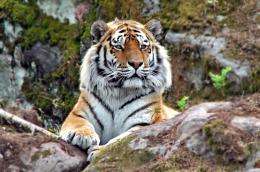
According to the authors of the SAFE (Species Ability to Forestall Extinction) index, conservationists with limited resources may want to channel their efforts on saving the tiger, a species that is at the 'tipping point' and could have reasonable chance of survival. Photo by Juliane Riedl.
(PhysOrg.com) -- A new index has been developed to help conservationists better understand how close species are to extinction.
The index, developed by a team of Australian researchers from the University of Adelaide and James Cook University, is called SAFE (Species Ability to Forestall Extinction).
The SAFE index builds on previous studies into the minimum population sizes needed by species to survive in the wild. It measures how close species are to their minimum viable population size.
"SAFE is a leap forward in how we measure relative threat risk among species," says co-author Professor Corey Bradshaw, Director of Ecological Modelling at the University of Adelaide's Environment Institute.
"The idea is fairly simple - it's the distance a population is (in terms of abundance) from its minimum viable population size. While we provide a formula for working this out, it's more than just a formula - we've shown that SAFE is the best predictor yet of the vulnerability of mammal species to extinction."
Professor Bradshaw says SAFE is designed to be an adjunct to the International Union for Conservation of Nature (IUCN) Red List of Threatened Species, not a replacement.
"Our index shows that not all Critically Endangered species are equal. A combined approach - using the IUCN Red List threat categories together with the SAFE index - is more informative than the IUCN categories alone, and provides a good method for gauging the relative 'safety' of a species from extinction," he says.
Of the 95 mammal species considered in the team's analysis, more than one in five are close to extinction, and more than half of them are at 'tipping points' that could take their populations to the point of no return.
"For example, our studies show that practitioners of conservation triage may want to prioritise resources on the Sumatran rhinoceros instead of the Javan rhinoceros. Both species are Critically Endangered, but the Sumatran rhino is more likely to be brought back from the brink of extinction based on its SAFE index," Professor Bradshaw says.
"Alternatively, conservationists with limited resources may want to channel their efforts on saving the tiger, a species that is at the 'tipping point' and could have reasonable chance of survival."
The SAFE index is detailed in a new paper published this month in the journal Frontiers in Ecology and Environment (http://dx.doi.org/ … .1890/100177). It is co-authored by Reuben Clements (James Cook University), Professor Corey Bradshaw and Professor Barry Brook (The University of Adelaide) and Professor Bill Laurance (James Cook University).
Provided by
University of Adelaide
-
From lemons to lemonade: Reaction uses carbon dioxide to make carbon-based semiconductor,
32 comments
-
Thioridazine kills cancer stem cells in human while avoiding toxic side-effects of conventional cancer treatments,
3 comments
-
SpaceX private rocket blasts off for space station (Update),
42 comments
-
Climate scientists say they have solved riddle of rising sea,
31 comments
-
Research team claims to have found evidence Lake Cheko is impact crater for Tunguska Event,
18 comments
-
What would stain as translucent on light-coloured fabric?
12 hours ago
-
How do I identify different bacteria on culture plates?
22 hours ago
-
Why Do Dogs do Strange things...
May 25, 2012
-
What does exophillic and endophillic mean in terms of mosquito and their control?
May 24, 2012
-
Semen stains glows under black lights (uv light)?
May 23, 2012
-
Question on Human Chromosome 2
May 23, 2012
- More from Physics Forums - Biology
More news stories
Scientist: Evolution debate will soon be history
(AP) -- Richard Leakey predicts skepticism over evolution will soon be history. Not that the avowed atheist has any doubts himself.
11 hours ago |
3.5 / 5 (11) |
29
It's in the genes: Research pinpoints how plants know when to flower
Scientists believe they've pinpointed the last crucial piece of the 80-year-old puzzle of how plants "know" when to flower.
May 25, 2012 |
3.9 / 5 (9) |
1
|
Researchers solve structure of human protein critical for silencing genes
In a study published in the journal Cell on May 24, Cold Spring Harbor Laboratory (CSHL) scientists describe the three-dimensional atomic structure of a human protein bound to a piece of RNA that "guides" the pr ...
May 25, 2012 |
4.7 / 5 (7) |
0
|
Thousands of shellfish found dead in Peru
Thousands of crustaceans were found dead off the coast of Lima following the mystery mass death of dolphins and pelicans, the Peruvian Navy said Friday.
21 hours ago |
4.8 / 5 (4) |
6
Copy of the genetic makeup travels in a protein suitcase
Scientists from the Institute for Physical and Theoretical Chemistry at the University of Bonn have succeeded for the first time in the real time filming of the transport of an important information carrier in biological ...
May 25, 2012 |
not rated yet |
0
|
Nvidia trumpets Tegra 3 phone design wins for 2012
(Phys.org) -- Nvidias competitive war paint has a name, Tegra 3. On the heels of Nvidia announcements about lowering costs of its Tegra 3 processors and Nvidia-enabled tablets running Android Ice Cream ...
Browser wars flare in mobile space
The browser wars are heating up again, but this time the fight is for dominance of the mobile Internet.
Dell tablet leak: 10.1-inch display, two-battery choice
(Phys.org) -- Headline after headline talks about vendors tablets in the wings as likely number-one contenders for the iPad. Such claims have justifiably been taken with a grain of salt, considering ...
SpaceX capsule has 'new car' smell, astronauts say (Update)
SpaceX's Dragon cargo vessel smells like a new car, said astronauts at the International Space Station after opening the hatches Saturday following the spacecraft's landmark mission to the orbiting lab.
Of mice and mental models: Neuroscientific implications of risk-optimized behavior in the mouse
(Medical Xpress) -- Regardless of an organism’s biological complexity, every encephalized animal continuously makes under-informed behavioral choices that can have serious consequences. Despite its ubiquity, ...
SpotterRF debuts Radar Backpack Kit (w/ Video)
(Phys.org) -- SpotterRF has announced a special radar backpack kit designed to enhance situational awareness for soldiers on the ground. The company says its special radar is designed for warfighters as part ...