Origami: Not just for paper anymore
While the primary job of DNA in cells is to carry genetic information from one generation to the next, some scientists also see the highly stable and programmable molecule as an ideal building material for nanoscale structures that could be used to deliver drugs, act as biosensors, perform artificial photosynthesis and more.
Trying to build DNA structures on a large scale was once considered unthinkable. But about five years ago, Caltech computational bioengineer Paul Rothemund laid out a new design strategy called DNA origami: the construction of two-dimensional shapes from a DNA strand folded over on itself and secured by short “staple” strands. Several years later, William Shih’s lab at Harvard Medical School translated this concept to three dimensions, allowing design of complex curved and bent structures that opened new avenues for synthetic biological design at the nanoscale.
A major hurdle to these increasingly complex designs has been automation of the design process. Now a team at MIT, led by biological engineer Mark Bathe, has developed software that makes it easier to predict the three-dimensional shape that will result from a given DNA template. While the software doesn’t fully automate the design process, it makes it considerably easier for designers to create complex 3-D structures, controlling their flexibility and potentially their folding stability.
“We ultimately seek a design tool where you can start with a picture of the complex three-dimensional shape of interest, and the algorithm searches for optimal sequence combinations,” says Bathe, the Samuel A. Goldblith Assistant Professor of Applied Biology. “In order to make this technology for nanoassembly available to the broader community — including biologists, chemists, and materials scientists without expertise in the DNA origami technique — the computational tool needs to be fully automated, with a minimum of human input or intervention.”
Bathe and his colleagues described their new software in the Feb. 25 issue of Nature Methods. In that paper, they also provide a primer on creating DNA origami with collaborator Hendrik Dietz at the Technische Universitaet Muenchen. “One bottleneck for making the technology more broadly useful is that only a small group of specialized researchers are trained in scaffolded DNA origami design,” Bathe says.
Programming DNA
DNA consists of a string of four nucleotide bases known as A, T, G and C, which make the molecule easy to program. According to nature’s rules, A binds only with T, and G only with C. “With DNA, at the small scale, you can program these sequences to self-assemble and fold into a very specific final structure, with separate strands brought together to make larger-scale objects,” Bathe says.
Rothemund’s origami design strategy is based on the idea of getting a long strand of DNA to fold in two dimensions, as if laid on a flat surface. In his first paper outlining the method, he used a viral genome consisting of approximately 8,000 nucleotides to create 2-D stars, triangles and smiley faces.
That single strand of DNA serves as a “scaffold” for the rest of the structure. Hundreds of shorter strands, each about 20 to 40 bases in length, combine with the scaffold to hold it in its final, folded shape.
“DNA is in many ways better suited to self-assembly than proteins, whose physical properties are both difficult to control and sensitive to their environment,” Bathe says.
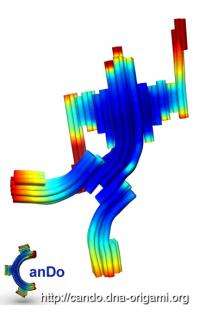
Bathe’s new software program interfaces with a software program from Shih’s lab called caDNAno, which allows users to manually create scaffolded DNA origami from a two-dimensional layout. The new program, dubbed CanDo, takes caDNAno’s 2-D blueprint and predicts the ultimate 3-D shape of the design. This resulting shape is often unintuitive, Bathe says, because DNA is a flexible object that twists, bends and stretches as it folds to form a complex 3-D shape.
According to Rothemund, the CanDo program should allow DNA origami designers to more thoroughly test their DNA structures and tweak them to fold correctly. “While we have been able to design the shape of things, we have had no tools to easily design and analyze the stresses and strains in those shapes or to design them for specific purposes,” he says.
At the molecular-level, stress in the double helix of DNA decreases the folding stability of the structure and introduces local defects, both of which have hampered progress in the scaffolded DNA origami field.
Postdoctoral researcher Do-Nyun Kim and graduate student Matthew Adendorff, both of the Bathe lab, are now furthering CanDo’s capabilities and optimizing the scaffolded DNA origami design process.
Building nanoscale tools
Once scientists have a reliable way to assemble DNA structures, the next question is what to do with them. One application scientists are excited about is a “DNA carrier” that can transport drugs to specific destinations in the body such as tumors, where the carrier would release the cargo based on a specific chemical signal from the target cancer cell.
Another possible application of scaffolded DNA origami could help reproduce part of the light-harvesting apparatus of photosynthetic plant cells. Researchers hope to recreate that complex series of about 20 protein subunits, but to do that, components must be held together in specific positions and orientations. That’s where DNA origami could come in.
“DNA origami enables the nanoscale construction of very precise architectural arrangements. Researchers are exploiting this unique property to pursue a number of applications at the nanoscale, including a synthetic photocell,” Bathe says. “While applications such as this are still quite far off on the horizon, we believe that predictive engineering software tools are essential for progress in this direction.”
Novel applications may also grow out of a new competition being held at Harvard this summer, called BIOMOD. Undergraduate teams from about a dozen schools, including MIT, Harvard and Caltech, will try to design nanoscale biomolecules for robotics, computing and other applications.
In the meantime, Bathe is focusing on further developing CanDo to enable automated DNA origami design. “Once you have an automated computational tool that allows you to design complex shapes in a precise way, I think we’re in a much better position to exploit this technology for interesting applications,” he says.
For DNA origami to have a broad impact, it needs to become routine to simply order up DNA parts to build any configuration you can dream up, Bathe says. He notes: “Once non-specialists can design arbitrary 3-D nanostructures using DNA origami, their imaginations can run free.”
This story is republished courtesy of MIT News (web.mit.edu/newsoffice/), a popular site that covers news about MIT research, innovation and teaching.
More information: www.nature.com/nmeth/journal/v … full/nmeth.1570.html
Provided by Massachusetts Institute of Technology


