Explaining the mystery of the missing sunspots
April 5, 2011

Explaining the mystery of the missing sunspots

Enlarge

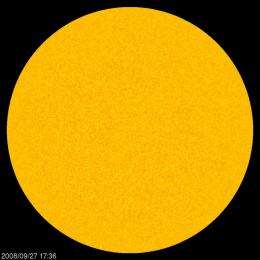
The "naked" sun, free of sunspots, as seen during its recent solar minimum. Credit: NASA/SOHO

Sunspots have been observed for about four centuries, since they were first reported by Galileo. Appearing in roughly eleven-year cycles of activity, sunspots are regions of strong and complex magnetic fields which are also home to large releases of energy and furious solar storms. These storms modulate winds of energetic charged particles that cause significant disruption to communications and power grids when they reach the Earth.

Furthermore, the eruption and decay of sunspots and their associated magnetic fields modulate and extra-galactic cosmic rays, quantities that also affect the Earth's climate.

Modeling sunspots and their influences are important goals of solar astrophysics, and today, four hundred years after their discovery, there has been significant progress.

The number of sunspots at any given time changes during a cycle. The minimum in the last one, numbered Cycle 23, was striking, however: the sun entered the quietest period it has had in 100 years, spending almost two years (2008-2010) devoid of sunspots.

In a paper in the recent issue of the journal Nature, CfA Andres Munoz-Jaramillo, Petrus Martens, and a colleague explain the unusual extended minimum of Cycle 23 in terms of the surface flow of hot material from the sun's equator towards its poles (and its counter-flow deep inside the sun).

They find that a more sophisticated accounting of these flows of material can explain the main characteristics of this extended minimum.

In particular, they argue that a faster flow at the beginning of the Cycle, which slows down after the Cycle's peak, diminished the strength at the poles and increased the number of days without sunspots.

The new results are a significant advance in our understanding of a dramatic phenomenon that has been well-known but mysterious since the time of Galileo.

Provided by Harvard-Smithsonian Center for Astrophysics search and more info website

4.4 /5 (5 votes)  

Filter


Move the slider to adjust rank threshold, so that you can hide some of the comments.


Display comments: newest first

ArtflDgr
Apr 05, 2011

Rank: 4 / 5 (4)
Brevity is the soul of wit
no, brevity is the soul of lingerie... (dorothy parker)
Shelgeyr
Apr 05, 2011

Rank: 3 / 5 (2)
"Brevity is the soul of wit"

I *so* much wish Shakespeare had not said that... Can you imagine the number of complicated, long-winded, and ultimately hilarious stories we've missed out on because people have accepted this statement as comic wisdom?
omatumr
Apr 05, 2011

Rank: 2 / 5 (7)
Probably the dense, energetic solar core or its iron-rich mantle generates sunspots.

"Superfluidity in the solar interior: Implications for solar eruptions and climate", Journal of Fusion Energy 21, 193-198, 2003.

www.omatumr.com/a...dity.pdf

With kind regards,
Oliver K. Manuel
Former NASA Principal
Investigator for Apollo
Bigblumpkin36
Apr 06, 2011

Rank: 2.3 / 5 (3)
We need to drill for oil on the sun sun," Tony Heyward I'm sorry

With kind regards,
Tony Heyward
Former BP CEO
Doush Bag for BP
omatumr
Apr 06, 2011

Rank: 1 / 5 (3)
We need to drill for oil on the sun sun," Tony Heyward I'm sorry

With kind regards,
Tony Heyward
Former BP CEO
Doush Bag for BP


We could more profitably collect the hydrogen that pours from the surface of the Sun as a neutron decay product:

1. Neutron emission from core
Neutron star => neutron

2. Neutron decay
Neutron => hydrogen

3. Escape in solar wind
10,000,000,000,000,000,000,000,000,000,000,000,000,000,000 hydrogen atoms per year depart in the solar wind
omatumr
Apr 06, 2011

Rank: 1 / 5 (2)
"We need to drill for oil on the sun," Tony Heyward . . .

With kind regards,
Tony Heyward
Former BP CEO
Doush Bag for BP


Hi Tony,

You have obviously been tossed about by the stormy seas of life.

I urge you to study and memorize the last 18 verses of the second chapter of the Gita for the way to successfully ride these waves: "He lives in wisdom who . . ."

Send me a message [omatumr@yahoo.com] if you have questions.

With kind regards,
Oliver K. Manuel
Rank 4.4 /5 (5 votes)
Relevant PhysicsForums posts
  • revamping general concept and cosmological principle
    createdMay 25, 2012
  • Transiting Exoplanet Light Curve
    createdMay 25, 2012
  • Math behind Theoretical Physics
    createdMay 24, 2012
  • Do we know whats at the center of galaxies yet?
    createdMay 23, 2012
  • Structure of the Milky Way?
    createdMay 20, 2012
  • What would it take to terraform Pluto and Charon?
    createdMay 19, 2012
  • More from Physics Forums - General Astronomy

More news stories

SpaceX capsule has 'new car' smell, astronauts say (Update)

SpaceX's Dragon cargo vessel smells like a new car, said astronauts at the International Space Station after opening the hatches Saturday following the spacecraft's landmark mission to the orbiting lab.

Space & Earth / Space Exploration

created 18 hours ago | popularity 4.5 / 5 (20) | comments 0

Astronomers seize last chance in lifetime for Venus Transit

Astronomers are gearing for one the rarest events in the Solar System: an alignment of Earth, Venus and the Sun that will not be seen for another 105 years.

Space & Earth / Astronomy

created 18 hours ago | popularity 5 / 5 (3) | comments 2

Australia hails surprise super-telescope decision

Australia has hailed a surprise decision giving it a role in a radio telescope project aimed at revolutionising astronomy, vowing to draw on its decades of experience in space science.

Space & Earth / Astronomy

created 18 hours ago | popularity 5 / 5 (4) | comments 1

Astronauts enter world's 1st private supply ship

(AP) -- Space station astronauts floated into the Dragon on Saturday, a day after its heralded arrival as the world's first commercial supply ship.

Space & Earth / Space Exploration

created 18 hours ago | popularity 5 / 5 (5) | comments 0

Sophisticated simulations predict future warming

The chances of our planet being hit by a global warming of 3 degrees Celsius by 2050 is as likely as it being hit by an increase of 1.4 degrees, new research shows. Presented in the journal Nature Geoscience, the British study ...

Space & Earth / Earth Sciences

created May 22, 2012 | popularity 4.4 / 5 (9) | comments 51


Scientist: Evolution debate will soon be history

(AP) -- Richard Leakey predicts skepticism over evolution will soon be history. Not that the avowed atheist has any doubts himself.

Dell tablet leak: 10.1-inch display, two-battery choice

(Phys.org) -- Headline after headline talks about vendors’ tablets in the wings as likely number-one contenders for the iPad. Such claims have justifiably been taken with a grain of salt, considering ...

SpotterRF debuts Radar Backpack Kit (w/ Video)

(Phys.org) -- SpotterRF has announced a special radar backpack kit designed to enhance situational awareness for soldiers on the ground. The company says its special radar is designed for warfighters as part ...

Thousands of shellfish found dead in Peru

Thousands of crustaceans were found dead off the coast of Lima following the mystery mass death of dolphins and pelicans, the Peruvian Navy said Friday.

Keep food safety in mind this memorial day weekend

(HealthDay) -- Picnics, parades and cookouts are as much a part of Memorial Day weekend as tributes to the United States' war veterans.

Family history of Alzheimer's affects functional connectivity

(HealthDay) -- Cognitively normal individuals with a family history of late-onset Alzheimer's disease (AD) may display lower resting state functional connectivity in the default mode network (DMN) of the brain, ...