Maritime laser demonstrator: Test moves Navy step closer to lasers for ship self-defense
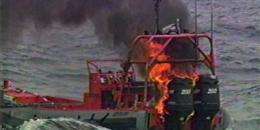
The Office of Naval Research successfully disables a small target vessel using a solid-state, high-energy laser mounted onto the deck of the Navy's self-defense test ship, former USS Paul Foster (DD 964). Credit: US Navy photograph
Marking a milestone for the Navy, the Office of Naval Research and its industry partner on April 6 successfully tested a solid-state, high-energy laser (HEL) from a surface ship, which disabled a small target vessel.
The Navy and Northrop Grumman completed at-sea testing of the Maritime Laser Demonstrator (MLD), which validated the potential to provide advanced self-defense for surface ships and personnel by keeping small boat threats at a safe distance.
"The success of this high-energy laser test is a credit to the collaboration, cooperation and teaming of naval labs at Dahlgren, China Lake, Port Hueneme and Point Mugu, Calif.," said Chief of Naval Research Rear Adm. Nevin Carr. "ONR coordinated each of their unique capabilities into one cohesive effort."
The latest test occurred near San Nicholas Island, off the coast of Central California in the Pacific Ocean test range. The laser was mounted onto the deck of the Navy's self-defense test ship, former USS Paul Foster (DD 964).
Carr also recognized the Office of the Secretary of Defense's High Energy Joint Technology Office and the Army's Joint High Powered Solid State Laser (JHPSSL) program for their work. MLD leverages the Army's JHPSSL effort.
"This is the first time a HEL, at these power levels, has been put on a Navy ship, powered from that ship and used to defeat a target at-range in a maritime environment," said Peter Morrison, program officer for ONR's MLD.
In just slightly more than two-and-a-half years, the MLD has gone from contract award to demonstrating a Navy ship defensive capability, he said.
"We are learning a ton from this program-how to integrate and work with directed energy weapons," Morrison said. "All test results are extremely valuable regardless of the outcome."
Additionally, the Navy accomplished several other benchmarks, including integrating MLD with a ship's radar and navigation system and firing an electric laser weapon from a moving platform at-sea in a humid environment. Other tests of solid state lasers for the Navy have been conducted from land-based positions.
Having access to a HEL weapon will one day provide warfighter with options when encountering a small-boat threat, Morrison said.
But while April's MLD test proves the ability to use a scalable laser to thwart small vessels at range, the technology will not replace traditional weapon systems, Carr added.
"From a science and technology point of view, the marriage of directed energy and kinetic energy weapon systems opens up a new level of deterrence into scalable options for the commander. This test provides an important data point as we move toward putting directed energy on warships. There is still much work to do to make sure it's done safely and efficiently," the admiral said.
Provided by Office of Naval Research
-
From lemons to lemonade: Reaction uses carbon dioxide to make carbon-based semiconductor,
32 comments
-
Thioridazine kills cancer stem cells in human while avoiding toxic side-effects of conventional cancer treatments,
3 comments
-
SpaceX private rocket blasts off for space station (Update),
42 comments
-
Climate scientists say they have solved riddle of rising sea,
30 comments
-
Research team claims to have found evidence Lake Cheko is impact crater for Tunguska Event,
18 comments
-
Need a rigid insulation material???
4 hours ago
-
magnets or EMF in car bumpers to protect from fender bender
21 hours ago
-
length of wire in a coil of known dimensions?
May 25, 2012
-
India Engineering Powerhouse
May 25, 2012
-
electromagnet core dereference between hard and soft iron
May 25, 2012
-
Measuring water pressure in an open tank
May 24, 2012
- More from Physics Forums - General Engineering
More news stories
SpotterRF debuts Radar Backpack Kit (w/ Video)
(Phys.org) -- SpotterRF has announced a special radar backpack kit designed to enhance situational awareness for soldiers on the ground. The company says its special radar is designed for warfighters as part ...
Probability of contamination from severe nuclear reactor accidents is higher than expected: study
Catastrophic nuclear accidents such as the core meltdowns in Chernobyl and Fukushima are more likely to happen than previously assumed. Based on the operating hours of all civil nuclear reactors and the number ...
Technology / Energy & Green Tech
May 22, 2012 |
3.6 / 5 (21) |
54
|
Delphi gasoline-injection engine technique rivals hybrid's edge
(Phys.org) -- Running a diesel like engine on gasoline is something Delphi is doing in notable fashion. They claim they are on to a promising way to enjoy an engine that gives the vehicle owner high efficiency ...
HyperSolar shows dirty water no barrier to power world
(Phys.org) -- The Santa Barbara, California, company, HyperSolar, is set to transparently share the ups and downs of its research experiences toward the companys ultimate vision, successfully producing ...
Tesla to launch electric sedan in US on June 22
Tesla Motors said Tuesday it would begin deliveries of "the world's first premium electric sedan" on June 22, slightly ahead of schedule.
Technology / Energy & Green Tech
May 22, 2012 |
4.5 / 5 (11) |
18
Scientist: Evolution debate will soon be history
(AP) -- Richard Leakey predicts skepticism over evolution will soon be history. Not that the avowed atheist has any doubts himself.
Dell tablet leak: 10.1-inch display, two-battery choice
(Phys.org) -- Headline after headline talks about vendors tablets in the wings as likely number-one contenders for the iPad. Such claims have justifiably been taken with a grain of salt, considering ...
SpaceX capsule has 'new car' smell, astronauts say (Update)
SpaceX's Dragon cargo vessel smells like a new car, said astronauts at the International Space Station after opening the hatches Saturday following the spacecraft's landmark mission to the orbiting lab.
Thousands of shellfish found dead in Peru
Thousands of crustaceans were found dead off the coast of Lima following the mystery mass death of dolphins and pelicans, the Peruvian Navy said Friday.
Astronomers seize last chance in lifetime for Venus Transit
Astronomers are gearing for one the rarest events in the Solar System: an alignment of Earth, Venus and the Sun that will not be seen for another 105 years.
Keep food safety in mind this memorial day weekend
(HealthDay) -- Picnics, parades and cookouts are as much a part of Memorial Day weekend as tributes to the United States' war veterans.
Apr 08, 2011
Rank: 5 / 5 (1)
Apr 08, 2011
Rank: 5 / 5 (1)
http://www.youtub...Qs4ct0c4
Edit: Thanks dilbert for proving my point. That we're interested in the videos; if available. ;)
Apr 08, 2011
Rank: not rated yet
If it's longer than a moment or two, what is the advantage this solution has over a kinetic weapon (gun)? aside from the way cool factor?
Apr 08, 2011
Rank: not rated yet
Apr 08, 2011
Rank: 1 / 5 (1)
Or simply put a piece of sheetmetal on top.
Apr 09, 2011
Rank: not rated yet
Apr 10, 2011
Rank: not rated yet
Apr 11, 2011
Rank: 3 / 5 (2)
Apr 11, 2011
Rank: not rated yet
At this point, the laser is used for non-lethal deterance so we can save the expendable ammunition for things we want to kill
Apr 11, 2011
Rank: not rated yet
The difficulty in hitting the target would be similar or even more difficult for the laser as it would have to hit the same spot on the target during the bobbing for an effect to take place, the gun would only need to be properly aligned once.
I see some great things we could do with a laser based weapons system, but i am not sure of why we would have it on a boat as opposed to satellites.
Then again if you want to take out a few satellites just launch a bag of gravel into space with a small explosive to spread out the gravel.
Apr 11, 2011
Rank: not rated yet
Lasers disperse over distance... therefore they absolutely do have an effective range... Though you did demonstrate the value of anonymity, just not in the way you intended.
Apr 11, 2011
Rank: 5 / 5 (1)
The military currently uses a high-speed minigun to shoot incoming missiles out of the sky but, in contrast to the laser, it takes thousands of rounds of extremely expensive and specialized ammunition from the minigun to get a reasonable chance of shooting the missile out of the sky. Not that we've reached the point that we can shoot a missile out of the sky with a laser but this seems to bring us closer to that reality.
Apr 11, 2011
Rank: not rated yet
Apr 17, 2011
Rank: not rated yet