New spin on graphene
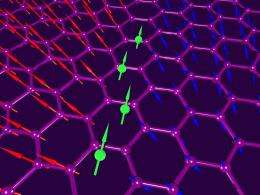
The image shows a flow of electrons (green arrows) which magnetises graphene in the opposite directions to the left and to the right from the current flow.
(PhysOrg.com) -- University of Manchester scientists have found a way to make wonder material graphene magnetic, opening up a new range of opportunities for the worlds thinnest material in the area of spintronics.
A team led by Professor Andre Geim, a recipient of the 2010 Nobel Prize for graphene, can now show that electric current a flow of electrons can magnetise graphene.
The results, reported in Science, could be a potentially huge breakthrough in the field of spintronics.
Spintronics is a group of emerging technologies that exploit the intrinsic spin of the electron, in addition to its fundamental electric charge that is exploited in microelectronics.
Billions of spintronics devices such as sensors and memories are already being produced. Every hard disk drive has a magnetic sensor that uses a flow of spins, and magnetic random access memory (MRAM) chips are becoming increasingly popular.
The findings are part of a large international effort involving research groups from the US, Russia, Japan and the Netherlands.
The key feature for spintronics is to connect the electron spin to electric current as current can be manipulated by means routinely used in microelectronics.
It is believed that, in future spintronics devices and transistors, coupling between the current and spin will be direct, without using magnetic materials to inject spins as it is done at the moment.
So far, this route has only been demonstrated by using materials with so-called spin-orbit interaction, in which tiny magnetic fields created by nuclei affect the motion of electrons through a crystal. The effect is generally small which makes it difficult to use.
The researchers found a new way to interconnect spin and charge by applying a relatively weak magnetic field to graphene and found that this causes a flow of spins in the direction perpendicular to electric current, making a graphene sheet magnetised.
The effect resembles the one caused by spin-orbit interaction but is larger and can be tuned by varying the external magnetic field.
The Manchester researchers also show that graphene placed on boron nitride is an ideal material for spintronics because the induced magnetism extends over macroscopic distances from the current path without decay.
The team believes their discovery offers numerous opportunities for redesigning current spintronics devices and making new ones such as spin-based transistors.
Professor Geim said: "The holy grail of spintronics is the conversion of electricity into magnetism or vice versa.
"We offer a new mechanism, thanks to unique properties of graphene. I imagine that many venues of spintronics can benefit from this finding."
Antonio Castro Neto, a physics professor from Boston who wrote a news article for the Science magazine which accompanies the research paper commented: "Graphene is opening doors for many new technologies.
"Not surprisingly, the 2010 Nobel Physics prize was awarded to Andre Geim and Kostya Novoselov for their groundbreaking experiments in this material.
"Apparently not satisfied with what they have accomplished so far, Geim and his collaborators have now demonstrated another completely unexpected effect that involves quantum mechanics at ambient conditions. This discovery opens a new chapter to the short but rich history of graphene".
More information: Giant Nonlocality Near the Dirac Point in Graphene, by D.A Abanin, S.V.Morozov, L. A Ponomarenko, R.V Gorbachev, A.S Mayorov, M.I Katsnelson, Kenji Watanabe, Takashi Taniguchi, K.S Novoselov, L.S Levitov and A.K Geim. http://www.science … 027/328.full
Provided by
University of Manchester
-
From lemons to lemonade: Reaction uses carbon dioxide to make carbon-based semiconductor,
32 comments
-
Thioridazine kills cancer stem cells in human while avoiding toxic side-effects of conventional cancer treatments,
3 comments
-
SpaceX private rocket blasts off for space station (Update),
42 comments
-
Climate scientists say they have solved riddle of rising sea,
30 comments
-
Research team claims to have found evidence Lake Cheko is impact crater for Tunguska Event,
18 comments
-
A Question relating Power
1 hour ago
-
Writing a book so im learning about things, i have some general questions please read
3 hours ago
-
Question about induced E field.
4 hours ago
-
Charging a capacitor in a tesla coil
4 hours ago
-
Water Rocket
8 hours ago
-
why do trucks have bigger brakes?
12 hours ago
- More from Physics Forums - General Physics
More news stories
Dopant gives graphene solar cells highest efficiency yet
(Phys.org) -- By taking advantage of graphenes favorable electrical and optical properties, and then adding an organic dopant, researchers have achieved the highest power conversion efficiency yet for ...
Nanomedicine: Quantum dots appear safe in pioneering study on primates
A pioneering study to gauge the toxicity of quantum dots in primates has found the tiny crystals to be safe over a one-year period, a hopeful outcome for doctors and scientists seeking new ways to battle diseases ...
Nanotechnology / Bio & Medicine
May 20, 2012 |
4.3 / 5 (3) |
8
|
In nanorod crystal growth, nanoparticles seen as artificial atoms
In the growth of crystals, do nanoparticles act as "artificial atoms" forming molecular-type building blocks that can assemble into complex structures? This is the contention of a major but controversial theory ...
May 24, 2012 |
4.8 / 5 (6) |
0
|
First direct observation of oriented attachment in nanocrystal growth
Berkeley Lab researchers have reported the first direct observation of nanoparticles undergoing oriented attachment, the critical step in biomineralization and the growth of nanocrystals. A better understanding ...
May 24, 2012 |
4.7 / 5 (3) |
0
|
Synthetic nano-waste does not disappear
(Phys.org) -- Tiny particles of cerium oxide do not burn or change in the heat of a waste incineration plant. They remain intact on combustion residues or in the incineration system, as a new study by Swiss ...
Nanotechnology / Bio & Medicine
May 25, 2012 |
5 / 5 (2) |
1
|
Scientist: Evolution debate will soon be history
(AP) -- Richard Leakey predicts skepticism over evolution will soon be history. Not that the avowed atheist has any doubts himself.
Dell tablet leak: 10.1-inch display, two-battery choice
(Phys.org) -- Headline after headline talks about vendors tablets in the wings as likely number-one contenders for the iPad. Such claims have justifiably been taken with a grain of salt, considering ...
SpotterRF debuts Radar Backpack Kit (w/ Video)
(Phys.org) -- SpotterRF has announced a special radar backpack kit designed to enhance situational awareness for soldiers on the ground. The company says its special radar is designed for warfighters as part ...
SpaceX capsule has 'new car' smell, astronauts say (Update)
SpaceX's Dragon cargo vessel smells like a new car, said astronauts at the International Space Station after opening the hatches Saturday following the spacecraft's landmark mission to the orbiting lab.
Thousands of shellfish found dead in Peru
Thousands of crustaceans were found dead off the coast of Lima following the mystery mass death of dolphins and pelicans, the Peruvian Navy said Friday.
Astronomers seize last chance in lifetime for Venus Transit
Astronomers are gearing for one the rarest events in the Solar System: an alignment of Earth, Venus and the Sun that will not be seen for another 105 years.
Apr 14, 2011
Rank: not rated yet
Apr 14, 2011
Rank: not rated yet
Apr 14, 2011
Rank: not rated yet