Fossil sirenians give scientists new look at ancient climate
April 21, 2011

Fossil sirenians give scientists new look at ancient climate

Enlarge

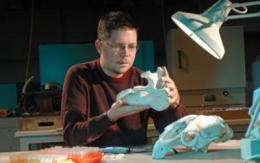
Geologist Mark Clementz samples tooth enamel from molars in the lower jaw of a Florida manatee. Credit: University of Wyoming

(PhysOrg.com) -- What tales they tell of their former lives, these old bones of sirenians, relatives of today's dugongs and manatees.

And now, geologists have found, they tell of the waters in which they swam.

While researching the evolutionary ecology of ancient sirenians--commonly known as sea cows--scientist Mark Clementz and colleagues unexpectedly stumbled across data that could change the view of climate during the Eocene Epoch, some 50 million years ago.

Clementz, from the University of Wyoming, published the results in a paper in this week's issue of the journal Science.

He and co-author Jacob Sewall of Kutztown University in Pennsylvania used their findings to dispute a popular scientific assumption about the temperature and composition of seawater during the time marked by the emergence of the first modern mammals.

The Sirenia, named for the sirens or mermaids of Greek myth, is an order of aquatic, plant-eating mammals that live in swamps, rivers, estuaries, marine wetlands and .

Four species of "" are alive today, in two families and genera: the dugong, with one species, and manatees with three species.

Sirenia also includes the Steller's sea cow, extinct since the 18th century, and others known only from fossil remains. The order evolved during the Eocene more than 50 million years ago.
Fossil sirenians give scientists new look at ancient climate
Enlarge

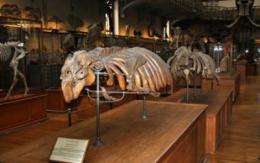
A fossil sirenian named Halitherium schinzi, shown at the Paris National Museum of Natural History. Credit: Mark Clementz

In their paper--"Latitudinal Gradients in Greenhouse Seawater δ18O: Evidence from Eocene Sirenian Tooth Enamel"--the scientists used the isotopic composition of sirenian fossils from a broad time period and geographic area, along with climate simulation data, to add to the long-running debate over Eocene climate.

"This study demonstrates the value of the fossil record, and of examining the deep time record of paleoclimatological events, so we can better understand climate change today," says Lisa Boush, program director in the National Science Foundation (NSF)'s Division of Earth Sciences, which funded the research.

"This novel approach will potentially transform our way of thinking about the hydrologic response to global climate change."

"I wasn't looking at it from this direction when we started the project," says Clementz, whose research is part of an NSF CAREER award.

"But once we started accumulating enough samples, we could step back and get a better understanding of the habitat and dietary preferences of these fossil species, and also of the big picture. We saw that it could be reflecting climate and environmental change."
Fossil sirenians give scientists new look at ancient climate
Enlarge

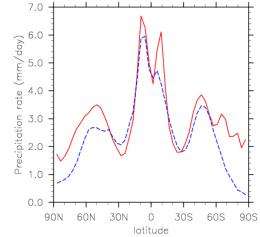
A comparison of zonally-averaged precipitation for the Eocene (red) and modern times (blue-dashed). Credit: Mark Clementz

A new look at climate during the Eocene, when Earth underwent a dramatic change, could help scientists better understand global climate change today.

Most scientists assumed that the oxygen isotopic composition of seawater in the past was very similar to that of today, with high values at low latitudes and low values at high latitudes.

Isotopes are variants of atoms of a particular chemical element, in this case oxygen, with differing numbers of neutrons.

"But when we looked at the oxygen isotopic values of the fossils from low-latitude sites for the Eocene, they were much lower than we would predict," says Clementz.

The finding suggests that low-latitude sites during the Eocene were much wetter than today.
Fossil sirenians give scientists new look at ancient climate
Enlarge

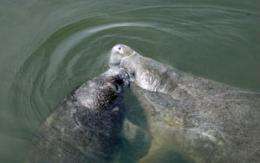
Manatees swim in Florida waters; their ancient relatives tell a story of climate change. Credit: Elizabeth Murdoch

"This created a very different distribution in the oxygen isotopic composition of seawater for this time interval, which would, in turn, significantly impact estimates of paleoclimate and paleotemperature in the distant past," says Clementz.

"Scientists have used this assumption of the oxygen isotopic values of to constrain temperature estimates for the past."

In their paper, Clementz and Sewall show that the assumption may be flawed, which could mean that previous estimates of water temperature are incorrect.

More information: Latitudinal Gradients in Greenhouse Seawater δ18O: Evidence from Eocene Sirenian Tooth Enamel, Science 22 April 2011: Vol. 332 no. 6028 pp. 455-458 DOI: 10.1126/science.1201182

ABSTRACT
The Eocene greenhouse climate state has been linked to a more vigorous hydrologic cycle at mid- and high latitudes; similar information on precipitation levels at low latitudes is, however, limited. Oxygen isotopic fluxes track moisture fluxes and, thus, the δ18O values of ocean surface waters can provide insight into hydrologic cycle changes. The offset between tropical δ18O values from sampled Eocene sirenian tooth enamel and modern surface waters is greater than the expected 1.0 per mil increase due to increased continental ice volume. This increased offset could result from suppression of surface-water δ18O values by a tropical, annual moisture balance substantially wetter than that of today. Results from an atmospheric general circulation model support this interpretation and suggest that Eocene low latitudes were extremely wet.

Provided by National Science Foundation search and more info website

3.6 /5 (5 votes)  

Filter


Move the slider to adjust rank threshold, so that you can hide some of the comments.


Display comments: newest first

lifewebb
Apr 21, 2011

Rank: not rated yet
Wish the article would tell us if the estimates are too high or too low. I cannot tell from reading this article and so would have to run off to do more research. Would like it the writer would think of the reader who is NOT an expert in the Eocene and just add a couple of sentences or references to help us. Thanks!
emsquared
Apr 21, 2011

Rank: 4 / 5 (1)
It doesn't tell you that information because I don't think they went that far in their paper, they're just saying their findings indicate that the assumptions commonly used to estimate paleo-historical temperature from that epoch could be the wrong assumptions. They're not doing the reinterpretation as a part of this study...

It sounds like the wrong assumption is; they've previously thought the climate was drier back then than this sirenian evidence indicates.

And while I'm sure they've done their due-diligence, I'd like to see some error bars on those peaks on that graph...
Avitar
Apr 22, 2011

Rank: not rated yet
Yes some error bars would be nice. They seem to indicate a finding of a warmer as well as wetter climate than expected.
Rank 3.6 /5 (5 votes)
Relevant PhysicsForums posts

More news stories

SpaceX capsule has 'new car' smell, astronauts say (Update)

SpaceX's Dragon cargo vessel smells like a new car, said astronauts at the International Space Station after opening the hatches Saturday following the spacecraft's landmark mission to the orbiting lab.

Space & Earth / Space Exploration

created 19 hours ago | popularity 4.5 / 5 (20) | comments 0

Astronomers seize last chance in lifetime for Venus Transit

Astronomers are gearing for one the rarest events in the Solar System: an alignment of Earth, Venus and the Sun that will not be seen for another 105 years.

Space & Earth / Astronomy

created 19 hours ago | popularity 5 / 5 (3) | comments 2

Australia hails surprise super-telescope decision

Australia has hailed a surprise decision giving it a role in a radio telescope project aimed at revolutionising astronomy, vowing to draw on its decades of experience in space science.

Space & Earth / Astronomy

created 19 hours ago | popularity 5 / 5 (4) | comments 1

Astronauts enter world's 1st private supply ship

(AP) -- Space station astronauts floated into the Dragon on Saturday, a day after its heralded arrival as the world's first commercial supply ship.

Space & Earth / Space Exploration

created 19 hours ago | popularity 5 / 5 (5) | comments 0

Sophisticated simulations predict future warming

The chances of our planet being hit by a global warming of 3 degrees Celsius by 2050 is as likely as it being hit by an increase of 1.4 degrees, new research shows. Presented in the journal Nature Geoscience, the British study ...

Space & Earth / Earth Sciences

created May 22, 2012 | popularity 4.4 / 5 (9) | comments 51


Scientist: Evolution debate will soon be history

(AP) -- Richard Leakey predicts skepticism over evolution will soon be history. Not that the avowed atheist has any doubts himself.

Dell tablet leak: 10.1-inch display, two-battery choice

(Phys.org) -- Headline after headline talks about vendors’ tablets in the wings as likely number-one contenders for the iPad. Such claims have justifiably been taken with a grain of salt, considering ...

SpotterRF debuts Radar Backpack Kit (w/ Video)

(Phys.org) -- SpotterRF has announced a special radar backpack kit designed to enhance situational awareness for soldiers on the ground. The company says its special radar is designed for warfighters as part ...

Thousands of shellfish found dead in Peru

Thousands of crustaceans were found dead off the coast of Lima following the mystery mass death of dolphins and pelicans, the Peruvian Navy said Friday.

Keep food safety in mind this memorial day weekend

(HealthDay) -- Picnics, parades and cookouts are as much a part of Memorial Day weekend as tributes to the United States' war veterans.

Family history of Alzheimer's affects functional connectivity

(HealthDay) -- Cognitively normal individuals with a family history of late-onset Alzheimer's disease (AD) may display lower resting state functional connectivity in the default mode network (DMN) of the brain, ...