Review: Eye-Fi card makes cameras talk to phones
If you're old enough, you probably used to marvel that digital cameras could show a picture right after it was shot, eliminating the need for a trip to the photo store. Now, they look nearly as dated as fax machines, as smartphones allow instant sharing of photos through the magic of wireless uploads and Facebook.
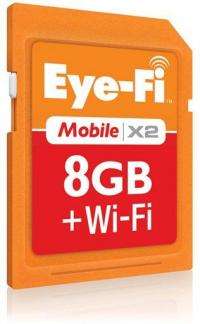
But there is a way for the good old-fashioned digital camera to catch up a bit and remain relevant. A company called Eye-Fi Inc. makes an SD memory card that fits most cameras. Through a nifty bit of engineering, it can send images directly to smartphones and tablet computers as they are shot.
You get the benefits of a standalone camera - its zoom, its strong flash, its high-resolution sensor and other features that trump the smartphone - with the ability to post photos right away. It works with videos, too.
Well, you get all that under ideal circumstances. In testing the Eye-Fi card and its new Direct Mode, I encountered some problems.
It's still worth a look, though.
The Eye-Fi is designed to send photos to iPhones, iPads and devices that use Google Inc.'s Android software. Working with an iPhone and iPad proved cumbersome and unreliable. The process was much easier on an Android phone or tablet, but I still had glitches.
The stamp-sized Eye-Fi card, which starts at $50, works like a miniature Wi-Fi router, producing a "hot spot" that stretches about 10 feet around the camera. The phone or tablet then latches on to that hot spot, and the free Eye-Fi application starts pulling over the photos (or video).
Images end up in the phone's Gallery or Camera Roll, where photos shot with the built-in camera also go. From there, they can be emailed, picture messaged or posted to photo-sharing sites.
On the Android-powered Samsung Galaxy S 4G phone and Motorola Xoom tablet, this mostly worked elegantly. The Eye-Fi app on the Android device stayed in the background, sensing when the camera was trying to communicate. It automatically made a wireless connection to the memory card's hot spot and notified me when the pictures had been transferred. In the meantime, I could use other apps.
However, the app on the Xoom often crashed, forcing me to wipe out my settings and start over.
Apple's devices are much less friendly to the Eye-Fi. Apple doesn't let apps do much in the background, while other apps are working. To start a transfer, you have to first make sure the device is connected to the hot spot, then start the Eye-Fi application. Only when the transfer is done can you close out of the app.
This gets extra fiddly if you're using another Wi-Fi hot spot for Internet access because you have to switch the connection back and forth between that hot spot and the camera's. Even when I went through this whole ritual, the Eye-Fi often failed to send photos to my iPad.
The reasons are unclear, but the problem highlighted another weakness in the system. The camera doesn't give you the slightest bit of help in figuring out what's going on because it was never designed to work with the Eye-Fi. There are no camera controls and no screen indicators to tell you a transfer is ongoing, or if not, what the problem is. The most you can do is turn the camera on and off to see if that might fix it, which was about as effective as kicking a vending machine.
This lack of responsiveness is particularly galling when using the Eye-Fi in the way it originally launched.
The Eye-Fi has been on sale for a few years - it's just the Direct Mode that's new. In the original mode of operation, rather than create a hot spot, the cards connect to an existing one, such as your home Wi-Fi router. It then transfers the images to a website or a folder on your computer. But the camera doesn't give you a clue whether this is happening or not.
Because Direct Mode frees the cards from being tied to particular hotspots, I expect it to be the default mode for users from now on. Older cards can be upgraded to Direct Mode capability as long as they have an "X2" designation.
I should point out that even if the Eye-Fi fails to transfer your photos wirelessly, they're not lost. The Eye-Fi works like a standard memory card too, storing every photo that's shot. The only caveat is that it may not work in your PC's built-in SD card slot because of differences in the electronics. You may need to use a card reader, which is included and sticks into a USB port.
There's another limitation to the Eye-Fi as well. Don't expect to be able to see every pixel in your high-resolution photos just because you've moved them over to a tablet with a big screen. The photos are moved over in full resolution, but won't display on the phone or tablet that way. This will disappoint photographers who want to check details and sharpness.
Despite its lack of reliability and some shortcomings, I think you'll find the Eye-Fi useful if you're a camera bug and have an Android phone.
Owners of iPhones and iPads will be better served by Apple's Camera Connection Kit, which costs $29. It's simply a memory-card reader that attaches to the USB port, so there's no need to fiddle with a camera that has no idea it's been kicked into the future and is now a wireless device.
©2011 The Associated Press. All rights reserved. This material may not be published, broadcast, rewritten or redistributed.


