Organic 2-D films could lead to better solar cells
April 12, 2011 By Lauren Gold
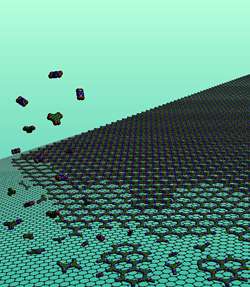
Molecular building blocks assemble on graphene to provide oriented and ordered covalent organic frameworks. (Fernando Uribe-Romo)
(PhysOrg.com) -- Solar cells made from organic materials are inexpensive, lightweight and flexible, but their performance lags behind cells that contain silicon or other inorganic materials. Cornell chemist William Dichtel and colleagues have found a way to synthesize ordered organic films that could be a major step toward solving this problem.
It's the first time researchers have been able to coax materials known as covalent organic frameworks (COFs) out of their common powdered form into flat sheets of precisely ordered molecules on a conductive surface. That clears a major hurdle toward using COFs to replace the more expensive, less versatile materials used in solar cells and other electronics today.
The research appears in the April 8 issue of Science.
COFs have a variety of properties that are not found in traditional organic polymers, including excellent thermal stability, high surface area and permanent porosity. But while researchers have identified them as intriguing candidates for such devices, they have been hamstrung by the fact that the materials normally exist only as insoluble powders.
Dichtel, assistant professor of chemistry and chemical biology, and colleagues developed a simple process for growing thin (25-400 nanometers thick) films of COFs on a surface of graphene, a single-atom-thick sheet of carbon. They used X-ray diffraction at the Cornell High Energy Synchrotron Source (CHESS) to determine the materials' structure and orientation. The COFs grow as continuous films of well ordered, stacked layers on the graphene surfaces.
Unlike the powder form, the films grown on transparent surfaces can be probed using modern optical measurements. Researchers can also vary the properties of the frameworks by altering the structure of their components.
"These materials are so versatile -- we can tune the properties rationally, rather than relying on molecules to pack into films unpredictably," Dichtel said.
To demonstrate, the researchers created three variations of the frameworks. Of the three, one shows particular promise for solar cells -- it uses molecules called phthalocyanines, which are commonly found in industrial dyes used in products from blue jeans to ink pens.
Phthalocyanines, which are related to chlorophyll, absorb light over most of the solar spectrum -- a rare property for a single organic material.
"Obtaining these materials as films on electrode materials is a major step toward studying and using them in devices," Dichtel said. "This method represents a general way to assemble molecules on surfaces predictably. This work opens the door to take these materials in many other directions."
Provided by
Cornell University
-
From lemons to lemonade: Reaction uses carbon dioxide to make carbon-based semiconductor,
32 comments
-
Thioridazine kills cancer stem cells in human while avoiding toxic side-effects of conventional cancer treatments,
3 comments
-
SpaceX private rocket blasts off for space station (Update),
42 comments
-
Climate scientists say they have solved riddle of rising sea,
30 comments
-
Research team claims to have found evidence Lake Cheko is impact crater for Tunguska Event,
18 comments
-
microstructure of titanium
11 hours ago
-
Steam in My Espresso Machine
17 hours ago
-
Density question
May 24, 2012
-
Mass transport originating from a point source at a solid gas interface
May 22, 2012
-
Ammonia dispersion in Air
May 22, 2012
-
Multi Choice Help
May 21, 2012
- More from Physics Forums - Materials & Chemical Engineering
More news stories
Dopant gives graphene solar cells highest efficiency yet
(Phys.org) -- By taking advantage of graphenes favorable electrical and optical properties, and then adding an organic dopant, researchers have achieved the highest power conversion efficiency yet for ...
Nanomedicine: Quantum dots appear safe in pioneering study on primates
A pioneering study to gauge the toxicity of quantum dots in primates has found the tiny crystals to be safe over a one-year period, a hopeful outcome for doctors and scientists seeking new ways to battle diseases ...
Nanotechnology / Bio & Medicine
May 20, 2012 |
4.3 / 5 (3) |
8
|
In nanorod crystal growth, nanoparticles seen as artificial atoms
In the growth of crystals, do nanoparticles act as "artificial atoms" forming molecular-type building blocks that can assemble into complex structures? This is the contention of a major but controversial theory ...
May 24, 2012 |
4.8 / 5 (6) |
0
|
First direct observation of oriented attachment in nanocrystal growth
Berkeley Lab researchers have reported the first direct observation of nanoparticles undergoing oriented attachment, the critical step in biomineralization and the growth of nanocrystals. A better understanding ...
May 24, 2012 |
4.7 / 5 (3) |
0
|
Synthetic nano-waste does not disappear
(Phys.org) -- Tiny particles of cerium oxide do not burn or change in the heat of a waste incineration plant. They remain intact on combustion residues or in the incineration system, as a new study by Swiss ...
Nanotechnology / Bio & Medicine
May 25, 2012 |
5 / 5 (2) |
1
|
Scientist: Evolution debate will soon be history
(AP) -- Richard Leakey predicts skepticism over evolution will soon be history. Not that the avowed atheist has any doubts himself.
Dell tablet leak: 10.1-inch display, two-battery choice
(Phys.org) -- Headline after headline talks about vendors tablets in the wings as likely number-one contenders for the iPad. Such claims have justifiably been taken with a grain of salt, considering ...
SpotterRF debuts Radar Backpack Kit (w/ Video)
(Phys.org) -- SpotterRF has announced a special radar backpack kit designed to enhance situational awareness for soldiers on the ground. The company says its special radar is designed for warfighters as part ...
SpaceX capsule has 'new car' smell, astronauts say (Update)
SpaceX's Dragon cargo vessel smells like a new car, said astronauts at the International Space Station after opening the hatches Saturday following the spacecraft's landmark mission to the orbiting lab.
Thousands of shellfish found dead in Peru
Thousands of crustaceans were found dead off the coast of Lima following the mystery mass death of dolphins and pelicans, the Peruvian Navy said Friday.
Astronomers seize last chance in lifetime for Venus Transit
Astronomers are gearing for one the rarest events in the Solar System: an alignment of Earth, Venus and the Sun that will not be seen for another 105 years.
Apr 12, 2011
Rank: 4 / 5 (1)
Another "could lead to better solar cells" article.
Hell, if they all teamed up, they should be able to get at least 90% efficiency by now, because EVERYONE seems to have an improvement.