3-D nanocone solar cell technology cranks up efficiency
April 29, 2011

3-D nanocone solar cell technology cranks up efficiency

Enlarge

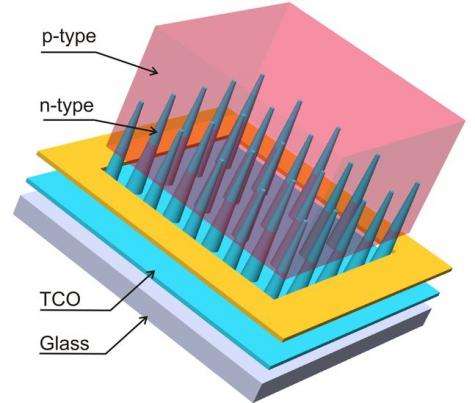
Nanocone-based solar cell consisting of n-type nanocones, p-type matrix, transparent conductive oxide (TCO) and glass substrate.

(PhysOrg.com) -- With the creation of a 3-D nanocone-based solar cell platform, a team led by Oak Ridge National Laboratory's Jun Xu has boosted the light-to-power conversion efficiency of photovoltaics by nearly 80 percent.

The technology substantially overcomes the problem of poor transport of charges generated by solar photons. These charges -- negative electrons and positive holes -- typically become trapped by defects in bulk materials and their interfaces and degrade performance.

"To solve the entrapment problems that reduce , we created a nanocone-based solar cell, invented methods to synthesize these cells and demonstrated improved charge collection efficiency," said Xu, a member of ORNL's Chemical Sciences Division.

The new solar structure consists of n-type nanocones surrounded by a p-type semiconductor. The n-type nanoncones are made of and serve as the junction framework and the electron conductor. The p-type matrix is made of polycrystalline and serves as the primary photon absorber medium and hole conductor.

With this approach at the laboratory scale, Xu and colleagues were able to obtain a light-to-power conversion efficiency of 3.2 percent compared to 1.8 percent efficiency of conventional planar structure of the same materials.

"We designed the three-dimensional structure to provide an intrinsic electric field distribution that promotes efficient charge transport and high efficiency in converting energy from sunlight into electricity," Xu said.

Key features of the solar material include its unique electric field distribution that achieves efficient charge transport; the synthesis of nanocones using inexpensive proprietary methods; and the minimization of defects and voids in semiconductors. The latter provides enhanced electric and optical properties for conversion of solar photons to electricity.

Because of efficient charge transport, the new solar cell can tolerate defective materials and reduce cost in fabricating next-generation .

"The important concept behind our invention is that the nanocone shape generates a high in the vicinity of the tip junction, effectively separating, injecting and collecting minority carriers, resulting in a higher efficiency than that of a conventional planar cell made with the same materials," Xu said.

Research that forms the foundation of this technology was accepted by this year's Institute of Electrical and Electronics Engineers photovoltaic specialist conference and will be published in the IEEE Proceedings. The papers are titled "Efficient Charge Transport in Nanocone Tip-Film Solar Cells" and "Nanojunction solar cells based on polycrystalline CdTe films grown on ZnO nanocones."

Provided by Oak Ridge National Laboratory search and more info website

4.7 /5 (13 votes)  

Filter


Move the slider to adjust rank threshold, so that you can hide some of the comments.


Display comments: newest first

fmfbrestel
Apr 29, 2011

Rank: 2 / 5 (3)
With this approach at the laboratory scale, Xu and colleagues were able to obtain a light-to-power conversion efficiency of 3.2 percent compared to 1.8 percent efficiency of conventional planar structure of the same materials.

3.2% does not seem like a very high conversion rate. I thought state of the art was 30-40%? Normally these articles are all exaggerated PR b.s., but I seem to missing the importance of this advance. Can someone try to tell me what I'm not getting about this?
RealScience
Apr 29, 2011

Rank: 3.7 / 5 (3)
They took a poor PV material and made it less poor.
If this same trick works on good PV materials, it might make them very good.
Good materials like crystalline silicon are near their theorectical limts already, so this is most likely to help thin film PV. If lucky this will be applicable to amorphous silicon.

But it is a real stretch because to be useful for thin-film PV, the cost per square meter has to be very low.

The 40% cells you refer to are on the opposite end of the price range - very efficient (and still improving rapidly), but very expensive so they need lenses or mirrors to concentrate sunlight 300x-1200x onto them to reduce the area needed.
wealthychef
Apr 30, 2011

Rank: 5 / 5 (1)
What we need is low cost per kWh, and low carbon footprint. Whether it's solar or not I don't care!
Winghunter
May 01, 2011

Rank: 1 / 5 (1)
"Low carbon footprint"?? You have internet access yet you're STILL assisting that worldwide con?

Breaking News: Global Warming Consensus was only 75 scientists worldwide bit.ly/eq5GBK

Princeton Physics Professor: Global warming really population-control movement bit.ly/4wx7fR

fmfbrestel
May 01, 2011

Rank: 5 / 5 (1)
Thanks Realscience. I dont follow PV science very close, and this articled didn't help me connect the dots at all. Your explanation was very clear and concise.
eigenbasis
May 01, 2011

Rank: 3 / 5 (1)
The 40% cells you refer to are on the opposite end of the price range - very efficient (and still improving rapidly), but very expensive so they need lenses or mirrors to concentrate sunlight 300x-1200x onto them to reduce the area needed.


All the 40% cells I'm aware of use multi-junctions that are stacked and together accept wider wavelength bands
SmarterThanYou
May 02, 2011

Rank: 1 / 5 (1)
This work is garbage. For starters, no one uses cadmium telluride/zinc oxide solar cells because (a) the material system is toxic and so even First Solar is moving away from CdTe based cells due to EU requirements & liability and (b) commercial a-Si is more than double the efficiency these guys show and will always be cheaper to make than CdTe/ZnO cells. This article is just another example how much money is being wasted due to the huge influx of money DoE has injected into the field.
Rank 4.7 /5 (13 votes)
Relevant PhysicsForums posts
  • Writing a book so im learning about things, i have some general questions please read
    created2 hours ago
  • Question about induced E field.
    created3 hours ago
  • Charging a capacitor in a tesla coil
    created3 hours ago
  • Water Rocket
    created7 hours ago
  • why do trucks have bigger brakes?
    created12 hours ago
  • Solar Sail Physics - Do they work on a large scale?
    created12 hours ago
  • More from Physics Forums - General Physics

More news stories

Dopant gives graphene solar cells highest efficiency yet

(Phys.org) -- By taking advantage of graphene’s favorable electrical and optical properties, and then adding an organic dopant, researchers have achieved the highest power conversion efficiency yet for ...

Nanotechnology / Nanophysics

created May 21, 2012 | popularity 5 / 5 (10) | comments 14 | with audio podcast feature

Nanomedicine: Quantum dots appear safe in pioneering study on primates

A pioneering study to gauge the toxicity of quantum dots in primates has found the tiny crystals to be safe over a one-year period, a hopeful outcome for doctors and scientists seeking new ways to battle diseases ...

Nanotechnology / Bio & Medicine

created May 20, 2012 | popularity 4.3 / 5 (3) | comments 8 | with audio podcast

In nanorod crystal growth, nanoparticles seen as artificial atoms

In the growth of crystals, do nanoparticles act as "artificial atoms" forming molecular-type building blocks that can assemble into complex structures? This is the contention of a major but controversial theory ...

Nanotechnology / Nanophysics

created May 24, 2012 | popularity 4.8 / 5 (6) | comments 0 | with audio podcast

First direct observation of oriented attachment in nanocrystal growth

Berkeley Lab researchers have reported the first direct observation of nanoparticles undergoing oriented attachment, the critical step in biomineralization and the growth of nanocrystals. A better understanding ...

Nanotechnology / Nanophysics

created May 24, 2012 | popularity 4.7 / 5 (3) | comments 0 | with audio podcast

Synthetic nano-waste does not disappear

(Phys.org) -- Tiny particles of cerium oxide do not burn or change in the heat of a waste incineration plant. They remain intact on combustion residues or in the incineration system, as a new study by Swiss ...

Nanotechnology / Bio & Medicine

created May 25, 2012 | popularity 5 / 5 (2) | comments 1 | with audio podcast


Scientist: Evolution debate will soon be history

(AP) -- Richard Leakey predicts skepticism over evolution will soon be history. Not that the avowed atheist has any doubts himself.

Dell tablet leak: 10.1-inch display, two-battery choice

(Phys.org) -- Headline after headline talks about vendors’ tablets in the wings as likely number-one contenders for the iPad. Such claims have justifiably been taken with a grain of salt, considering ...

SpotterRF debuts Radar Backpack Kit (w/ Video)

(Phys.org) -- SpotterRF has announced a special radar backpack kit designed to enhance situational awareness for soldiers on the ground. The company says its special radar is designed for warfighters as part ...

SpaceX capsule has 'new car' smell, astronauts say (Update)

SpaceX's Dragon cargo vessel smells like a new car, said astronauts at the International Space Station after opening the hatches Saturday following the spacecraft's landmark mission to the orbiting lab.

Thousands of shellfish found dead in Peru

Thousands of crustaceans were found dead off the coast of Lima following the mystery mass death of dolphins and pelicans, the Peruvian Navy said Friday.

Astronomers seize last chance in lifetime for Venus Transit

Astronomers are gearing for one the rarest events in the Solar System: an alignment of Earth, Venus and the Sun that will not be seen for another 105 years.