Did clay mould life's origins?
April 4, 2011 By Cath Harris
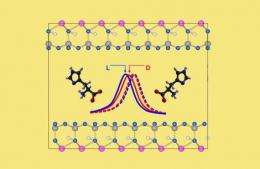
Clay's layered structure interacts differently with left- and right-handed versions of histidine, an amino acid.
(PhysOrg.com) -- An Oxford University scientist has taken our understanding of the origin of life a step further.
Professor Don Fraser from the Department of Earth Sciences has carried out neutron scattering experiments to try to find out more about the role of geochemistry in determining the origin of our amino acids key building blocks of life on Earth and specifically why the DNA-coded amino acids that make up our proteins are all left-handed.
There are two varieties of amino acids, known as left- or right-handed (referred to as S and R). They are mirror images of each other and both exist in nature, as shown for other substances by Louis Pasteur.
Biochemical processes in living organisms use left- and right-handed or chiral receptors that template differently with these two forms. The olfactory receptors in our noses, for example, easily distinguish the distinct smells of the otherwise identical molecules (called carvones) of spearmint (R-carvone) and caraway (S-carvone).
Another example is the thalidomide tragedy that was related to the presence in the drug of both the mirror-image forms. One of these (S) was later understood to be harmful.
An important and outstanding mystery is why nature chooses only exclusively left-handed amino acids in forming proteins.
In the late 19th century, TH Huxley and Charles Darwin realised that life may have begun abiotically in a warm little pond containing all the elements needed for life, so that a protein compound was chemically formed ready to undergo still more complex changes, Darwin wrote.
Much later, in 1924, the Soviet scientist Alexander Oparin returned to the idea of spontaneous generation, suggesting that a primeval soup of organic molecules, created by the action of sunlight in an oxygen-free environment, was the basis of all life.
Electric spark experiments subsequently carried out by Stanley Miller in model primeval atmospheres showed that amino acids form in lightning discharges. In contrast to biological systems, these show no preference for either mirror image form and are 50%:50% (racemic) mixtures.
Clay was suggested by the crystallographer John Bernal as a means of concentrating primitive biomolecules onto its surface so as to be available for further reactions. Clays again became the focus of studies more recently when James Ferris showed that they can act as catalysts for the formation of long strands of RNA, which with proteins and DNA are major compounds essential for the origin of life.
In a second paper, also published in Physical Chemistry Chemical Physics, Professor Fraser has extended these ideas to consider amino acids and to try to understand why all amino acids used to make proteins are left-handed.
With colleagues Professor Neal Skipper from UCL, Dr Martin Smalley from York University and Dr Chris Greenwell from Durham University he replaced the cations between the layers making up natural clay molecules with weakly bound organic cations, causing the clay layers to drift apart.
That created an extremely sensitive clay system with sufficient space to insert both left-handed and right-handed forms of the amino acid histidine between the layers.
"We found that the R- and S-histidine molecules interact differently with the clay surfaces. These clays are abiotically able to select for chirality left- or right-handedness as well as being implicated in the abiotic synthesis of RNA," Professor Fraser says. "Our experiments were the first to show that clay molecules could do that.
"We also found that the tiny interlayer space some 5nm wide was a very important dynamic region for studying prebiotic chemistry and that the reactions of simple chemicals there leads to the formation both of RNA oligomers and the selection of left-handed amino acids.
Clays have also been shown by Jack Szostak and others to enable fatty acids to form primitive cells and, interestingly, clays show similar selective behaviour in space, as reported recently by the NASA scientists Glavin and Dworkin.
Amino acids contained in the meteorites Murchison and Orgueil show enrichment in S-amino acids and this correlates with the amount of intrinsic hydrous clay present in these primitive meteorites that are 4.55 billion years old. The amino acid studied isovaline cannot be a contaminant as it is not found in terrestrial living systems, Professor Fraser explains. We are thus building an increasingly detailed picture of the steps that lead to the origin of life.
"We are continuing our research next month on the new NIMROD instrument at the ISIS neutron source near Oxford. This will involve amino acids enriched in deuterium, an isotope of hydrogen, and will provide a detailed atomic picture of the way amino acids interact with the layers of clay for the first time.
"In the long term, this work could have significant applications not only for our understanding of the origin of life, but also in medicine as the design of new mineral surfaces that aid the production of chiral drugs would be of great benefit to the pharmaceutical industry."
Provided by
Oxford University
-
From lemons to lemonade: Reaction uses carbon dioxide to make carbon-based semiconductor,
32 comments
-
Thioridazine kills cancer stem cells in human while avoiding toxic side-effects of conventional cancer treatments,
3 comments
-
SpaceX private rocket blasts off for space station (Update),
42 comments
-
Climate scientists say they have solved riddle of rising sea,
30 comments
-
Research team claims to have found evidence Lake Cheko is impact crater for Tunguska Event,
18 comments
-
Schwartz reagent-- NMR/MS/IR
17 hours ago
-
Inversion temp
22 hours ago
-
High school chemistry EEI
May 25, 2012
-
oxidation of I- by KMnO4
May 25, 2012
-
Invesion temp
May 25, 2012
-
Hybridization of SnCl3 -
May 25, 2012
- More from Physics Forums - Chemistry
More news stories
From lemons to lemonade: Reaction uses carbon dioxide to make carbon-based semiconductor
(Phys.org) -- A materials scientist at Michigan Technological University has discovered a chemical reaction that not only eats up the greenhouse gas carbon dioxide, it also creates something useful. And, by ...
May 21, 2012 |
4.7 / 5 (88) |
32
|
New CO2-removing catalyst can take the heat
(Phys.org) -- The current method of removing the greenhouse gas carbon dioxide (CO2) from the flues of coal-fired power plants uses so much energy that no one bothers to use it. So says Roger Aines, principal ...
May 24, 2012 |
5 / 5 (7) |
7
|
High-speed method to aid search for solar energy storage catalysts
Eons ago, nature solved the problem of converting solar energy to fuels by inventing the process of photosynthesis.
May 25, 2012 |
5 / 5 (3) |
4
|
Researchers demonstrate possible primitive mechanism of chemical info self-replication
(Phys.org) -- When scientists think about the replication of information in chemistry, they usually have in mind something akin to what happens in living organisms when DNA gets copied: a double-stranded molecule ...
May 25, 2012 |
5 / 5 (4) |
2
|
Castor oil: Action mechanism of one of the oldest drugs known to man elucidated
Castor oil is known primarily as an effective laxative; however, it was also used in ancient times with pregnant women to induce labour. Only now have scientists at the Max Planck Institute for Heart and Lung ...
May 21, 2012 |
3 / 5 (2) |
3
|
Scientist: Evolution debate will soon be history
(AP) -- Richard Leakey predicts skepticism over evolution will soon be history. Not that the avowed atheist has any doubts himself.
Dell tablet leak: 10.1-inch display, two-battery choice
(Phys.org) -- Headline after headline talks about vendors tablets in the wings as likely number-one contenders for the iPad. Such claims have justifiably been taken with a grain of salt, considering ...
SpotterRF debuts Radar Backpack Kit (w/ Video)
(Phys.org) -- SpotterRF has announced a special radar backpack kit designed to enhance situational awareness for soldiers on the ground. The company says its special radar is designed for warfighters as part ...
SpaceX capsule has 'new car' smell, astronauts say (Update)
SpaceX's Dragon cargo vessel smells like a new car, said astronauts at the International Space Station after opening the hatches Saturday following the spacecraft's landmark mission to the orbiting lab.
Thousands of shellfish found dead in Peru
Thousands of crustaceans were found dead off the coast of Lima following the mystery mass death of dolphins and pelicans, the Peruvian Navy said Friday.
Astronomers seize last chance in lifetime for Venus Transit
Astronomers are gearing for one the rarest events in the Solar System: an alignment of Earth, Venus and the Sun that will not be seen for another 105 years.
Apr 04, 2011
Rank: 0.9 / 5 (59)
Apr 04, 2011
Rank: 1.5 / 5 (13)
Apr 04, 2011
Rank: 4.7 / 5 (21)
Let's not get silly on the article for once.
Apr 04, 2011
Rank: not rated yet
Apr 04, 2011
Rank: not rated yet
Would that be aluminium silicate dust, or perhaps equally ordinary silicon dioxide, or other finely ground up minerals?
Apr 04, 2011
Rank: 5 / 5 (5)
Apr 04, 2011
Rank: 5 / 5 (3)
And on the equator it depends on which way you spin yourself.
Apr 04, 2011
Rank: 3.7 / 5 (3)
Well said SH!
Apr 04, 2011
Rank: 4.6 / 5 (10)
Apr 04, 2011
Rank: not rated yet
The term, "clay" is also in at least some translations.
Apr 04, 2011
Rank: 4 / 5 (5)
Don't know about the cockatrice, born of a hen's egg, that kills with a glance, but the world had 4 corners, was centered on Jerusalem and Leviathan ruled the deep.
I don't have a problem with Creative Design as long as you're speculating about the physicists in another Universe who designed the particle accelerator or black hole generator that created the singularity that became our Universe.
Other than that? Meh.
Apr 04, 2011
Rank: 1.5 / 5 (2)
Apr 04, 2011
Rank: 1 / 5 (7)
Apr 04, 2011
Rank: 5 / 5 (6)
You probably changed pages too quickly in your zealous fervor to spread this 'scientific discovery'.
Apr 04, 2011
Rank: 3 / 5 (2)
Apr 04, 2011
Rank: not rated yet
Perhaps somewhere, but I think it is getting more difficult to ignore the possibility that life has been raining down on old Mother Earth for 4.5GY.
Apr 05, 2011
Rank: 1 / 5 (13)
Note that once again the researcher had to interfere with what was available in nature. So NOTHING spontaneous can occur here!
Hence one can point out that any other research done on the modified clay and any results obtained will be as questionable as the study itself. Life is simply far too complex to have ever arisen spontaneously out of some chemical soup.
The real mystery is why human beings continue to want life to have arisen spontaneously when all the latest research points to ever-increasing complexity in even the simplest of cells.
Nature cannot "choose", only a living intelligent mind can do that. So when will the researcher[and other evolutionists] wake up to there having been a creator?
Apr 05, 2011
Rank: 5 / 5 (7)
"You evidence-based guys think life just sort of magically popped into existence. No way."
"OK then, how did it happen?"
"It magically popped into existence, of course."
Apr 05, 2011
Rank: 5 / 5 (2)
Scientists and other like-minded individuals (you might call them evolutionists) require Proof before we call something a Fact.
Provide me indisputable proof of your god and i'll go along with it. Until you can do that Religion will continue to wallow in in faith and hope - Neither of which are helpful AT ALL in science.
Most folks who go to church, believe in god, and consider themselves religious, also believe in modern science (Including Evolution). Those who do not, are really just fooling themselves into thinking they're anything but a fringe minority, laughed at even by their fellow Christians.
Do you also think other areas of science are wrong as well? If so list them out, i'm sure we could have a wonderful discussion on those issues as well.
Apr 05, 2011
Rank: 5 / 5 (6)
To be cont.
Apr 05, 2011
Rank: 5 / 5 (6)
variance in temperature or phase of the amino acids. The chirality of life has actually given us some indications of when life arose/where life arose based on when the potential amount of D- amino acids conformed to those conditions, which would be in tidal pools varying between 0 and 120 degrees F or in sub oceanic vents between 30 and 400 degrees F (based on pressure).
The chirality of amino acids also leads to rigid chirality constraints based upon the presence of bonding catalysts in the environment, like the clay mentioned in the article above.
In short, you're saying that life couldn't have arisen because the article above says it can't.
Truth is, the article above says it can and must enforce chirality (if you actually read the paper you'd know this). Stop wanking out that 'answersingenesis' nonsense. It's all been debunked, all of it.
Apr 05, 2011
Rank: 5 / 5 (5)
Hey, we gotta sit up and listen to people whose idea of a scientific authority is Ken Ham, right?
Listening to a creationist talk about science is like watching a dog chasing a car. He barks nonstop, but if he catches it, he has no idea of how to drive it.
Apr 06, 2011
Rank: 1 / 5 (1)
Because in our country with the right to free speech, we can burn the flag or the bible but if we burn the qur'an or mention it in a disparaging way, it is a sin, almost as bad as saying the n word.
Apr 06, 2011
Rank: not rated yet
Pretty specific range there. Wish my qualification time for Boston was in that range. A 2:24 up to a 6:45 would qualify me. Yippie.
Apr 06, 2011
Rank: not rated yet
Apr 07, 2011
Rank: not rated yet
Apr 10, 2011
Rank: 0.7 / 5 (48)
Apr 05, 2011
Rank: 1/5 after 10 votes