Biosensors: Sweet and simple
April 14, 2011 By Lee Swee Heng

Biosensors: Sweet and simple

Enlarge

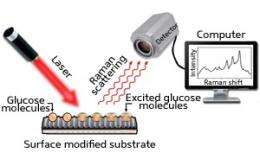
Surface-enhanced Raman spectroscopy (SERS) is a highly sensitive and versatile analytical tool that is widely used in biosensing applications. In conventional Raman spectroscopy, molecules are detected by their characteristic scattering of laser light, but the sensitivity of the standard method is relatively low. By detecting the same Raman scattering from molecules adsorbed to rough metal surfaces, however, the sensitivity can be enhanced remarkably, even allowing the detection of single molecules (see image). Unfortunately, the mechanism of this enhancement is not well understood and is strongly dependent on the combination of surface and molecular target.

Malini Olivo and co-workers at the A*STAR Singapore Bioimaging Consortium and Institute of Microelectronics have now developed a new class of surface that provides a much-needed sensitivity enhancement for the detection of glucose. The new promises the fast, direct and accurate detection of glucose in solution at physiological concentrations.

Olivo and her co-workers have been investigating SERS for the measurement of glucose in biological samples. Glucose has very low Raman scattering efficiency and existing substrates for SERS fail to bring the method’s sensitivity of detection up to a level suitable for detecting the typical concentrations in real samples.

Instead of the commonly used rough metal substrates, the researchers turned to silicon, which they etched to form a well-defined pattern of nanogaps. They then coated the patterned silicon with thin layers of silver and gold. In tests comparing the new substrate with commercial substrates for glucose detection, Olivo and her team found that the silicon-based substrate gave the sensitivity boost they were looking for, which they attribute to the uniformity of roughness provided by the nanogap pattern.

“We were actually very surprised by our substrate’s high reproducibility,” say Olivo. “The best reproducibility reported previously for glucose was only about 10%. However, due to the special design and pattern of our substrate, we achieved reproducibility of about 3–4%, which is outstanding.” The nanogap substrate also provided good for the detection of glucose in the physiologically important 0–25 millimolar range.

Olivo and her co-workers are already building on their success with work on an analogous system for sensing proteins. “We would like to translate similar SERS substrate platforms to optical fibers in order to develop a minimally invasive in vivo SERS platform for clinical diagnostics,” she says. The researchers have high hopes that small sensors based on this SERS platform may one day be implanted into patients for real-time sensing.

More information: Dinish, U. S., et al. Development of highly reproducible nanogap SERS substrates: Comparative performance analysis and its application for glucose sensing. Biosensors and Bioelectronics 26, 1987–1992 (2011).

Provided by Agency for Science, Technology and Research (A*STAR)

4.5 /5 (2 votes)  

Rank 4.5 /5 (2 votes)
Relevant PhysicsForums posts
  • Schwartz reagent-- NMR/MS/IR
    created17 hours ago
  • Inversion temp
    created22 hours ago
  • High school chemistry EEI
    createdMay 25, 2012
  • oxidation of I- by KMnO4
    createdMay 25, 2012
  • Invesion temp
    createdMay 25, 2012
  • Hybridization of SnCl3 -
    createdMay 25, 2012
  • More from Physics Forums - Chemistry

More news stories

From lemons to lemonade: Reaction uses carbon dioxide to make carbon-based semiconductor

(Phys.org) -- A materials scientist at Michigan Technological University has discovered a chemical reaction that not only eats up the greenhouse gas carbon dioxide, it also creates something useful. And, by ...

Chemistry / Materials Science

created May 21, 2012 | popularity 4.7 / 5 (88) | comments 32 | with audio podcast

New CO2-removing catalyst can take the heat

(Phys.org) -- The current method of removing the greenhouse gas carbon dioxide (CO2) from the flues of coal-fired power plants uses so much energy that no one bothers to use it. So says Roger Aines, principal ...

Chemistry / Materials Science

created May 24, 2012 | popularity 5 / 5 (7) | comments 7 | with audio podcast

High-speed method to aid search for solar energy storage catalysts

Eons ago, nature solved the problem of converting solar energy to fuels by inventing the process of photosynthesis.

Chemistry / Materials Science

created May 25, 2012 | popularity 5 / 5 (3) | comments 4 | with audio podcast

Researchers demonstrate possible primitive mechanism of chemical info self-replication

(Phys.org) -- When scientists think about the replication of information in chemistry, they usually have in mind something akin to what happens in living organisms when DNA gets copied: a double-stranded molecule ...

Chemistry / Materials Science

created May 25, 2012 | popularity 5 / 5 (4) | comments 2 | with audio podcast

Castor oil: Action mechanism of one of the oldest drugs known to man elucidated

Castor oil is known primarily as an effective laxative; however, it was also used in ancient times with pregnant women to induce labour. Only now have scientists at the Max Planck Institute for Heart and Lung ...

Chemistry / Biochemistry

created May 21, 2012 | popularity 3 / 5 (2) | comments 3 | with audio podcast


Scientist: Evolution debate will soon be history

(AP) -- Richard Leakey predicts skepticism over evolution will soon be history. Not that the avowed atheist has any doubts himself.

Dell tablet leak: 10.1-inch display, two-battery choice

(Phys.org) -- Headline after headline talks about vendors’ tablets in the wings as likely number-one contenders for the iPad. Such claims have justifiably been taken with a grain of salt, considering ...

SpotterRF debuts Radar Backpack Kit (w/ Video)

(Phys.org) -- SpotterRF has announced a special radar backpack kit designed to enhance situational awareness for soldiers on the ground. The company says its special radar is designed for warfighters as part ...

SpaceX capsule has 'new car' smell, astronauts say (Update)

SpaceX's Dragon cargo vessel smells like a new car, said astronauts at the International Space Station after opening the hatches Saturday following the spacecraft's landmark mission to the orbiting lab.

Thousands of shellfish found dead in Peru

Thousands of crustaceans were found dead off the coast of Lima following the mystery mass death of dolphins and pelicans, the Peruvian Navy said Friday.

Astronomers seize last chance in lifetime for Venus Transit

Astronomers are gearing for one the rarest events in the Solar System: an alignment of Earth, Venus and the Sun that will not be seen for another 105 years.