Big personality birds find the best homes
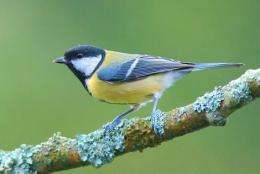
(PhysOrg.com) -- Birds willing to move around and take risks are better at finding the best places to live, researchers have found. Those with ‘fast-exploring’ personalities – birds tending to be hyperactive – are far more likely to end up in areas providing enough food, shelter and reproductive opportunities, a new study shows.
The research, led by scientists at Oxford University, has also found that smaller immigrant birds – those flying into, and staying, in a better habitat – are likely to have faster personalities than those born in the better habitat.
"If you’re quite big, your personality probably doesn’t matter because you’re likely to be able to secure a territory anyway, or a mate with a territory," said Dr. John Quinn of Oxford University's Department of Zoology. "But if you’re quite small you have to have a big personality to join a new population.’
Researchers from the Edward Grey Institute in the Department of Zoology have been studying great tits – a common garden and woodland bird – for more than 50 years and Wytham Woods near Oxford, an oak woodland that is comparatively rare near Oxford, is one of the best local habitats for the species.
"Great tits can probably see the woods from several kilometres away and we think the immigrants were born in towns or hedgerows where the habitat quality is not so good,’ Dr. Quinn says. His study showed that immigrant birds flying into Wytham were likely to have fast personality types.
The research by Dr. Quinn and colleagues was published this week in the BES's Journal of Animal Ecology. The birds were housed overnight in a field station near to Wytham and in the morning placed in a room with artificial trees ‘so that we could determine their behaviour in these unusual circumstances," Dr. Quinn explains.
Great tits are generally calm, and readily adapt to captivity, but there were clear differences between fast and slow personalities. "The slow types just sat on the trees and did very little while the hyperactive types moved around constantly.
"This behavior is consistent throughout an individual bird’s life and even predicts whether birds are assertive, aggressive or promiscuous in the wild."
The scientists also assessed whether the fast-exploring trait was passed onto offspring. "Overall in Wytham, exploration behavior is heritable – it is spurred partly by “nature” - but the difference between immigrants and residents seems primarily to be driven by environmental conditions, or “nurture”. Although this trait stays with an individual for life, we found that the offspring of immigrant birds behaved in the same way as the residents."
The ability of birds, and other animals, to relocate to better sites is often important for gene flow, Dr. Quinn adds. ‘Immigration generally increases the genetic variation and makes populations more resilient to environmental change and inbreeding’. But while immigrants to Wytham may bring in new genes for some kinds of traits, this does not appear to be the case for genes normally associated with personality.
"We generally think fast-exploring birds are risk takers that prioritise finding food. But with that comes a greater chance of predation and perhaps a risk of injury from fighting. If you watched great tits at your garden feeder there’s a good chance you’d pick out the fast and slow personality types. In Wytham, fast birds tend to dominate the feeders."
Fast personality traits are commonly seen in other animals ranging from spiders to squid and from fish to pond skaters. "These wild-animal personalities are also biologically similar to those you see in pets. Some dogs for example have quite agreeable personalities, or temperaments, while others are quite aggressive," Dr. Quinn says. "But while the variation you see in pets is caused by artificial selection, the patterns we see in wild birds seem to be caused by natural selection."
Provided by Oxford University


