Building a better battery
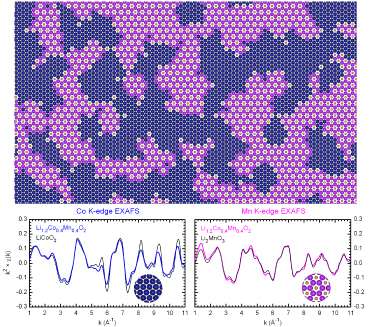
(PhysOrg.com) -- “What we are trying to do is put different pieces of a puzzle together,” said Argonne National Laboratory scientist Daniel P. Abraham. The puzzle is a lithium-rich compound material, Li1.2Co0.4Mn0.4O2, that holds key insights into the development of more powerful and robust batteries for electric cars. Using a suite of advanced techniques, including the resources of the U.S. Department of Energy’s Advanced Photon Source at Argonne, Abraham and his colleagues have pieced together both the long-range and local structure of this compound, devising a model that could explain how such materials operate on the electrochemical level — and how to use them to build a better battery.
Argonne is at the cutting edge of the effort to create advanced battery technologies, focusing especially on the lithium-ion (Li-ion) battery, which promises more energy and longer life than the nickel-metal hydride battery currently used in electric and hybrid vehicles. For instance, the new Chevy Volt, the first mass-produced plug-in hybrid electric car, is powered by a battery whose chemistry is based in part on important breakthroughs developed by scientists at Argonne. Like all batteries, Li-ion batteries work by moving electric charge (in this case, lithium ions) between an anode and cathode. But vital properties — such as the amount of electricity a battery can deliver before recharging is necessary and how many times it can be recharged before its microstructure breaks down under the repeated cycling stress — can vary greatly depending on the composition of the cathode and anode. Most research has focused on compounds using transition metals such as cobalt and manganese, but the precise structural formulation of the compounds and what might make one work better than another have largely been a matter of trial and error and speculation. The new Argonne work, published in Chemistry of Materials, is an important step toward resolving the confusion.
Co-principal investigator Mahalingam Balasubramanian (also from Argonne), Abraham, and colleagues from Argonne and the Frederick Seitz Materials Research Laboratory of the University of Illinois examined the layered lithium oxide Li1.2Co0.4Mn0.4O2 , which is a model compound for many of the advanced battery materials currently under development for electric vehicles. The experimenters subjected samples to a variety of techniques including x-ray diffraction (XRD), scanning-transmission electron microscopy (STEM), and x-ray absorption spectroscopy (XAS). The combination of methods yielded a more comprehensive picture than previously achieved. “It’s sort of like the story of the blind men and the elephant,” Abraham explained. “When different people use different techniques, they obtain data that are only one part of the puzzle, but often the results are presented in literature as the final answer. The most important thing that we did was to put together information from the various experimental techniques to obtain a composite picture.”
When examined by XRD, Li1.2Co0.4Mn0.4O2 reveals an average long-range crystal structure similar to that of layered LiCoO2. STEM results, however, revealed the presence of lithium atoms, in sites typically occupied by cobalt and manganese atoms, ordered in a manner similar to that in layered Li2MnO3. But the STEM data could not establish the structural relationship between the ordered lithium atoms and the neighboring cobalt and manganese atoms. The XAS experiments conducted at the X-ray Science Division 20-BM bending magnet beamline of the Advanced Photon Source, on the other hand, were successful in distinguishing the local atomic environments around the cobalt and manganese. Balasubramanian and his collaborators determined that while the crystalline structure of the Li1.2Co0.4Mn0.4O2 compound is largely homogeneous over the long range, the local structure contains Li2MnO3 and LiCoO2 nanoclusters. These local clusters might present connectivity over long distances as a dendritic network. “Having continuous regions allows for each unit cell to ‘talk’ to the next unit cell over very long distances,” Balasubramanian said. This connectivity enhances the transport of lithium ions and hence, the electrochemical performance of the material for battery applications. “It’s the local structure that determines the properties of the compound,” Abraham added.
The team’s broad-based approach of bringing together a wide palette of experimental methods, rather than relying on a single technique, is an important step towards the custom design of battery materials based on results from advanced diagnostic techniques. “In the past, most advances in battery materials development arose from intuitive experimentation,” explained Balasubramanian. “We want to complement this intuitive Edisonian approach with a rigorous basic approach to tailoring new materials.”
The next step is to observe the structural changes that occur in these lithium-rich compounds as they are cycled through various voltage windows, which is critical for determining battery life and durability. “Tools and techniques like those available at the APS can provide us unique insights to develop structure-property correlations, which are very important to predict long-term battery performance,” Abraham said.
The work lays a solid foundation for the design and development of new compounds. “We want to be able to tailor these materials with desired properties for specific applications," Balasubramanian said. "We need transformational materials with high capacities, high power, and stable crystal structures for the successful commercialization of lithium-ion batteries for a myriad of demanding applications.”
More information: J. Bareño1, M. et al, “Long-Range and Local Structure in the Layered Oxide 2 Li1.2Co0.4Mn0.4O2,” Chem. Mater. 23(8), 2039 (2011). DOI:10.1021/cm200250a
Provided by Argonne National Laboratory


