Universal detector made of DNA building blocks
(PhysOrg.com) -- A method for detecting such diverse substances as antibiotics, narcotics and explosives - a universal detector, so to speak - has been developed by German researchers at the Max Planck Institute for Polymer Research in Mainz.
The key element of this is an atomic force microscope that can be used to subject individual molecules to a tensile test. The Mainz-based researchers are therefore focussing on aptamers, which are composed of the building blocks of the genetic material DNA. If the substance researched binds to the aptamers, the force at which they tear apart changes. In this way, the substance can not only be accurately detected at small concentrations, but can also be studied more precisely. It is therefore possible for instance to investigate how the substances researched bind to aptamers, and how great their binding strength is (Journal of the American Chemical Society 133, pages 2025 - 2027).
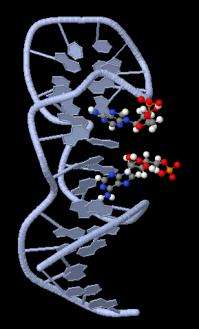
Aptamers are a practically ideal means of detecting an extremely wide variety of chemicals. Typically, they consist of the building blocks from the hereditary materials DNA and RNA, and combine universality with specificity. They form, as it were, a box of bait with which to catch another kind of fish. Their versatility results from the innumerable possibilities of varying the sequence of the four bases of which DNA is composed. Their specificity, on the other hand, results from the physical structure that a strand of DNA with a certain base sequence adopts. This produces in the aptamer individually formed pockets into which only certain molecules fit - rather like a clay figure in its mould. "Aptamers with appropriate pockets can be found for most molecules, be they antibiotics, cocaine, TNT or proteins", explains Rüdiger Berger of the Max Planck Institute for Polymer Research.
Among the appropriate aptamers, the researchers in Mainz are looking for one that can be split into two parts in such a way that the target molecule bound in the pocket forms a bridge between the two halves. An aptamer such as this could be found mostly in pre-selection, explains Mark Helm of the Institute of Pharmacy at the Johannes Gutenberg University Mainz, co-author of the study. For their first trials with the universal detector, the researchers selected adenosine monophosphate (AMP) as the target molecule and an aptamer with pockets for two AMP molecules.
They then fix one half of the split aptamer to the tip of an atomic force microscope and the other to a support. When they then lower the tip and the halves come into contact, hydrogen bridge bonds form between individual bases of the two aptamer halves. If the tip is withdrawn, the joined aptamer is stretched like a spring. The force this produces can be measured: it increases with the strain until the halves tear apart at a certain force. In a second trial, before ripping apart, the researchers added a solution of the biomolecule adenosine monophosphate (AMP) to the system. In this way, two AMP molecules are placed in the free pockets; both then form hydrogen bridge bonds with the two halves of the aptamer. As a result of this bridge function, the AMP molecules reinforce the coherence between the two parts and therefore only tear apart at a much greater force. This difference enables the AMP to be detected.
To determine the rupture forces, the researchers repeated the measurements 1000 times and determined a statistical mean which was around 39 piconewtons for the AMP-loaded aptamer, around 12 piconewtons higher than without the AMP. As a control, they used a mutated aptamer with a differently formed binding pocket in which the rupture force did not change. The binding strength between the AMP and the aptamer can also be readily determined by splitting the aptamer into two. To do this, the concentration of the AMP molecules in the solution was increased stepwise until approximately half of all tensile tests showed an increase in the tear force. The greater the concentration necessary for this, the smaller the binding strength is.
The new method is suitable not only for detecting certain molecules in a solution, but also for researching individual molecules, says Rüdiger Berger. "For example, with a defined force you can pull the aptamer without tearing it and examine how the properties of the molecule-aptamer bond changes", he continues. The target molecule could also be changed so that it forms, for example, only two hydrogen bridge bonds with the pocket instead of three. "This makes is possible to understand which bonds between the target molecule and the aptamer are significant", he explains.
Knowledge of aptamers and their binding properties has great application potential. DNA fragments are already being used today for environmental analysis and in medical diagnostics; their uses as molecular tools and building blocks can be expanded even further with the new method thanks to the fresh insight, says Rüdiger Berger.
More information: Thi-Huong Nguyen, Lorenz Jan Steinbock, Hans-Jürgen Butt, Mark Helm, Rüdiger Berger, Measuring Single Small Molecule Binding via Rupture Forces of a Split Aptamer, Journal of the American Chemical Society, 2. Februar 2011, DOI:10.1021/ja1092002
Provided by Max-Planck-Gesellschaft


