Scientists produce a crystal that could help unlock the mystery of high-temperature superconductors
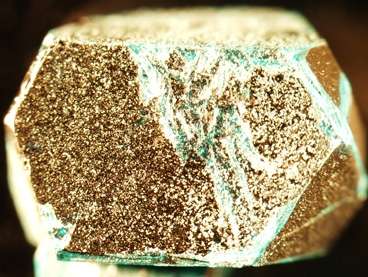
MIT scientists have synthesized, for the first time, a crystal they believe to be a two-dimensional quantum spin liquid: a solid material whose atomic spins continue to have motion, even at absolute zero temperature.
The crystal, known as herbertsmithite, is part of a family of crystals called Zn-paratacamites, which were first discovered in 1906. Physicists started paying more attention to quantum spin liquids in 1987, when Nobel laureate Philip W. Anderson theorized that quantum spin liquid theory may relate to the phenomenon of high-temperature superconductivity, which allows materials to conduct electricity with no resistance at temperatures above 20 degrees Kelvin (-253 degrees Celsius).
To test this theory, scientists have been looking for materials that preserve quantum spin (a measure of angular momentum) dynamics down to milli Kelvin temperatures (those below -273 degrees Celsius). Almost all ordinary materials lose their spin dynamics at such low temperatures, just as they lose all of their kinetic energy.
Identifying a quantum spin liquid, and producing large single crystals of it, could potentially help physicists understand the mechanisms of high-temperature superconductors, says Tianheng Han, an MIT physics graduate student and lead author of a paper describing the synthesis in the March 3 edition of Physical Review B. Senior authors of the paper are associate professor of physics Young Lee and Daniel Nocera, the Henry Dreyfus Professor of Energy and professor of chemistry.
Herbertsmithite is an insulator, not a superconductor, but quantum spin liquid theory predicts that doping the crystal (such as substituting its chlorine with sulfur) could transform it into a superconductor.
Han, Lee and their colleagues were able to synthesize about a third of a gram of pure single crystal herbertsmithite in their recent work. The crystal exists in nature, but in forms that are too impure for experiments to test its physical characteristics. The researchers plan to do more tests to determine whether the crystal really is a quantum spin liquid. One important investigation is to search for a spinon continuum — a signature of quantum fractionalization, a famous example of which is the fractional quantum hall effect, which was awarded the 1998 Nobel Prize in physics.
Having large amounts of the crystal available should enable experiments that will reveal the unusual behavior of herbertsmithite, says Collin Broholm, professor of physics at Johns Hopkins University. “Neutron scattering experiments are now possible, and these provide very detailed information that cannot be achieved in any other way,” he says.
Provided by Massachusetts Institute of Technology


