Moth eyes inspire antireflective surfaces for military applications
March 8, 2011 by Karen B. Roberts

Moth eyes inspire antireflective surfaces for military applications

Enlarge

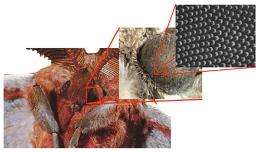
The corneal surface of many insects is structured with a subwavelength grating of protrusions believed to provide wide bandwidth antireflective properties.

(PhysOrg.com) -- If you look closely at the surface of a moth's cornea, you see that it is comprised of tiny protruding bumps. These bumps exist to keep moths safe from predators by preventing light from reflecting in their eyes and betraying their presence. In essence, the moth's eyes are naturally antireflective.

Antireflective (AR) surfaces are commonly used to prevent glare in optics -- think of the thin film coating applied to then lens of your favorite glasses.

In a unique application, Mark Mirotznik, associate professor in the Department of Electrical and Computer Engineering at the University of Delaware, has adapted these AR ideas and applied them to materials at .

Advances in passive imaging at millimeter wave frequencies have created a need for high quality , such as lenses, designed specifically for these wavelength bands, explains Mirotznik.

Broadband AR surfaces are commonly implemented by coating the surface with multiple layers of , with the exact number and thickness of layers needed determined by various optimization algorithms.

The approach is tricky when using microwave and millimeter wavelengths, however, because suitable materials are scarce and signal strength is commonly many orders of magnitude smaller than that encountered in the visible or .

Inspired by the subwavelength surface pattern of the cornea in common insects, Mirotznik has developed an inverse motheye surface that is easier to fabricate than traditional motheye surfaces, more mechanically robust and provides good AR behavior.

The main application for this research is to create (RF) transparent windows, most likely using , for use in military applications.

“We've demonstrated that it is possible to use a moth eye approach to create special surfaces in which microwave energy is transmitted with very little reflections over large ranges of frequency or bandwidths,” he says.

“Expensive antenna systems can then be placed behind the structural windows, safe from the outside environment, or in the case of military applications, from hazards such as gun fire or explosives.”

Mirotznik's research is documented in a paper entitled “Broadband Antireflective Properties of Inverse Motheye Surfaces.” The paper, which appeared in the IEEE journal Transactions on Antennas and Propagation, recently earned Mirotznik the 2011 H.A. Wheeler Prize Paper award. The H. A. Wheeler Prize is presented to authors of the best applications paper published in the IEEE Transactions on Antennas and Propagation during the previous year.

Co-authors for the paper include UD doctoral student Brandon L. Good, one of two researchers at Carderock Division of the Naval Surface Warfare Center; and two researchers from the U.S. Army Research Laboratory.

Provided by University of Delaware search and more info website


Rank not rated yet
Relevant PhysicsForums posts

More news stories

SpotterRF debuts Radar Backpack Kit (w/ Video)

(Phys.org) -- SpotterRF has announced a special radar backpack kit designed to enhance situational awareness for soldiers on the ground. The company says its special radar is designed for warfighters as part ...

Technology / Hi Tech & Innovation

created 15 hours ago | popularity 5 / 5 (3) | comments 12 | with audio podcast report

Probability of contamination from severe nuclear reactor accidents is higher than expected: study

Catastrophic nuclear accidents such as the core meltdowns in Chernobyl and Fukushima are more likely to happen than previously assumed. Based on the operating hours of all civil nuclear reactors and the number ...

Technology / Energy & Green Tech

created May 22, 2012 | popularity 3.6 / 5 (21) | comments 52 | with audio podcast

Delphi gasoline-injection engine technique rivals hybrid's edge

(Phys.org) -- Running a diesel like engine on gasoline is something Delphi is doing in notable fashion. They claim they are on to a promising way to enjoy an engine that gives the vehicle owner high efficiency ...

Technology / Energy & Green Tech

created May 21, 2012 | popularity 4.7 / 5 (18) | comments 37 | with audio podcast report

HyperSolar shows dirty water no barrier to power world

(Phys.org) -- The Santa Barbara, California, company, HyperSolar, is set to transparently share the ups and downs of its research experiences toward the company’s ultimate vision, successfully producing ...

Technology / Energy & Green Tech

created May 24, 2012 | popularity 4.8 / 5 (15) | comments 17 | with audio podcast report

Tesla to launch electric sedan in US on June 22

Tesla Motors said Tuesday it would begin deliveries of "the world's first premium electric sedan" on June 22, slightly ahead of schedule.

Technology / Energy & Green Tech

created May 22, 2012 | popularity 4.5 / 5 (11) | comments 18


Dell tablet leak: 10.1-inch display, two-battery choice

(Phys.org) -- Headline after headline talks about vendors’ tablets in the wings as likely number-one contenders for the iPad. Such claims have justifiably been taken with a grain of salt, considering ...

Scientist: Evolution debate will soon be history

(AP) -- Richard Leakey predicts skepticism over evolution will soon be history. Not that the avowed atheist has any doubts himself.

SpaceX capsule has 'new car' smell, astronauts say (Update)

SpaceX's Dragon cargo vessel smells like a new car, said astronauts at the International Space Station after opening the hatches Saturday following the spacecraft's landmark mission to the orbiting lab.

Thousands of shellfish found dead in Peru

Thousands of crustaceans were found dead off the coast of Lima following the mystery mass death of dolphins and pelicans, the Peruvian Navy said Friday.

Astronomers seize last chance in lifetime for Venus Transit

Astronomers are gearing for one the rarest events in the Solar System: an alignment of Earth, Venus and the Sun that will not be seen for another 105 years.

Australia hails surprise super-telescope decision

Australia has hailed a surprise decision giving it a role in a radio telescope project aimed at revolutionising astronomy, vowing to draw on its decades of experience in space science.