Fundamental discovery could lead to better memory chips
March 15, 2011

Fundamental discovery could lead to better memory chips

Enlarge

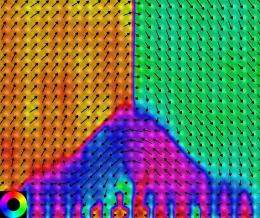
At the atomic scale, University of Michigan researchers have for the first time mapped the polarization of a cutting-edge material for memory chips. Credit: Chris Nelson and Xiaoqing Pan

(PhysOrg.com) -- Engineering researchers at the University of Michigan have found a way to improve the performance of ferroelectric materials, which have the potential to make memory devices with more storage capacity than magnetic hard drives and faster write speed and longer lifetimes than flash memory.

In ferroelectric memory the direction of molecules' electrical serves as a 0 or a 1 bit. An electric field is used to flip the polarization, which is how data is stored.

With his colleagues at U-M and collaborators from Cornell University, Penn State University, and University of Wisconsin, Madison, Xiaoqing Pan, a professor in the U-M Department of Materials Science and Engineering, has designed a material system that spontaneously forms small nano-size spirals of the electric polarization at controllable intervals, which could provide natural budding sites for the polarization switching and thus reduce the power needed to flip each bit.

"To change the state of a ferroelectric , you have to supply enough electric field to induce a small region to switch the polarization. With our material, such a nucleation process is not necessary," Pan said. "The nucleation sites are intrinsically there at the material interfaces."

To make this happen, the engineers layered a ferroelectric material on an insulator whose crystal lattices were closely matched. The polarization causes large electric fields at the ferroelectric surface that are responsible for the spontaneous formation of the budding sites, known as "vortex nanodomains."

The researchers also mapped the material's polarization with atomic resolution, which was a key challenge, given the small scale. They used images from a sub-angstrom resolution at Lawrence Berkeley National Laboratory. They also developed image processing software to accomplish this.

"This type of mapping has never been done," Pan said. "Using this technique, we've discovered unusual vortex nanodomains in which the electric polarization gradually rotates around the vortices."

More information: A paper on the research, titled "Spontaneous Vortex Nanodomain Arrays at Ferroelectric Heterointerfaces" is available online at Nano Letters website.

Provided by University of Michigan search and more info website


Rank 5 /5 (2 votes)
Relevant PhysicsForums posts
  • Water Rocket
    created3 hours ago
  • why do trucks have bigger brakes?
    created7 hours ago
  • Solar Sail Physics - Do they work on a large scale?
    created8 hours ago
  • How should I switch an air conditioner off?
    created9 hours ago
  • Question about current decay in R-L circuit
    created9 hours ago
  • Elementary time - how does it work?
    created12 hours ago
  • More from Physics Forums - General Physics

More news stories

Dopant gives graphene solar cells highest efficiency yet

(Phys.org) -- By taking advantage of graphene’s favorable electrical and optical properties, and then adding an organic dopant, researchers have achieved the highest power conversion efficiency yet for ...

Nanotechnology / Nanophysics

created May 21, 2012 | popularity 5 / 5 (10) | comments 14 | with audio podcast feature

Nanomedicine: Quantum dots appear safe in pioneering study on primates

A pioneering study to gauge the toxicity of quantum dots in primates has found the tiny crystals to be safe over a one-year period, a hopeful outcome for doctors and scientists seeking new ways to battle diseases ...

Nanotechnology / Bio & Medicine

created May 20, 2012 | popularity 4.3 / 5 (3) | comments 8 | with audio podcast

In nanorod crystal growth, nanoparticles seen as artificial atoms

In the growth of crystals, do nanoparticles act as "artificial atoms" forming molecular-type building blocks that can assemble into complex structures? This is the contention of a major but controversial theory ...

Nanotechnology / Nanophysics

created May 24, 2012 | popularity 4.8 / 5 (6) | comments 0 | with audio podcast

First direct observation of oriented attachment in nanocrystal growth

Berkeley Lab researchers have reported the first direct observation of nanoparticles undergoing oriented attachment, the critical step in biomineralization and the growth of nanocrystals. A better understanding ...

Nanotechnology / Nanophysics

created May 24, 2012 | popularity 4.7 / 5 (3) | comments 0 | with audio podcast

Synthetic nano-waste does not disappear

(Phys.org) -- Tiny particles of cerium oxide do not burn or change in the heat of a waste incineration plant. They remain intact on combustion residues or in the incineration system, as a new study by Swiss ...

Nanotechnology / Bio & Medicine

created May 25, 2012 | popularity 5 / 5 (2) | comments 1 | with audio podcast


Dell tablet leak: 10.1-inch display, two-battery choice

(Phys.org) -- Headline after headline talks about vendors’ tablets in the wings as likely number-one contenders for the iPad. Such claims have justifiably been taken with a grain of salt, considering ...

Scientist: Evolution debate will soon be history

(AP) -- Richard Leakey predicts skepticism over evolution will soon be history. Not that the avowed atheist has any doubts himself.

SpotterRF debuts Radar Backpack Kit (w/ Video)

(Phys.org) -- SpotterRF has announced a special radar backpack kit designed to enhance situational awareness for soldiers on the ground. The company says its special radar is designed for warfighters as part ...

SpaceX capsule has 'new car' smell, astronauts say (Update)

SpaceX's Dragon cargo vessel smells like a new car, said astronauts at the International Space Station after opening the hatches Saturday following the spacecraft's landmark mission to the orbiting lab.

Thousands of shellfish found dead in Peru

Thousands of crustaceans were found dead off the coast of Lima following the mystery mass death of dolphins and pelicans, the Peruvian Navy said Friday.

Australia hails surprise super-telescope decision

Australia has hailed a surprise decision giving it a role in a radio telescope project aimed at revolutionising astronomy, vowing to draw on its decades of experience in space science.