New camera makes seeing the 'invisible' possible
March 3, 2011

Seeing the invisible

Enlarge

(PhysOrg.com) -- The science similar to the type used in airport body scanners could soon be used to detect everything from defects in aerospace vehicles or concrete bridges to skin cancer, thanks to researchers at Missouri University of Science and Technology.

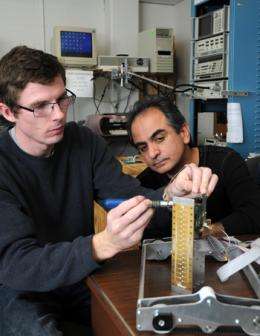
The research team, led by Dr. Reza Zoughi, the Schlumberger Distinguished Professor of at Missouri S&T, has developed a patented handheld camera that uses millimeter and microwave signals to non-intrusively peek inside materials and structures in real time. His contributions to this field, in part, have earned him the 2011 Joseph F. Keithley Award in Instrumentation and Measurement from the Institute of Electrical and Electronics Engineers (IEEE).

"In the not-so-distant future, the technology may be customized to address many critical inspection needs, including detecting defects in thermal insulating materials that are found in spacecraft heat insulating foam and tiles, space habitat structures, aircraft radomes and composite-strengthened concrete bridge members," Zoughi says.

The technology could help medical professionals detect and monitor a variety of skin conditions in humans, including cancer and burns. It also has the potential to help Homeland Security personnel detect concealed contraband (such as weapons) or reduce the number of passenger pat downs at airports. Even homeowners could see a direct benefit from the technology as it potentially could be used to detect termite damage.

This video is not supported by your browser at this time.

How it works

The compact system can produce synthetically focused images of objects - at different planes in front of the camera - at speeds of up to 30 images per second. A laptop computer then collects the signal and displays the image in real-time for review. The entire system, powered by a battery similar to the size used in laptops, can run for several hours.

"Unlike X-rays, microwaves are non-ionizing and may only cause some heating effect," Zoughi says. "However, the high sensitivity and other characteristics of this camera enables it to operate at a low-power level."

The idea for developing a real-time, portable camera came to Zoughi in 1998 while he was on sabbatical in France. In 2007, Zoughi's research group completed the first prototype and has spent the past three years decreasing its size, while improving its overall efficiency.

Currently the camera operates in the transmission mode, meaning objects must pass between a transmitting source and its collector to be reviewed. The team is working on designing and developing a one-sided version of it, which will make it operate in a similar fashion to a video camera.

"Further down the road, we plan to develop a wide-band capable of producing real-time 3-D or holographic images," Zoughi adds.

In 2010, a U.S. patent was issued for this technology.

Provided by Missouri University of Science and Technology search and more info website


Rank 5 /5 (7 votes)
Relevant PhysicsForums posts

More news stories

SpotterRF debuts Radar Backpack Kit (w/ Video)

(Phys.org) -- SpotterRF has announced a special radar backpack kit designed to enhance situational awareness for soldiers on the ground. The company says its special radar is designed for warfighters as part ...

Technology / Hi Tech & Innovation

created 16 hours ago | popularity 5 / 5 (4) | comments 12 | with audio podcast report

Probability of contamination from severe nuclear reactor accidents is higher than expected: study

Catastrophic nuclear accidents such as the core meltdowns in Chernobyl and Fukushima are more likely to happen than previously assumed. Based on the operating hours of all civil nuclear reactors and the number ...

Technology / Energy & Green Tech

created May 22, 2012 | popularity 3.6 / 5 (21) | comments 54 | with audio podcast

Delphi gasoline-injection engine technique rivals hybrid's edge

(Phys.org) -- Running a diesel like engine on gasoline is something Delphi is doing in notable fashion. They claim they are on to a promising way to enjoy an engine that gives the vehicle owner high efficiency ...

Technology / Energy & Green Tech

created May 21, 2012 | popularity 4.7 / 5 (18) | comments 37 | with audio podcast report

HyperSolar shows dirty water no barrier to power world

(Phys.org) -- The Santa Barbara, California, company, HyperSolar, is set to transparently share the ups and downs of its research experiences toward the company’s ultimate vision, successfully producing ...

Technology / Energy & Green Tech

created May 24, 2012 | popularity 4.8 / 5 (15) | comments 17 | with audio podcast report

Tesla to launch electric sedan in US on June 22

Tesla Motors said Tuesday it would begin deliveries of "the world's first premium electric sedan" on June 22, slightly ahead of schedule.

Technology / Energy & Green Tech

created May 22, 2012 | popularity 4.5 / 5 (11) | comments 18


Dell tablet leak: 10.1-inch display, two-battery choice

(Phys.org) -- Headline after headline talks about vendors’ tablets in the wings as likely number-one contenders for the iPad. Such claims have justifiably been taken with a grain of salt, considering ...

Scientist: Evolution debate will soon be history

(AP) -- Richard Leakey predicts skepticism over evolution will soon be history. Not that the avowed atheist has any doubts himself.

SpaceX capsule has 'new car' smell, astronauts say (Update)

SpaceX's Dragon cargo vessel smells like a new car, said astronauts at the International Space Station after opening the hatches Saturday following the spacecraft's landmark mission to the orbiting lab.

Thousands of shellfish found dead in Peru

Thousands of crustaceans were found dead off the coast of Lima following the mystery mass death of dolphins and pelicans, the Peruvian Navy said Friday.

Keep food safety in mind this memorial day weekend

(HealthDay) -- Picnics, parades and cookouts are as much a part of Memorial Day weekend as tributes to the United States' war veterans.

Astronomers seize last chance in lifetime for Venus Transit

Astronomers are gearing for one the rarest events in the Solar System: an alignment of Earth, Venus and the Sun that will not be seen for another 105 years.