New blood analysis chip could lead to disease diagnosis in minutes
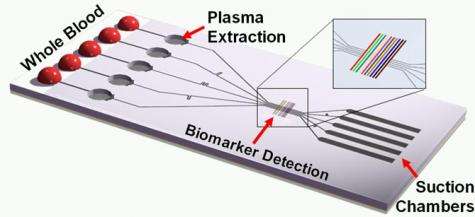
(PhysOrg.com) -- A major milestone in microfluidics could soon lead to stand-alone, self-powered chips that can diagnose diseases within minutes. The device, developed by an international team of researchers from the University of California, Berkeley, Dublin City University in Ireland and Universidad de Valparaíso Chile, is able to process whole blood samples without the use of external tubing and extra components.
The researchers have dubbed the device SIMBAS, which stands for Self-powered Integrated Microfluidic Blood Analysis System. SIMBAS appeared as the cover story March 7 in the peer-reviewed journal Lab on a Chip.
“The dream of a true lab-on-a-chip has been around for a while, but most systems developed thus far have not been truly autonomous,” said Ivan Dimov, UC Berkeley post-doctoral researcher in bioengineering and co-lead author of the study. “By the time you add tubing and sample prep setup components required to make previous chips function, they lose their characteristic of being small, portable and cheap. In our device, there are no external connections or tubing required, so this can truly become a point-of-care system.”
Dimov works in the lab of the study’s principal investigator, Luke Lee, UC Berkeley professor of bioengineering and co-director of the Berkeley Sensor and Actuator Center.
“This is a very important development for global healthcare diagnostics,” said Lee. “Field workers would be able to use this device to detect diseases such as HIV or tuberculosis in a matter of minutes. The fact that we reduced the complexity of the biochip and used plastic components makes it much easier to manufacture in high volume at low cost. Our goal is to address global health care needs with diagnostic devices that are functional, cheap and truly portable.”
For the new SIMBAS biochip, the researchers took advantage of the laws of microscale physics to speed up processes that may take hours or days in a traditional lab. They note, for example, that the sediment in red wine that usually takes days to years to settle can occur in mere seconds on the microscale.
The SIMBAS biochip uses trenches patterned underneath microfluidic channels that are about the width of a human hair. When whole blood is dropped onto the chip’s inlets, the relatively heavy red and white blood cells settle down into the trenches, separating from the clear blood plasma. The blood moves through the chip in a process called degas-driven flow.
For degas-driven flow, air molecules inside the porous polymeric device are removed by placing the device in a vacuum-sealed package. When the seal is broken, the device is brought to atmospheric conditions, and air molecules are reabsorbed into the device material. This generates a pressure difference, which drives the blood fluid flow in the chip.
In experiments, the researchers were able to capture more than 99 percent of the blood cells in the trenches and selectively separate plasma using this method.
“This prep work of separating the blood components for analysis is done with gravity, so samples are naturally absorbed and propelled into the chip without the need for external power,” said Dimov.
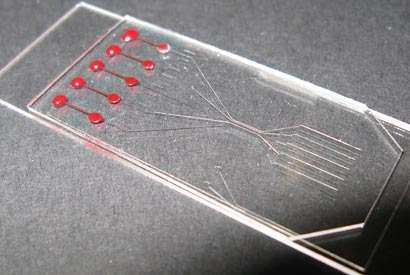
The team demonstrated the proof-of-concept of SIMBAS by placing into the chip’s inlet a 5-microliter sample of whole blood that contained biotin (vitamin B7) at a concentration of about 1 part per 40 billion.
“That can be roughly thought of as finding a fine grain of sand in a 1700-gallon sand pile,” said Dimov.
The biodetectors in the SIMBAS chip provided a readout of the biotin levels in 10 minutes.
“Imagine if you had something as cheap and as easy to use as a pregnancy test, but that could quickly diagnose HIV and TB,” said Benjamin Ross, a UC Berkeley graduate student in bioengineering and study co-author. “That would be a real game-changer. It could save millions of lives.”
“The SIMBAS platform may create an effective molecular diagnostic biochip platform for cancer, cardiac disease, sepsis and other diseases in developed countries as well,” said Lee.
Provided by University of California - Berkeley


