When is an asteroid not an asteroid?
March 30, 2011 By Jia-Rui C. Cook

When is an asteroid not an asteroid?

Enlarge

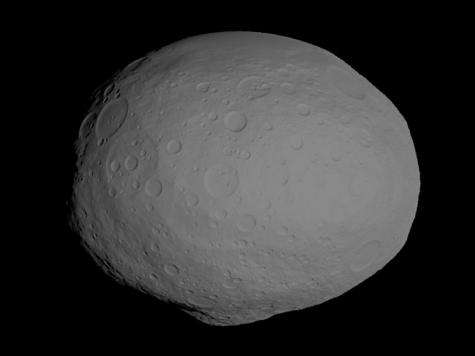
This image shows a model of the protoplanet Vesta, using scientists' best guess to date of what the surface of the protoplanet might look like. Credit: NASA/JPL-Caltech/UCLA/PSI

(PhysOrg.com) -- On March 29, 1807, German astronomer Heinrich Wilhelm Olbers spotted Vesta as a pinprick of light in the sky. Two hundred and four years later, as NASA's Dawn spacecraft prepares to begin orbiting this intriguing world, scientists now know how special this world is, even if there has been some debate on how to classify it.

Vesta is most commonly called an asteroid because it lies in the orbiting rubble patch known as the between Mars and Jupiter. But the vast majority of objects in the main belt are lightweights, 100-kilometers-wide (about 60-miles wide) or smaller, compared with Vesta, which is about 530 kilometers (330 miles) across on average. In fact, numerous bits of Vesta ejected by collisions with other objects have been identified in the main belt.

"I don't think Vesta should be called an asteroid," said Tom McCord, a Dawn co-investigator based at the Bear Fight Institute, Winthrop, Wash. "Not only is Vesta so much larger, but it's an evolved object, unlike most things we call asteroids."

The layered structure of Vesta (core, mantle and crust) is the key trait that makes Vesta more like planets such as Earth, and Mars than the other asteroids, McCord said. Like the planets, Vesta had sufficient radioactive material inside when it coalesced, releasing heat that melted rock and enabled lighter layers to float to the outside. Scientists call this process differentiation.

McCord and colleagues were the first to discover that Vesta was likely differentiated when special detectors on their telescopes in 1972 picked up the signature of basalt. That meant that the body had to have melted at one time.

Officially, Vesta is a "minor planet" -- a body that orbits the sun but is not a proper planet or comet. But there are more than 540,000 minor planets in our solar system, so the label doesn't give Vesta much distinction. Dwarf planets – which include Dawn's second destination, Ceres -- are another category, but Vesta doesn't qualify as one of those. For one thing, Vesta isn't quite large enough.

Dawn scientists prefer to think of Vesta as a protoplanet because it is a dense, layered body that orbits the sun and began in the same fashion as Mercury, Venus, Earth and , but somehow never fully developed. In the swinging early history of the solar system, objects became planets by merging with other Vesta-sized objects. But Vesta never found a partner during the big dance, and the critical time passed. It may have had to do with the nearby presence of Jupiter, the neighborhood's gravitational superpower, disturbing the orbits of objects and hogging the dance partners.

Other space rocks have collided with Vesta and knocked off bits of it. Those became debris in the known as Vestoids, and even hundreds of meteorites that have ended up on Earth. But Vesta never collided with something of sufficient size to disrupt it, and it remained intact. As a result, Vesta is a time capsule from that earlier era.

"This gritty little protoplanet has survived bombardment in the belt for over 4.5 billion years, making its surface possibly the oldest planetary surface in the ," said Christopher Russell, Dawn's principal investigator, based at UCLA. "Studying Vesta will enable us to write a much better history of the solar system's turbulent youth."

Dawn's scientists and engineers have designed a master plan to investigate these special features of Vesta. When Dawn arrives at Vesta in July, the south pole will be in full sunlight, giving scientists a clear view of a huge crater at the south pole. That crater may reveal the layer cake of materials inside Vesta that will tell us how the body evolved after formation. The orbit design allows Dawn to map new terrain as the seasons progress over its 12-month visit. The spacecraft will make many measurements, including high-resolution data on surface composition, topography and texture. The spacecraft will also measure the tug of Vesta's gravity to learn more about its internal structure.

"Dawn's ion thrusters are gently carrying us toward , and the spacecraft is getting ready for its big year of exploration," said Marc Rayman, Dawn's chief engineer at NASA's Jet Propulsion Laboratory, Pasadena, Calif. "We have designed our mission to get the most out of this opportunity to reveal the exciting secrets of this uncharted, exotic world."

Provided by JPL/NASA search and more info website

4.8 /5 (10 votes)  

Filter


Move the slider to adjust rank threshold, so that you can hide some of the comments.


Display comments: newest first

Yellowdart
Mar 30, 2011

Rank: not rated yet
Vesta had sufficient radioactive material inside when it coalesced, releasing heat that melted rock and enabled lighter layers to float to the outside.


I believe Alan Rubin did a few published calcs and showed that the rate of heat loss on an asteroid like Vesta would be too great for radioactivity to account for the needed heat to melt the rock.

He later suggested impacts. The problem with impacts is that even as the article notes Vesta hasn't sustained a large one, and impacts only raise the temperature near the point of impact.

Shootist
Mar 30, 2011

Rank: not rated yet
Vesta had sufficient radioactive material inside when it coalesced, releasing heat that melted rock and enabled lighter layers to float to the outside.


I believe Alan Rubin did a few published calcs and showed that the rate of heat loss on an asteroid like Vesta would be too great for radioactivity to account for the needed heat to melt the rock.

He later suggested impacts. The problem with impacts is that even as the article notes Vesta hasn't sustained a large one, and impacts only raise the temperature near the point of impact.


The entire southern hemisphere appears to be an impact crater.

http://www.univer...esta.jpg
Callmewhatuwant
Mar 31, 2011

Rank: not rated yet
heheehee....protoplanet if u like....
ubavontuba
Mar 31, 2011

Rank: 1 / 5 (1)
Wow. Vesta, then on to Ceres. I can't wait to learn more about the bright spot on Ceres (is it ice?).
Rank 4.8 /5 (10 votes)
Relevant PhysicsForums posts
  • revamping general concept and cosmological principle
    createdMay 25, 2012
  • Transiting Exoplanet Light Curve
    createdMay 25, 2012
  • Math behind Theoretical Physics
    createdMay 24, 2012
  • Do we know whats at the center of galaxies yet?
    createdMay 23, 2012
  • Structure of the Milky Way?
    createdMay 20, 2012
  • What would it take to terraform Pluto and Charon?
    createdMay 19, 2012
  • More from Physics Forums - General Astronomy

More news stories

SpaceX capsule has 'new car' smell, astronauts say (Update)

SpaceX's Dragon cargo vessel smells like a new car, said astronauts at the International Space Station after opening the hatches Saturday following the spacecraft's landmark mission to the orbiting lab.

Space & Earth / Space Exploration

created 12 hours ago | popularity 4.6 / 5 (16) | comments 0

Australia hails surprise super-telescope decision

Australia has hailed a surprise decision giving it a role in a radio telescope project aimed at revolutionising astronomy, vowing to draw on its decades of experience in space science.

Space & Earth / Astronomy

created 12 hours ago | popularity 5 / 5 (2) | comments 0

Astronomers seize last chance in lifetime for Venus Transit

Astronomers are gearing for one the rarest events in the Solar System: an alignment of Earth, Venus and the Sun that will not be seen for another 105 years.

Space & Earth / Astronomy

created 12 hours ago | popularity 5 / 5 (1) | comments 0

Astronauts enter world's 1st private supply ship

(AP) -- Space station astronauts floated into the Dragon on Saturday, a day after its heralded arrival as the world's first commercial supply ship.

Space & Earth / Space Exploration

created 12 hours ago | popularity 5 / 5 (5) | comments 0

Dragon arrives at space station in historic 1st (Update 2)

The privately bankrolled Dragon capsule made a historic arrival at the International Space Station on Friday, triumphantly captured by astronauts wielding a giant robot arm.

Space & Earth / Space Exploration

created May 25, 2012 | popularity 5 / 5 (10) | comments 19


Dell tablet leak: 10.1-inch display, two-battery choice

(Phys.org) -- Headline after headline talks about vendors’ tablets in the wings as likely number-one contenders for the iPad. Such claims have justifiably been taken with a grain of salt, considering ...

Scientist: Evolution debate will soon be history

(AP) -- Richard Leakey predicts skepticism over evolution will soon be history. Not that the avowed atheist has any doubts himself.

Keep food safety in mind this memorial day weekend

(HealthDay) -- Picnics, parades and cookouts are as much a part of Memorial Day weekend as tributes to the United States' war veterans.

SpotterRF debuts Radar Backpack Kit (w/ Video)

(Phys.org) -- SpotterRF has announced a special radar backpack kit designed to enhance situational awareness for soldiers on the ground. The company says its special radar is designed for warfighters as part ...

Thousands of shellfish found dead in Peru

Thousands of crustaceans were found dead off the coast of Lima following the mystery mass death of dolphins and pelicans, the Peruvian Navy said Friday.

Family history of Alzheimer's affects functional connectivity

(HealthDay) -- Cognitively normal individuals with a family history of late-onset Alzheimer's disease (AD) may display lower resting state functional connectivity in the default mode network (DMN) of the brain, ...