Antibiotics wrapped in nanofibers turn resistant disease-producing bacteria into ghosts
March 29, 2011

Antibiotics wrapped in nanofibers turn resistant disease-producing bacteria into ghosts

Enlarge

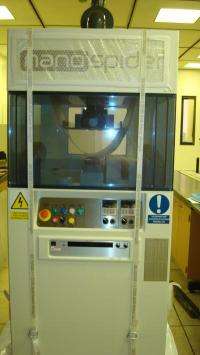
This nanospider machine is used to spin the fibers that deliver antibiotics to disable disease-producing bacteria and fungi. Credit: Elmarco s.r.o.

Encapsulating antibiotics inside nanofibers, like a mummy inside a sarcophagus, gives them the amazing ability to destroy drug-resistant bacteria so completely that scientists described the remains as mere "ghosts," according to a report today at the the 241st National Meeting & Exposition of the American Chemical Society (ACS).

Mohamed H. El-Newehy, Ph.D., leader of the nanofibers research team, said the new technology has potentially important applications in the on-going battle against antibiotic-resistant infections. Estimates suggest that more than 100,000 people in the United States alone develop such infections each year, with nearly 20,000 deaths. Health care costs from those infections may exceed $20 billion annually.

"The rapid emergence of resistant to commonly used antibiotics has become a serious public health problem," said El-Newehy. "There is an urgent need to identify new antibiotics that work in different ways that can overcome resistance. Our approach is not a new antibiotic, but a new way of delivering existing antibiotics."

That approach, El-Newehy explained, could make new treatments available to patients much faster than trying to discover and develop brand-new medicines, a process that typically takes 10-12 years and costs $800 million to almost $2 billion. It could be used against a broad range of bacteria to fight disease, prevent bacterial and fungal contamination in the food industry, inhibit the growth of microorganisms in drinking water and enhance the effects of chemotherapy, he added.

It involves putting common antibiotics inside nanofibers made of polyvinyl alcohol and polyethylene oxide — wisps of plastic-like material so small that peach hair or a strand of spider silk are gigantic by comparison. Nanofibers can't even be seen under a regular microscope, and almost a billion could be lined up side-by-side along the length of a yard stick.

El-Newehy's group knew that nanofibers have special properties due to their high surface area to weight ratio. Those properties have kindled research on multiple biomedical applications nanofibers, including wound dressings, medical textiles, antibacterial materials to control post-operative inflammation, and new ways of delivering drugs. They decided to test the effects of nanofibers with multiple antibiotics encapsulated directly into fiber, using laboratory cultures of various microbes. Antibiotics wrapped inside nanofibers were highly effective in killing a variety of disease causing bacteria and fungi, including Escherichia coli and Pseudomonas aeruginosa, two increasingly drug-resistant microbes.

"When treated with antibiotics wrapped in nanofibers, the microbes were severely damaged and many cells were enlarged, elongated, fragmented, or left as just empty ghosts," El-Newehy said. "The fibers by themselves, without antibiotic did not affect the bacteria. They seem to work by boosting the power of the . By wrapping the anti-microbial agents in the fibers, it makes the drug action more focused and the agents are effective for longer period of time than with conventional delivery techniques."

El-Newehy, with the Petrochemical Research Chair, Department of Chemistry College of Science, King Saud University, Riyadh, Riyadh, Saudi Arabia, said that besides drug delivery, nanofibers are being used for tissue engineering, wound dressing, medical textiles and antimicrobial materials that can be used to control post-operative inflammation, promote wound healing and dressing, especially for diabetic ulcers.

Salem Al-Deyab, Ph.D., the supervisor of Petrochemical Research Chair at King Saud University, said that this study was funded by the Petrochemical Research Chair at King Saud University, Saudi Arabia. In addition, Petrochemical Research Chair has the lead in the possession of the first machine (Nanospider) for producing nanofibers in Saudi Arabia, said Al-Deyab. Officials plan a major effort to develop the Nanofibers Research Center at Petrochemical Research Chair to become a major center for Research for different applications at King Saud University, said Al-Deyab.

Provided by American Chemical Society search and more info website

4.8 /5 (11 votes)  

Filter


Move the slider to adjust rank threshold, so that you can hide some of the comments.


Display comments: newest first

Grallen
Mar 30, 2011

Rank: 5 / 5 (1)
Sounds like an amazing tech.
Only thing that would concern me is: How long do the fibers might take to break down in the body?
Vilewoman
Mar 30, 2011

Rank: 3.7 / 5 (3)
You could stop feeding antibiotics to animals that we eat. That would reduce the need for "amazing" technology as this.
Just a thought.
Riks
Mar 30, 2011

Rank: 5 / 5 (1)
This is a cool development.

The science reporting needs improvement. We see a paragraph including:
"wisps of plastic-like material so small that peach hair or a strand of spider silk are gigantic by comparison. Nanofibers can't even be seen under a regular microscope, and almost a billion could be lined up side-by-side along the length of a yard stick."
and are NOT treated to a simple estimate of how big they are. How hard is it to write "1.2nm diameter"? (for example: I'm reverse engineering the poetic descriptions of the size).
Then, if there's a need for space-filler, you can include the poetry about how small that is.
How big IS a peach hair? What kind of peach? Is that from the peach's head, or "down there"? What kind of spider and which kind of silk: most spiders spin several different kinds for various purposes and they are not all the same thickness. Are standard peach hairs finer or coarser than standard spider silks? What makes a microscope regular: meusli?
Riks
Mar 30, 2011

Rank: not rated yet
In case someone other than a Yankee is reading this, a yardstick is approximately 0.91 meter long.
Rank 4.8 /5 (11 votes)
Relevant PhysicsForums posts
  • Schwartz reagent-- NMR/MS/IR
    created10 hours ago
  • Inversion temp
    created15 hours ago
  • High school chemistry EEI
    created22 hours ago
  • oxidation of I- by KMnO4
    createdMay 25, 2012
  • Invesion temp
    createdMay 25, 2012
  • Hybridization of SnCl3 -
    createdMay 25, 2012
  • More from Physics Forums - Chemistry

More news stories

From lemons to lemonade: Reaction uses carbon dioxide to make carbon-based semiconductor

(Phys.org) -- A materials scientist at Michigan Technological University has discovered a chemical reaction that not only eats up the greenhouse gas carbon dioxide, it also creates something useful. And, by ...

Chemistry / Materials Science

created May 21, 2012 | popularity 4.7 / 5 (88) | comments 30 | with audio podcast

New CO2-removing catalyst can take the heat

(Phys.org) -- The current method of removing the greenhouse gas carbon dioxide (CO2) from the flues of coal-fired power plants uses so much energy that no one bothers to use it. So says Roger Aines, principal ...

Chemistry / Materials Science

created May 24, 2012 | popularity 5 / 5 (7) | comments 7 | with audio podcast

High-speed method to aid search for solar energy storage catalysts

Eons ago, nature solved the problem of converting solar energy to fuels by inventing the process of photosynthesis.

Chemistry / Materials Science

created May 25, 2012 | popularity 5 / 5 (3) | comments 4 | with audio podcast

Researchers demonstrate possible primitive mechanism of chemical info self-replication

(Phys.org) -- When scientists think about the replication of information in chemistry, they usually have in mind something akin to what happens in living organisms when DNA gets copied: a double-stranded molecule ...

Chemistry / Materials Science

created May 25, 2012 | popularity 5 / 5 (4) | comments 2 | with audio podcast

Castor oil: Action mechanism of one of the oldest drugs known to man elucidated

Castor oil is known primarily as an effective laxative; however, it was also used in ancient times with pregnant women to induce labour. Only now have scientists at the Max Planck Institute for Heart and Lung ...

Chemistry / Biochemistry

created May 21, 2012 | popularity 3 / 5 (2) | comments 3 | with audio podcast


Dell tablet leak: 10.1-inch display, two-battery choice

(Phys.org) -- Headline after headline talks about vendors’ tablets in the wings as likely number-one contenders for the iPad. Such claims have justifiably been taken with a grain of salt, considering ...

Scientist: Evolution debate will soon be history

(AP) -- Richard Leakey predicts skepticism over evolution will soon be history. Not that the avowed atheist has any doubts himself.

Keep food safety in mind this memorial day weekend

(HealthDay) -- Picnics, parades and cookouts are as much a part of Memorial Day weekend as tributes to the United States' war veterans.

SpaceX capsule has 'new car' smell, astronauts say (Update)

SpaceX's Dragon cargo vessel smells like a new car, said astronauts at the International Space Station after opening the hatches Saturday following the spacecraft's landmark mission to the orbiting lab.

SpotterRF debuts Radar Backpack Kit (w/ Video)

(Phys.org) -- SpotterRF has announced a special radar backpack kit designed to enhance situational awareness for soldiers on the ground. The company says its special radar is designed for warfighters as part ...

Australia hails surprise super-telescope decision

Australia has hailed a surprise decision giving it a role in a radio telescope project aimed at revolutionising astronomy, vowing to draw on its decades of experience in space science.