Algal antifreeze makes inroads into ice
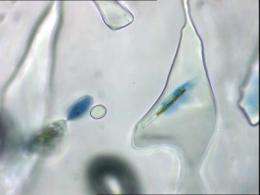
Inside an ice pore, gel-like mucus (stained blue to be visible) clings to an individual diatom of sea-ice algae. Credit: Christopher Krembs
the important first rung of the food web each spring in places like the Arctic Ocean can engineer ice to its advantage, according to the first published findings about this ability.
The same gel-like mucus secreted by sea-ice algae as a kind of antifreeze against temperatures well below minus 10 C is also allowing algae to sculpt microscopic channels and pores in ice that are hospitable to itself and other microorganisms.
Altering ice to their benefit should help sea-ice algae adapt to a warming world, which is good news for hungry fish and shellfish farther up the food web, but what it means for the integrity of the ice itself raises unanswered questions according to Jody Deming, University of Washington professor of oceanography and co-author of a paper appearing in the March 1 Proceedings of the National Academy of Sciences.
Ice riddled with more channels and pores will be weaker, yet such openings plugged with algal secretions actually hold more salty water and thus may slow melting in the spring and summer, she says. Scientists have yet to determine if the two processes cancel each other or if one will dominate, say Deming and co-authors Christopher Krembs, Washington State Department of Ecology, and Hajo Eicken, University of Alaska Fairbanks.
Sea ice is home to microscopic plants and animals, bacteria and viruses that stay alive in brine-filled openings in the ice. The gel-like mucus secreted by ice algae and other microorganisms, called extracellular polysaccharide substances, consists of complex sugar compounds. The mucus depresses the freezing point and keeps pore spaces in ice filled with at least some liquid.
The researchers focused on the algae that dominate the sea-ice biota across the Arctic each spring and in particular the variety Melosira arctica. Individually, Melosira arctica are about 50 micrometers long, or the width of a strand of human hair. Joined together, however, they form filaments that are meters long. Under-ice divers witness great forests of the algae hanging underwater from the sea ice each spring, Deming says.
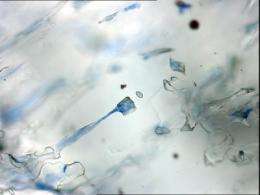
Gel-like mucus (stained blue) covers individual sea-ice algae clustered in a tiny box-shaped pore in the ice and fills the channel from the pore to the ocean. Credit: Christopher Krembs
Once considered minor contributors to the food web, sea-ice algae are gaining respect, Deming says. They bloom first in the spring and are responsible for nearly 60 percent of the primary production in ice-covered water at that time of year. As ice melts, creating open water, other microorganisms come to dominate primary production but Melosira arctica and brethren get credit for kick-starting the growing season.
Faced with a warming world, some scientists speculate that the importance of sea-ice algae, even in the spring, will diminish.
That may not be the case according to the new findings. In lab work, for instance, Deming and her co-authors found mucus from ice algae increased ice salinity by up to 59 percent and increased the number and complexity of channels. That means more places in the ice for algae to live where they can receive sunlight and avoid being eaten. The channels also retain more iron, nutrients and carbon dioxide needed for algal growth.
"Sea-ice primary productivity is expected to increase in a warming climate until the nutrient supply from below becomes limiting," the PNAS paper says. The work was funded by the National Science Foundation.
More information: http://www.pnas.or … t/108/9/3653
Provided by
University of Washington
-
From lemons to lemonade: Reaction uses carbon dioxide to make carbon-based semiconductor,
30 comments
-
Thioridazine kills cancer stem cells in human while avoiding toxic side-effects of conventional cancer treatments,
3 comments
-
SpaceX private rocket blasts off for space station (Update),
42 comments
-
Climate scientists say they have solved riddle of rising sea,
30 comments
-
Research team claims to have found evidence Lake Cheko is impact crater for Tunguska Event,
18 comments
-
What would stain as translucent on light-coloured fabric?
3 hours ago
-
How do I identify different bacteria on culture plates?
13 hours ago
-
Why Do Dogs do Strange things...
May 25, 2012
-
What does exophillic and endophillic mean in terms of mosquito and their control?
May 24, 2012
-
Semen stains glows under black lights (uv light)?
May 23, 2012
-
Question on Human Chromosome 2
May 23, 2012
- More from Physics Forums - Biology
More news stories
Scientist: Evolution debate will soon be history
(AP) -- Richard Leakey predicts skepticism over evolution will soon be history. Not that the avowed atheist has any doubts himself.
2 hours ago |
3.5 / 5 (4) |
3
Thousands of shellfish found dead in Peru
Thousands of crustaceans were found dead off the coast of Lima following the mystery mass death of dolphins and pelicans, the Peruvian Navy said Friday.
12 hours ago |
4.8 / 5 (4) |
5
More plant species responding to global warming than previously thought
(Phys.org) -- Far more wild plant species may be responding to global warming than previous large-scale estimates have suggested.
May 22, 2012 |
4.6 / 5 (14) |
18
|
Totally rad: Scientists create rewritable digital data storage in DNA
(Phys.org) -- Scientists from Stanford's Department of Bioengineering have devised a method for repeatedly encoding, storing and erasing digital data within the DNA of living cells.
May 21, 2012 |
4.9 / 5 (17) |
11
|
For monogamous sparrows, it doesn't pay to stray (but they do it anyway)
It's quite common for a female song sparrow to stray from her breeding partner and mate with the male next door, but a new study shows that sleeping around can be costly.
May 22, 2012 |
5 / 5 (1) |
7
|
Dell tablet leak: 10.1-inch display, two-battery choice
(Phys.org) -- Headline after headline talks about vendors tablets in the wings as likely number-one contenders for the iPad. Such claims have justifiably been taken with a grain of salt, considering ...
Keep food safety in mind this memorial day weekend
(HealthDay) -- Picnics, parades and cookouts are as much a part of Memorial Day weekend as tributes to the United States' war veterans.
SpaceX capsule has 'new car' smell, astronauts say (Update)
SpaceX's Dragon cargo vessel smells like a new car, said astronauts at the International Space Station after opening the hatches Saturday following the spacecraft's landmark mission to the orbiting lab.
SpotterRF debuts Radar Backpack Kit (w/ Video)
(Phys.org) -- SpotterRF has announced a special radar backpack kit designed to enhance situational awareness for soldiers on the ground. The company says its special radar is designed for warfighters as part ...
Australia hails surprise super-telescope decision
Australia has hailed a surprise decision giving it a role in a radio telescope project aimed at revolutionising astronomy, vowing to draw on its decades of experience in space science.
Astronomers seize last chance in lifetime for Venus Transit
Astronomers are gearing for one the rarest events in the Solar System: an alignment of Earth, Venus and the Sun that will not be seen for another 105 years.
