Advanced Light Source finds big surprise in Paleozoic scorpion fossil
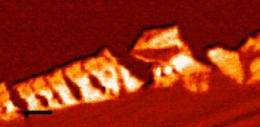
(PhysOrg.com) -- It’s not quite Jurassic Park, but who wants Paleozoic scorpions scurrying around anyway? Scientists used a powerful microscope at the U.S. Department of Energy’s Lawrence Berkeley National Laboratory (Berkeley Lab) to detect remnants of protein and chitin in the exoskeleton of a 417-million-year-old fossil of an extinct mega-scorpion, a discovery that is several hundred million years older than previously thought possible.
The finding was made by a team of scientists led by George Cody of the Carnegie Institution of Washington. The research was conducted at the Advanced Light Source, a synchrotron located at Berkeley Lab.
Their work upends the conventional view that organic material, such as that found in the outer portion of exoskeleton, doesn’t endure in extremely old fossils because it’s readily broken down by hungry microbes and other natural processes. The outer layer of exoskeleton is composed of a fibrous weave of chitin, a polysaccharide rich in nitrogen, embedded in a matrix of structural proteins.
The scientists found the molecular signature of this material in a 417-million-year-old eurypterid fossil, an extinct arthropod that resembles an enormous scorpion. Some eurypterid species measured six feet long. They also found chitin-protein complex in a 310-million-year-old scorpion fossil. Previously, the oldest evidence of chitin dates to 25-million-year-old fossils.
“It turns out that vestiges of chitin and structural protein are abundant in much older fossils than we thought. Who knows what other surprises we’ll find when we search for organic material in even older fossils,” says Cody, the lead author of an article on this research that was recently published online by the journal Geology.
Scientists have used mass spectrometry to detect chitin in fossils from the Cenozoic era, which spans from today to when the dinosaurs became extinct 65 million years ago. But the trail grows cold further back in time. Analyses of shrimp, eurypterid, and scorpion fossils dating from the Paleozoic era, which spans from 542 to 251 million years ago, failed to uncover evidence of chitin. This led scientists to conclude that fossilized chitin is whittled away to nothing by millions of years of degradation.
Cody’s team tried a new approach to hunt for chitin-protein complex. They turned to beamline 5.3.2 of the Advanced Light Source, a national user facility that generates intense x-rays to probe the fundamental properties of substances.
The beamline boasts a state-of-the-art scanning transmission x-ray microscope that can produce nanoscale images of materials. It can also perform an analytic technique, called x-ray absorption near edge structure spectroscopy, which identifies atoms of individual elements, within their molecular framework, by probing their electrons at distinctive energies. Beamline 5.3.2 is specially tuned to detect carbon, nitrogen, and oxygen atoms.
The beamline instrumentation was developed by Berkeley Lab’s David Kilcoyne, who previously teamed up with Cody to catalog the chemical makeup of meteorites and comet dust. Other scientists have used the beamline to explore the characteristics of carbon nanotubes and study air pollution samples, among many applications.
In this research, Cody and Kilcoyne studied the fossil remains of two Paleozoic arthropods: a scorpion unearthed in a cave in northern Illinois, and a eurypterid plucked from a quarry in Ontario, Canada. In both fossils, x-ray absorption near edge structure analyses revealed that much of the carbon, nitrogen, and oxygen detected in the exoskeleton are from chitin-protein complex.
“The microscope at the Advanced Light Source is the star in this research,” says Cody. “It opens up new ways of conducting molecular paleontology research.”
Cody believes the preservation of chitin-protein residues in extremely old fossils likely depends on the build up of fatty acids on a scaffold of chitin-protein molecules. This layer saves the remaining matrix of chitin and proteins from degradation by microorganisms even after 500 million years.
More information: “Molecular signature of chitin-protein complex in Paleozoic arthropods” is published online Feb. 3 by the journal Geology.
Provided by Lawrence Berkeley National Laboratory


