Xenacoelomorpha -- a new phylum in the animal kingdom
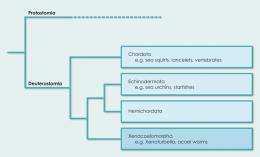
Modified phylogeny: The Xenacoelomorpha represent the fourth phylum of the deuterostomia. Credit: Art for Science
An international team of scientists including Albert Poustka from the Max Planck Institute for Molecular Genetics in Berlin has discovered that Xenoturbellida and the acoelomorph worms, both simple marine worms, are more closely related to complex organisms like humans and sea urchins than was previously assumed. As a result they have made a major revision to the phylogenetic history of animals. Up to now, the acoelomate worms were viewed as the crucial link between simple animals like sponges and jellyfish and more complex organisms. It has now emerged that these animals did not always have as simple a structure as they do today.
The genus Xenoturbella lives off the coast of Scandinavia, Scotland and Iceland. It shares a simple body structure with the acoelomorph worms: these organisms, which reach a maximum size of just a few millimetres, have no through gut, no gill slits and no body cavity (Greek: coelom = cavity). Many members of both groups live on the ocean floor and feed on organic particles in the sediment. Some species live parasitic, e.g. in the intestines of sea cucumbers.
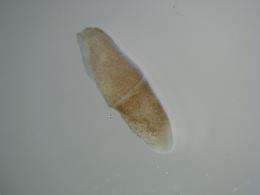
Worms of the genus Xenoturbella belong to another deuterostome branch. Credit: University of Tsukuba, Japan/Hiroaki Nakano
The animal kingdom is divided into different evolutionary lines. These include, among others, the protostomes (mouth first) and deuterostomes (second mouth). In the protostomes, the mouth that develops at the beginning of embryonic development becomes the organisms actual mouth, whereas, in the deuterostomes, it becomes the anus and the mouth develops at a later stage. Three deuterostome phyla were known up to now: the Chordates (e.g. vertebrates), the Echinoderms (sea urchins, starfish, sea cucumbers) and the Hemichordates (e.g. acorn worm). Our research shows that Xenoturbellida and Acoelomorpha together form the fourth phylum which we have called Xenacoelomorpha, explains Albert Poustka from the Planck Institute for Molecular Genetics in Berlin.According to the scientists, Xenoturbellida and Acoelomorpha have a shared ancestor, from which the complex group of deuterostomes descend. Therefore, contrary to what was previously assumed xenacoelomorph worms did not always have a simple structure but lost the characteristics typical for many deuterostomes over the course of evolution. The worms simplified their construction plan in reality because that was clearly as advantageous or even more advantageous than a complicated body structure, says Poustka.
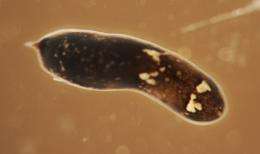
Hofstenia miamia also belongs to the deuterostomes. Credit: Uppsala University/Andreas Wallberg
With the help of extremely processor-intensive mathematical models, the scientists examined new mini genes (microRNAs) and amino acids from the fully sequenced mitochondrial genomes of Acoelomorpha and Xenoturbellida, and a large set of several hundred genes. The analysis of the Xenoturbella microRNAs and the acoelomate worm Hofstenia miamia showed that the previously analysed acoelomate worm Symsagittifera roscoffensis had lost many of these mini genes. The gene repertoire of the analyzed animals points instead to the kinship between these animals and the deuterostomes. For example, they have a microRNA that was previously only known to exist in echinoderms and acorn worms. Moreover, all of the animals analysed up to now from the new Xenacoelomorpha phylum have the gene RSB66, which could previously only be demonstrated in deuterostomes.
The complex organisms of the protostomes and deuterostomes do not originate both from acoelomorph like worms as was previously assumed. Earlier studies were clearly subject to a systematic error that scientists refer to as the long branch artefact. This error often arises in the comparison of the genotypes of organisms that have long developed independently of each other. Even if the DNA sequences of some organisms mutated more quickly than the average, this effect can arise. This was precisely the case with the acoelomorph worms, says Poustka. As a next step the researchers are now decoding the entire genome of the different species of Xenacoelomorpha in order to reach a better understanding of the evolution of the deuterostomes.
More information: Hervé Philippe, et al. Acoelomorph flatworms are deuterostomes related to Xenoturbella published in online in Nature, February 10th 2011.
Provided by
Max-Planck-Gesellschaft
-
From lemons to lemonade: Reaction uses carbon dioxide to make carbon-based semiconductor,
30 comments
-
Thioridazine kills cancer stem cells in human while avoiding toxic side-effects of conventional cancer treatments,
3 comments
-
SpaceX private rocket blasts off for space station (Update),
42 comments
-
Climate scientists say they have solved riddle of rising sea,
30 comments
-
Research team claims to have found evidence Lake Cheko is impact crater for Tunguska Event,
18 comments
-
What would stain as translucent on light-coloured fabric?
2 hours ago
-
How do I identify different bacteria on culture plates?
12 hours ago
-
Why Do Dogs do Strange things...
May 25, 2012
-
What does exophillic and endophillic mean in terms of mosquito and their control?
May 24, 2012
-
Semen stains glows under black lights (uv light)?
May 23, 2012
-
Question on Human Chromosome 2
May 23, 2012
- More from Physics Forums - Biology
More news stories
Scientist: Evolution debate will soon be history
(AP) -- Richard Leakey predicts skepticism over evolution will soon be history. Not that the avowed atheist has any doubts himself.
1 hour ago |
3.5 / 5 (4) |
2
Thousands of shellfish found dead in Peru
Thousands of crustaceans were found dead off the coast of Lima following the mystery mass death of dolphins and pelicans, the Peruvian Navy said Friday.
11 hours ago |
4.8 / 5 (4) |
5
More plant species responding to global warming than previously thought
(Phys.org) -- Far more wild plant species may be responding to global warming than previous large-scale estimates have suggested.
May 22, 2012 |
4.6 / 5 (14) |
18
|
Totally rad: Scientists create rewritable digital data storage in DNA
(Phys.org) -- Scientists from Stanford's Department of Bioengineering have devised a method for repeatedly encoding, storing and erasing digital data within the DNA of living cells.
May 21, 2012 |
4.9 / 5 (17) |
11
|
For monogamous sparrows, it doesn't pay to stray (but they do it anyway)
It's quite common for a female song sparrow to stray from her breeding partner and mate with the male next door, but a new study shows that sleeping around can be costly.
May 22, 2012 |
5 / 5 (1) |
7
|
Dell tablet leak: 10.1-inch display, two-battery choice
(Phys.org) -- Headline after headline talks about vendors tablets in the wings as likely number-one contenders for the iPad. Such claims have justifiably been taken with a grain of salt, considering ...
Keep food safety in mind this memorial day weekend
(HealthDay) -- Picnics, parades and cookouts are as much a part of Memorial Day weekend as tributes to the United States' war veterans.
SpaceX capsule has 'new car' smell, astronauts say (Update)
SpaceX's Dragon cargo vessel smells like a new car, said astronauts at the International Space Station after opening the hatches Saturday following the spacecraft's landmark mission to the orbiting lab.
SpotterRF debuts Radar Backpack Kit (w/ Video)
(Phys.org) -- SpotterRF has announced a special radar backpack kit designed to enhance situational awareness for soldiers on the ground. The company says its special radar is designed for warfighters as part ...
Australia hails surprise super-telescope decision
Australia has hailed a surprise decision giving it a role in a radio telescope project aimed at revolutionising astronomy, vowing to draw on its decades of experience in space science.
Astronomers seize last chance in lifetime for Venus Transit
Astronomers are gearing for one the rarest events in the Solar System: an alignment of Earth, Venus and the Sun that will not be seen for another 105 years.


Feb 17, 2011
Rank: not rated yet
Either one derives "protostomes" and "deuterostomes" from the Greek word for mouth (stoma) or from the Greek word for opening (stomio). In the former case the plural would have to be protostomata and deuterostomata. In the latter case the plural would have to be protostomia and deuterostomia.
But please not the inconsistency of "mouth" (stoma) in the text and "protostomia" and "deuterostomia" (first and second opening) in the picture.