Web makes 15 mins fame a lifetime of shame
February 11, 2011 by Sebastian Smith

A journalist looks at a page of Gawker.com

Enlarge

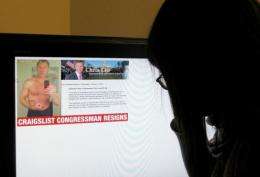
A journalist looks looks at the Gawker.com internet site showing a shirtless New York Republican Congressman Christopher Lee flexing in a mirror. Lee stepped down after the publication of the picture.

Thought the Internet was a place for anonymity? Ask Christopher Lee, who resigned as a US congressman this week.

The married Republican must have thought the famous dating section of Craigslist the perfect vehicle for organizing trysts.

The next thing he knew his cheesy self-portrait photo of his muscular torso had been shipped by his would-be date to Gawker.com, a gossip website, and from there into career-killing infamy.

In the early days, the Web resembled a virtual, parallel world, where anything went. Now it is not only perhaps less private than the real world -- but far less forgiving.

"The microscope is coming to a theater near you and everyone is going to live under a microscope," says Michael Fertik, CEO of Reputation.com, which helps people worried about their online presence.

That "microscope" is astonishing in power, drawing on everything from blog entries and postings to food orders and search histories.

Fertik rattled off data a typical person reveals online:

"Your musical preferences, who your friends are, what you buy, where you live, where you travel, where you surf on the Internet, what your health hazards are, what you eat, what exercise, what size clothes you wear, what the names of all your family members are, your political affiliations."

And that's without the drunken photos, sexual boasts, online rants, or other lapses in judgment that Internet tools like Facebook, , YouTube, and the like encourage.

Lee's online search for a mistress was probably bound to get him in trouble.

But what about Ashley Payne, a US school teacher sacked over Facebook photos that showed her holding wine and beer glasses while on holiday in Europe? Or the Connecticut woman fired by an ambulance company because she complained on Facebook about her boss?

The growing reality is that far from being able to hide behind avatars, pseudonyms and , going online more resembles going into a public street and shouting. That off-the-record chat once confined to around the office water cooler -- it's gone global.

Christopher Lee's office on Capitol Hill
Enlarge

The office of former Republican Representative Christopher Lee of New York is seen on Capitol Hill in Washington, DC, February 10. Lee resigned late Wednesday after apparently sending a shirtless photo of himself and flirty messages to a woman not his wife in reply to her online personal ad on Craigslist.

-- Forget about forgetting --

Even scarier, web watchers say, is that in Web world, with its vast and constantly expanding archive, your past becomes permanent.

"Right now, there is no delete button for the Internet," Fertik said.

For advertisers, that sea of Web data is a goldmine allowing them to target millions of people with ads tailored to their online profiles. For bosses and the simply curious, it's also a giant keyhole to peep through.

Hiring managers routinely Google applicants -- it's dubbed the Google Handshake -- and a Microsoft survey found that 70 percent of company representatives had turned down candidates after finding something they didn't like.

Meanwhile, if you're on a first date, an iPhone app called Date Check will even let you search criminal records and property ownership of the potential lover sitting across the table.

A big weapon of the future is likely to be facial-recognition technology, allowing you to search an individual online by photo, not name.

The impossibility of escaping your past heralds a disturbing new era, says Viktor Mayer-Schoenberger, a cyber specialist at the Oxford Internet Institute.

"I think it's an existential crisis," he said, "because in order to forgive, we also need to forget."

And for all those Internet-addicted youths out there now, the revenge of the Web has barely begun. Wait till they apply for sensitive jobs or political posts in a decade, like last year's congressional candidate, Krystal Ball, who was slammed by the reemergence of embarrassing party pictures on the net.

"We are underestimating the problem, because the problem manifests itself usually much later than when we shared the information," Mayer-Schoenberger warned.

Facebook's founder Mark Zuckerberg has said that society will adapt and find a way to deal with the morass of public embarrassment.

"People have really gotten comfortable not only sharing more information and different kinds, but more openly and with more people," Zuckerberg says. "That social norm is just something that has evolved over time."

But with awareness only spreading gradually, concerns are growing. A Gallup poll this week found that 52 percent of Google users and nearly 70 percent of Facebook members are worried that they are risking their privacy.

The skeptics found a new champion in First Lady Michelle Obama who on Wednesday revealed that she was not rushing to get her daughters, aged 12 and nine, onto Facebook.

While the site has a lower age limit of 13, children often sign up by lying about their age. "I'm not a big fan of young kids having Facebook," Obama said. "It's not something they need. It's not necessary."

Fertik's company can clean up a person's Internet history, deleting some unwanted posts and burying the rest in more positive information so that at least an initial Google Handshake comes up clean.

But he says that the power of the data collecting giants prevents serious enactment of privacy measures, leaving consumers to face an uncertain future.

"Some people say the culture changes. I agree a photograph of someone drinking today may not matter in 30 years," Fertik said. "But there'll be something that does matter that we don't think of today."

(c) 2011 AFP

Filter


Move the slider to adjust rank threshold, so that you can hide some of the comments.


Display comments: newest first

Skepticus
Feb 11, 2011

Rank: 4 / 5 (2)
Live by the sword, die by the sword. your privacy depends on how much and how detailed information you are willingly putting into writing,cyberspace, or coming out of your mouth. Facebook, Twitter, YouTube are designed goldmine for Big Brothers, stalkers and criminals.
Quantum_Conundrum
Feb 11, 2011

Rank: 4 / 5 (2)
Live by the sword, die by the sword. your privacy depends on how much and how detailed information you are willingly putting into writing,cyberspace, or coming out of your mouth. Facebook, Twitter, YouTube are designed goldmine for Big Brothers, stalkers and criminals.


Well, this I can certainly agree with, as we've seen so many crimes and bullying issues in the past several years which had internet as a primary tool in the acts.

However, as this article outlines, the internet is also becoming a place to permanently demonize someone over one mistake, however minor it may be, often over ridiculous things that are really nobody's business anyway. People are losing their jobs or relationships because they can't be forgiven of some minor screw up.

There are just so many things wrong with this and related aspects of the internet, but then any time governments try to do anything about it, the liberals throw a fit because of "freedom of speech/press" issues.
Quantum_Conundrum
Feb 11, 2011

Rank: 4 / 5 (2)
And as for employers or potential dates "googling" something about someone, it's also BS, because who's to say the person or group who wrote whatever you find online was telling the truth?

Anyone can write or do just about anything on here, including false acusations and other forms of libel or slander, and there's basicly no legal course of action to take against it, additionally, you might not even know about it personally for years or decades later. One person can basicly ruin the rest of your life with one or two false statements to the right organizations.
ekim
Feb 12, 2011

Rank: 5 / 5 (2)
There are just so many things wrong with this and related aspects of the internet, but then any time governments try to do anything about it, the liberals throw a fit because of "freedom of speech/press" issues.

Government is part of the problem. The Department of Justice is now advocating holding on to internet and cell records even longer.
"Mandatory data retention laws would require companies to maintain large databases of subscribers' personal information, which would be vulnerable to hackers, accidental disclosure, and government or other third party access."
- John Morris, Center for Democracy & Technology
Rank 5 /5 (5 votes)
Relevant PhysicsForums posts

More news stories

SpotterRF debuts Radar Backpack Kit (w/ Video)

(Phys.org) -- SpotterRF has announced a special radar backpack kit designed to enhance situational awareness for soldiers on the ground. The company says its special radar is designed for warfighters as part ...

Technology / Hi Tech & Innovation

created 13 hours ago | popularity 5 / 5 (3) | comments 10 | with audio podcast report

Probability of contamination from severe nuclear reactor accidents is higher than expected: study

Catastrophic nuclear accidents such as the core meltdowns in Chernobyl and Fukushima are more likely to happen than previously assumed. Based on the operating hours of all civil nuclear reactors and the number ...

Technology / Energy & Green Tech

created May 22, 2012 | popularity 3.7 / 5 (20) | comments 52 | with audio podcast

Delphi gasoline-injection engine technique rivals hybrid's edge

(Phys.org) -- Running a diesel like engine on gasoline is something Delphi is doing in notable fashion. They claim they are on to a promising way to enjoy an engine that gives the vehicle owner high efficiency ...

Technology / Energy & Green Tech

created May 21, 2012 | popularity 4.7 / 5 (18) | comments 37 | with audio podcast report

HyperSolar shows dirty water no barrier to power world

(Phys.org) -- The Santa Barbara, California, company, HyperSolar, is set to transparently share the ups and downs of its research experiences toward the company’s ultimate vision, successfully producing ...

Technology / Energy & Green Tech

created May 24, 2012 | popularity 4.8 / 5 (14) | comments 17 | with audio podcast report

Tesla to launch electric sedan in US on June 22

Tesla Motors said Tuesday it would begin deliveries of "the world's first premium electric sedan" on June 22, slightly ahead of schedule.

Technology / Energy & Green Tech

created May 22, 2012 | popularity 4.5 / 5 (11) | comments 18


Dell tablet leak: 10.1-inch display, two-battery choice

(Phys.org) -- Headline after headline talks about vendors’ tablets in the wings as likely number-one contenders for the iPad. Such claims have justifiably been taken with a grain of salt, considering ...

Scientist: Evolution debate will soon be history

(AP) -- Richard Leakey predicts skepticism over evolution will soon be history. Not that the avowed atheist has any doubts himself.

SpaceX capsule has 'new car' smell, astronauts say (Update)

SpaceX's Dragon cargo vessel smells like a new car, said astronauts at the International Space Station after opening the hatches Saturday following the spacecraft's landmark mission to the orbiting lab.

Keep food safety in mind this memorial day weekend

(HealthDay) -- Picnics, parades and cookouts are as much a part of Memorial Day weekend as tributes to the United States' war veterans.

Thousands of shellfish found dead in Peru

Thousands of crustaceans were found dead off the coast of Lima following the mystery mass death of dolphins and pelicans, the Peruvian Navy said Friday.

Australia hails surprise super-telescope decision

Australia has hailed a surprise decision giving it a role in a radio telescope project aimed at revolutionising astronomy, vowing to draw on its decades of experience in space science.