Russia loses military satellite: reports
Feb 01, 2011
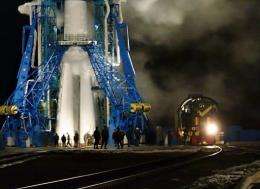
A Soyuz space craft is seen at the launch pad of Plesetsk cosmodrome in 2004. Russia's top military and space official launched a search Tuesday for a missing military satellite that apparently was put into the wrong orbit shortly after its launch.

Russia's top military and space official launched a search Tuesday for a missing military satellite that apparently was put into the wrong orbit shortly after its launch.

The Russian defence ministry confirmed that it had lost sight of the craft -- a dual-use vessel that can draw a three-dimensional map of the Earth and locate the precise positions of various targets.

The incident came just a month after President Dmitry Medvedev sacked two top space officials for a similar setback and delivered another humiliating blow to Russia's much-maligned space industry.

The seriousness of the situation was underscored late Tuesday by reports that the defence ministry had set up an urgent joint task force with the Russia's space agency to look for the missing craft.

The Geo-IK-2 satellite was created in Russia to help the military survey land and create a detailed three-dimensional map of the Earth. It was designed to spin in a circular orbit 1,000 kilometres (600 miles) above ground.

But news reports said that the had been put in an an whose lowest point brought it to within 330 kilometres of Earth.

"We have still not been able to establish contact with the craft, and it looks like most likely, it will be declared lost," a Russian space source told the Interfax-AVN news service.

"The spacecraft will not be able to perform its intended functions at these orbit characteristics," another space official told the news agency.

Reports pointed the initial blame for the failure on the satellite's Briz-KM upper stage rocket.

The satellite's launch had already been delayed from December because of technical malfunctions that were detected at its northern Russian launch site in .

Tuesday's malfunction came less than five weeks after Medvedev fired two top space officials and reprimanded the agency chief for a launch failure caused to delay the deployment of its own navigation system.

Russia's Proton-M rocket had on that occasion proven too heavy to reach its initial orbit and had been forced to dump its three high-tech Glonass-M satellites near the Hawaii Islands.

Investigators said that accident was caused by a basic fuel miscalculation that made the craft too heavy to reach its required height.

The three Glonass satellites would have completed a system whose research had been started by the Soviet Union in 1976.

Explore further: NASA head views progress on asteroid lasso mission

add to favorites email to friend print save as pdf

Related Stories

Russia probes navigation system spending after crash

Dec 07, 2010

Russia launched a probe Tuesday into whether the money assigned to create a satellite navigation rival to the US GPS system was being wisely spent, prosecutors said, after the latest launch ended in failure.

Recommended for you

NASA head views progress on asteroid lasso mission

2 hours ago

Surrounded by engineers, NASA chief Charles Bolden inspected a prototype spacecraft engine that could power an audacious mission to lasso an asteroid and tow it closer to Earth for astronauts to explore.

Ecuador satellite collides with Russian space junk

2 hours ago

A small Ecuadoran satellite collided in orbit with the remains of a Russian rocket, but it is too soon to know how much damage it might have sustained, Quito's space agency said Thursday.

Forecast for Titan: Wild weather could be ahead

May 22, 2013

(Phys.org) —Saturn's moon Titan might be in for some wild weather as it heads into its spring and summer, if two new models are correct. Scientists think that as the seasons change in Titan's northern hemisphere, ...

SDO observes mid-level solar flare

May 22, 2013

UPDATE 16:30 p.m. EDT: The M7-class flare was also associated with a coronal mass ejection or CME, another solar phenomenon that can send billions of tons of particles into space. While this CME was not Ea ...

User comments : 0

More news stories

Hubble reveals the ring nebula's true shape

(Phys.org) —The Ring Nebula's distinctive shape makes it a popular illustration for astronomy books. But new observations by NASA's Hubble Space Telescope of the glowing gas shroud around an old, dying, ...

NASA head views progress on asteroid lasso mission

Surrounded by engineers, NASA chief Charles Bolden inspected a prototype spacecraft engine that could power an audacious mission to lasso an asteroid and tow it closer to Earth for astronauts to explore.

A hidden population of exotic neutron stars

(Phys.org) —Magnetars – the dense remains of dead stars that erupt sporadically with bursts of high-energy radiation - are some of the most extreme objects known in the Universe. A major campaign using ...

Controlling mood through the motions of mitochondria

(Medical Xpress)—Regulating the distribution of power in neurons is done by a system that makes the national electric grid look simple by comparison. Each neuron has several thousand mitochondria confined ...

Google Drive sports new view and scan enhancements

(Phys.org) —Google Drive has a new look and functions. The makeover in Google Drive features scanning and interface enhancements that put the user into "card" mode. The enhancements make it easy for the ...

Future doctors unaware of their obesity bias

Two out of five medical students have an unconscious bias against obese people, according to a new study by researchers at Wake Forest Baptist Medical Center. The study is published online ahead of print in the Journal of ...