New plastics can conduct electricity
February 22, 2011 By Bob Beale

New plastics can conduct electricity

Enlarge

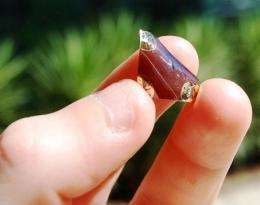
Sample of the conducting film. (Photo: Adam Micolich)

(PhysOrg.com) -- A newly discovered technique makes it possible to create a whole new array of plastics with metallic or even superconducting properties.

Plastics usually conduct electricity so poorly that they are used to insulate electric cables but, by placing a thin film of metal onto a plastic sheet and mixing it into the polymer surface with an , Australian researchers have shown that the method can be used to make cheap, strong, flexible and conductive plastic films.

The research has been published in the journal ChemPhysChem by a team led by Professor Paul Meredith and Associate Professor Ben Powell, both at the University of Queensland, and Associate Professor Adam Micolich of the UNSW School of Physics. This latest discovery reports experiments by former UQ Ph.D. student, Dr Andrew Stephenson.

Ion beam techniques are widely used in the microelectronics industry to tailor the of such as silicon, but attempts to adapt this process to plastic films have been made since the 1980s with only limited success – until now.

"What the team has been able to do here is use an ion beam to tune the properties of a plastic film so that it conducts electricity like the metals used in the electrical wires themselves, and even to act as a superconductor and pass electric current without resistance if cooled to low enough temperature," says Professor Meredith.

To demonstrate a potential application of this new material, the team produced electrical resistance thermometers that meet industrial standards. Tested against an industry standard platinum resistance thermometer, it had comparable or even superior accuracy.

"This material is so interesting because we can take all the desirable aspects of polymers - such as mechanical flexibility, robustness and low cost - and into the mix add good electrical conductivity, something not normally associated with plastics," says Professor Micolich. "It opens new avenues to making plastic electronics."

Andrew Stephenson says the most exciting part about the discovery is how precisely the film’s ability to conduct or resist the flow of electrical current can be tuned. It opens up a very broad potential for useful applications.

"In fact, we can vary the electrical resistivity over 10 orders of magnitude – put simply, that means we have ten billion options to adjust the recipe when we're making the plastic film. In theory, we can make that conduct no electricity at all or as well as metals do – and everything in between,” Dr Stephenson says.

These new materials can be easily produced with equipment commonly used in the industry and are vastly more tolerant of exposure to oxygen compared to standard semiconducting polymers.

Combined, these advantages may give ion beam processed polymer films a bright future in the on-going development of soft materials for plastic electronics applications – a fusion between current and next generation technology, the researchers say.

Provided by University of New South Wales search and more info website

4.7 /5 (37 votes)  

Filter


Move the slider to adjust rank threshold, so that you can hide some of the comments.


Display comments: newest first

irjsiq
Feb 24, 2011

Rank: 5 / 5 (1)
'Brown's Gas' for use in Stock, Internal Combustion Engines.
These Ionized Polymers should be incorporated into the Electrolizing elements of 'Brown's Gas' Generators;
Anode/Cathode properties may be vastly superior to Metallics.
Little or no Oxydization,
Long lived as a result; less energy required for Electrolysis, higher H2 production numbers?

Just as our Petrol Spigots are nearing shut-down, a Mini-Manhattan Project, Privately funded, is direly needed to avoid total Economic Collapse, toward which we were headed already what with our Wanton Debt Accumulation, funded with Fiat Dollars!

Roy J Stewart,
Phoenix AZ USA
Egnite
Mar 01, 2011

Rank: not rated yet
It's been a while since I studied chemistry but isn't the oxidation an important part of Electrolysis? Without it wouldn't you be left with H2O since the O2 doesn't go anywhere...?
Rank 4.7 /5 (37 votes)
Relevant PhysicsForums posts
  • Schwartz reagent-- NMR/MS/IR
    created13 hours ago
  • Inversion temp
    created17 hours ago
  • High school chemistry EEI
    createdMay 25, 2012
  • oxidation of I- by KMnO4
    createdMay 25, 2012
  • Invesion temp
    createdMay 25, 2012
  • Hybridization of SnCl3 -
    createdMay 25, 2012
  • More from Physics Forums - Chemistry

More news stories

From lemons to lemonade: Reaction uses carbon dioxide to make carbon-based semiconductor

(Phys.org) -- A materials scientist at Michigan Technological University has discovered a chemical reaction that not only eats up the greenhouse gas carbon dioxide, it also creates something useful. And, by ...

Chemistry / Materials Science

created May 21, 2012 | popularity 4.7 / 5 (88) | comments 32 | with audio podcast

New CO2-removing catalyst can take the heat

(Phys.org) -- The current method of removing the greenhouse gas carbon dioxide (CO2) from the flues of coal-fired power plants uses so much energy that no one bothers to use it. So says Roger Aines, principal ...

Chemistry / Materials Science

created May 24, 2012 | popularity 5 / 5 (7) | comments 7 | with audio podcast

High-speed method to aid search for solar energy storage catalysts

Eons ago, nature solved the problem of converting solar energy to fuels by inventing the process of photosynthesis.

Chemistry / Materials Science

created May 25, 2012 | popularity 5 / 5 (3) | comments 4 | with audio podcast

Researchers demonstrate possible primitive mechanism of chemical info self-replication

(Phys.org) -- When scientists think about the replication of information in chemistry, they usually have in mind something akin to what happens in living organisms when DNA gets copied: a double-stranded molecule ...

Chemistry / Materials Science

created May 25, 2012 | popularity 5 / 5 (4) | comments 2 | with audio podcast

Castor oil: Action mechanism of one of the oldest drugs known to man elucidated

Castor oil is known primarily as an effective laxative; however, it was also used in ancient times with pregnant women to induce labour. Only now have scientists at the Max Planck Institute for Heart and Lung ...

Chemistry / Biochemistry

created May 21, 2012 | popularity 3 / 5 (2) | comments 3 | with audio podcast


Dell tablet leak: 10.1-inch display, two-battery choice

(Phys.org) -- Headline after headline talks about vendors’ tablets in the wings as likely number-one contenders for the iPad. Such claims have justifiably been taken with a grain of salt, considering ...

Scientist: Evolution debate will soon be history

(AP) -- Richard Leakey predicts skepticism over evolution will soon be history. Not that the avowed atheist has any doubts himself.

SpotterRF debuts Radar Backpack Kit (w/ Video)

(Phys.org) -- SpotterRF has announced a special radar backpack kit designed to enhance situational awareness for soldiers on the ground. The company says its special radar is designed for warfighters as part ...

SpaceX capsule has 'new car' smell, astronauts say (Update)

SpaceX's Dragon cargo vessel smells like a new car, said astronauts at the International Space Station after opening the hatches Saturday following the spacecraft's landmark mission to the orbiting lab.

Thousands of shellfish found dead in Peru

Thousands of crustaceans were found dead off the coast of Lima following the mystery mass death of dolphins and pelicans, the Peruvian Navy said Friday.

Australia hails surprise super-telescope decision

Australia has hailed a surprise decision giving it a role in a radio telescope project aimed at revolutionising astronomy, vowing to draw on its decades of experience in space science.