NRL scientists elevate warfighter readiness against invisible threats
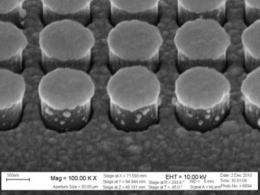
A 100,000 times magnified view of the gold coated, silicon nanopillars that make up the arrays used in the SERS measurements. Each array consists of 250,000 nanopillars with up to 400 arrays per wafer. Credit: U.S. Naval Research Laboratory
In asymmetric warfare, early detection and identification of trace level chemical and biological agents and explosive compounds is critical to rapid reaction, response, and survivability. While there are many methods currently being used that can detect these threats, none allow for the unique fingerprinting of threat agents at trace levels.
A research team, led by Drs. Joshua Caldwell and Orest Glembocki, scientists at the U.S. Naval Research Laboratory, Electronic Science and Technology Division, has overcome this limitation with surface enhanced Raman scattering (SERS) using optically stimulated plasmon oscillations in nanostructured substrates.
Shown to provide enhancements of the Raman signal, large-area gold (Au) coated silicon (Si) nanopillar arrays are over 100 million times more sensitive than Raman scattering sensing alone, while maintaining a very uniform response with less than 30 percent variability across the sensor area.
"These arrays are over an order-of-magnitude more sensitive than the best reported SERS sensors in the literature and the current state-of-the-art large-area commercial SERS sensors," said Caldwell. "These arrays can be a key component of fully integrated, autonomously operating chemical sensors that detect, identify and report the presence of a threat at trace levels of exposure."
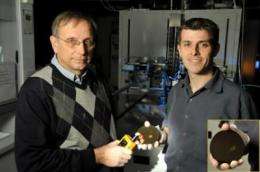
Scientists Orest Glembocki (holding a DeltaNu ExamineR hand-held Raman spectrometer) and Joshua Caldwell, display one of the silicon wafers they fabricated for the SERS sensing using ion etching and e-beam lithography. Several square arrays of gold-coated silicon nanopillar were fabricated on the wafer to perform surface-enhanced Raman scattering testing. Credit: U.S. Naval Research Laboratory/Jamie Hartman
Raman devices use laser light to excite molecular vibrations, which in turn causes a shift in the energy of the scattered laser photons, up or down, creating a unique visual pattern. In the case of trace amounts of molecules in gases or liquids, detection through ordinary Raman scattering is virtually impossible. However, the Raman signal can be enhanced via the SERS effect using metal nanoparticles.Despite surface-enhanced Raman scattering being first observed in the late 1970s, efforts to provide reproducible SERS-based chemical sensors has been hindered by the inability to make large-area devices with a uniform SERS response. The ability to reproducibly pattern nanometer-sized particles in periodic arrays has finally allowed this requirement to be met.
"While many tools are currently available to detect trace amounts of chemical warfare and biological agents and explosive compounds, a device using SERS can be used to identify these minute quantities of the chemicals of interest by providing a 'fingerprint' of the material, which all but eliminates the prevalence of false alarms," says Glembocki.
SERS offers several potential advantages over other spectroscopic techniques because of its measurement speed, high sensitivity, portability, and simple maneuverability. SERS can additionally be used to enhance existing Raman technologies, such as the hand held and standoff units that are already in use in field applications.
Provided by
Naval Research Laboratory
-
From lemons to lemonade: Reaction uses carbon dioxide to make carbon-based semiconductor,
31 comments
-
Thioridazine kills cancer stem cells in human while avoiding toxic side-effects of conventional cancer treatments,
3 comments
-
SpaceX private rocket blasts off for space station (Update),
42 comments
-
Climate scientists say they have solved riddle of rising sea,
30 comments
-
Research team claims to have found evidence Lake Cheko is impact crater for Tunguska Event,
18 comments
-
Water Rocket
2 hours ago
-
why do trucks have bigger brakes?
6 hours ago
-
Solar Sail Physics - Do they work on a large scale?
7 hours ago
-
How should I switch an air conditioner off?
8 hours ago
-
Question about current decay in R-L circuit
8 hours ago
-
Elementary time - how does it work?
11 hours ago
- More from Physics Forums - General Physics
More news stories
Dopant gives graphene solar cells highest efficiency yet
(Phys.org) -- By taking advantage of graphenes favorable electrical and optical properties, and then adding an organic dopant, researchers have achieved the highest power conversion efficiency yet for ...
Nanomedicine: Quantum dots appear safe in pioneering study on primates
A pioneering study to gauge the toxicity of quantum dots in primates has found the tiny crystals to be safe over a one-year period, a hopeful outcome for doctors and scientists seeking new ways to battle diseases ...
Nanotechnology / Bio & Medicine
May 20, 2012 |
4.3 / 5 (3) |
8
|
In nanorod crystal growth, nanoparticles seen as artificial atoms
In the growth of crystals, do nanoparticles act as "artificial atoms" forming molecular-type building blocks that can assemble into complex structures? This is the contention of a major but controversial theory ...
May 24, 2012 |
4.8 / 5 (6) |
0
|
First direct observation of oriented attachment in nanocrystal growth
Berkeley Lab researchers have reported the first direct observation of nanoparticles undergoing oriented attachment, the critical step in biomineralization and the growth of nanocrystals. A better understanding ...
May 24, 2012 |
4.7 / 5 (3) |
0
|
Synthetic nano-waste does not disappear
(Phys.org) -- Tiny particles of cerium oxide do not burn or change in the heat of a waste incineration plant. They remain intact on combustion residues or in the incineration system, as a new study by Swiss ...
Nanotechnology / Bio & Medicine
May 25, 2012 |
5 / 5 (2) |
1
|
Dell tablet leak: 10.1-inch display, two-battery choice
(Phys.org) -- Headline after headline talks about vendors tablets in the wings as likely number-one contenders for the iPad. Such claims have justifiably been taken with a grain of salt, considering ...
Scientist: Evolution debate will soon be history
(AP) -- Richard Leakey predicts skepticism over evolution will soon be history. Not that the avowed atheist has any doubts himself.
SpotterRF debuts Radar Backpack Kit (w/ Video)
(Phys.org) -- SpotterRF has announced a special radar backpack kit designed to enhance situational awareness for soldiers on the ground. The company says its special radar is designed for warfighters as part ...
SpaceX capsule has 'new car' smell, astronauts say (Update)
SpaceX's Dragon cargo vessel smells like a new car, said astronauts at the International Space Station after opening the hatches Saturday following the spacecraft's landmark mission to the orbiting lab.
Thousands of shellfish found dead in Peru
Thousands of crustaceans were found dead off the coast of Lima following the mystery mass death of dolphins and pelicans, the Peruvian Navy said Friday.
Australia hails surprise super-telescope decision
Australia has hailed a surprise decision giving it a role in a radio telescope project aimed at revolutionising astronomy, vowing to draw on its decades of experience in space science.
