NASA sees former Tropical Storm Carlos still a soaker in the Northern Territory
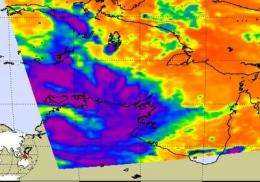
Now a remnant low pressure area, former Tropical Storm Carlos continues to move southwest inland over Australia's Northern Territory and dump heavy amounts of rainfall. NASA's Aqua satellite saw some of the high thunderstorms within Carlos over land and extending north into the Timor Sea.
The Atmospheric Infrared Sounder (AIRS) instrument onboard NASA's Aqua satellite measures cloud-top, sea surface and land temperatures. Those are important factors in determining the strength and power of a tropical cyclone. Sea surface temperatures need to be at least as warm 26.6 Celsius (80 degrees Fahrenheit) to power a tropical cyclone. Conversely, frigid cloud temperatures, such as those seen in the tops of Carlos' thunderstorms that are as cold as or colder than -52C (-63F) show strong thunderstorms and suggest heavy rainfall.
Even before Carlos became a tropical storm it was a low pressure system that lingered around Darwin, Australia for a couple of days. Over the course of the last four days, Darwin airport reported 26.5 inches of rainfall (673 mm). The largest rainfall total came from Channel Island at 32.87 inches (835 mm).
As Carlos moved south-southwest, those heavy rains continued to fall from those powerful thunderstorms with the cold cloud tops, causing more flooding. The AIRS infrared image from Feb. 17 at 0429 UTC (Feb. 16 at 11:29 p.m. EST) of Carlos' cold clouds showed that there are bands of thunderstorms to the north of Carlos' center. Those bands of thunderstorms are picking up energy from the warm waters of the Timor Sea and feeding the storm, of which the center is over land.
Reports from ABC News Darwin indicated that the Darwin River Dam and the Adelaide River rose significantly. The Territory Wildlife Park in Berry Springs has also reported flooding and their website reported that the park was closed "due to wet weather" because some areas were unsafe for visitors.
At 0900 UTC (4 a.m. EST/ 6:30 p.m. Australia/Darwin local time) on Feb. 17, Carlos had maximum sustained winds near 39 mph. It was located about 75 nautical miles south of Darwin near 13.9 South and 130.6 East. It was moving southwest near 5 knots.
AIRS infrared imagery showed disorganized convection (rising air that forms the thunderstorms that power/make up the tropical cyclone). The low-level circulation is also weakening as it is over land.
Carlos is forecast to continue moving southwest and the Joint Typhoon Warning Center expects Carlos' remnants to move over or south of the Joseph Bonaparte Gulf between 2100 UTC today and 2100 UTC on Feb. 18. As Carlos continues moving southwestward residents in its path should be on guard for moderate to heavy rainfall.
Provided by NASA's Goddard Space Flight Center


