Hinode looks into a hole on the Sun
Feb 09, 2011
Image credit: Hinode/XRT

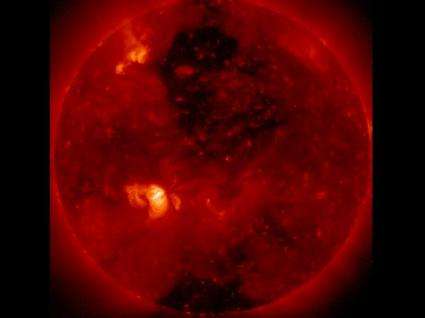
On Feb. 1, 2011, the Hinode satellite captured this breathtaking image of a coronal hole, seen in the top center of the image. A polar coronal hole can also be seen at the bottom of the image.

A coronal hole is an opening in the sun's through which gas can easily escape into space.

The holes are relatively cool in temperature as compared to the active regions nearby -- such as the bright region on the lower left portion of the solar disk -- the cooler temperature is one of the reasons for the darker appearance.

Hinode, a Japanese mission in partnership with , NAOJ, STFC, ESA, and NSC, currently in Earth orbit, is studying the sun to improve our understanding of the mechanisms that power the solar atmosphere and drive solar eruptions.

Explore further: Collisions of coronal mass ejections can be super-elastic

Related Stories

Image: Holes in the Sun's corona

Jan 12, 2011

This Solar Dynamics Observatory image of the Sun taken on January 10 in extreme ultraviolet light captures a dark coronal hole just about at sun center.

Hinode helps unravel long-standing solar mysteries

Aug 22, 2007

A year after launch, scientists working with Hinode, a Japanese mission with ESA participation, are meeting at Trinity College, Dublin, to discuss latest findings on solar mysteries - including new insights ...

Scientists Explore the Mystery of Active Region Outflows

Jun 25, 2010

(PhysOrg.com) -- The Japanese Hinode spacecraft that launched in September 2006 contains the Extreme-ultraviolet Imaging Spectrometer (EIS), which provides measurements of properties of the solar corona such ...

Science with the solar space observatory Hinode

Mar 20, 2008

The solar space observatory Hinode was launched in September 2006, with the name "Hinode" meaning sunrise in Japanese. The Hinode satellite carries a solar optical telescope (SOT), an X-ray telescope (XRT), ...

Solar Eruption Seen in Unprecedented Detail

May 27, 2008

On April 9, the Sun erupted and blasted a bubble of hot, ionized gas into the solar system. The eruption was observed in unprecedented detail by a fleet of spacecraft, revealing new features that are predicted by computer ...

Recommended for you

NASA head views progress on asteroid lasso mission

13 hours ago

Surrounded by engineers, NASA chief Charles Bolden inspected a prototype spacecraft engine that could power an audacious mission to lasso an asteroid and tow it closer to Earth for astronauts to explore.

Ecuador satellite collides with Russian space junk

13 hours ago

A small Ecuadoran satellite collided in orbit with the remains of a Russian rocket, but it is too soon to know how much damage it might have sustained, Quito's space agency said Thursday.

Forecast for Titan: Wild weather could be ahead

May 22, 2013

(Phys.org) —Saturn's moon Titan might be in for some wild weather as it heads into its spring and summer, if two new models are correct. Scientists think that as the seasons change in Titan's northern hemisphere, ...

SDO observes mid-level solar flare

May 22, 2013

UPDATE 16:30 p.m. EDT: The M7-class flare was also associated with a coronal mass ejection or CME, another solar phenomenon that can send billions of tons of particles into space. While this CME was not Ea ...

User comments : 4

Adjust slider to filter visible comments by rank

Display comments: newest first

d_robison
not rated yet Feb 09, 2011
I'm not really sure what the point of this article is (not trying to bash anyone). I would think it would be obvious that the super-heated gas in the corona would follow the regular magnetic field lines (having ionized particles following the field to the poles), except for the bizzare twists in the field causing sun spots and ejected material. Am I misunderstanding the idea here or is this really just common sense? I'm not complaining about the data itself, it just seems as though they are surprised about the findings.
neiorah
not rated yet Feb 10, 2011
Much of what is discovered is really common sense stuff.
abhishekbt
not rated yet Feb 10, 2011
The idea for this article is simple. They wanted to post a so called 'breathtaking' image period.

There is no science attached to it.
d_robison
not rated yet Feb 14, 2011
The idea for this article is simple. They wanted to post a so called 'breathtaking' image period.

There is no science attached to it.


Much of what is discovered is really common sense stuff.


I figured as much.

More news stories

A hidden population of exotic neutron stars

(Phys.org) —Magnetars – the dense remains of dead stars that erupt sporadically with bursts of high-energy radiation - are some of the most extreme objects known in the Universe. A major campaign using ...

Hubble reveals the ring nebula's true shape

(Phys.org) —The Ring Nebula's distinctive shape makes it a popular illustration for astronomy books. But new observations by NASA's Hubble Space Telescope of the glowing gas shroud around an old, dying, ...

Century-old science helps confirm global warming

(Phys.org) —Ocean measurements taken more than 135 years ago during the scientific expedition of HMS Challenger have provided further confirmation of human-produced global warming over the past century.

Hormone replacement therapy—clarity at last

The British Menopause Society and Women's Health Concern have today released updated guidelines on Hormone Replacement Therapy (HRT) to provide clarity around the role of HRT, the benefits and the risks. The new guidelines ...

Controlling mood through the motions of mitochondria

(Medical Xpress)—Regulating the distribution of power in neurons is done by a system that makes the national electric grid look simple by comparison. Each neuron has several thousand mitochondria confined ...

A quantum simulator for magnetic materials

Physicists understand perfectly well why a fridge magnet sticks to certain metallic surfaces. But there are more exotic forms of magnetism whose properties remain unclear, despite decades of intense research. ...