German scientists eye Afghan Buddha reconstruction
February 25, 2011

Bamiyan Buddhas once glowed in red, white and blue

Enlarge

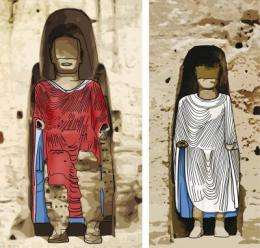
The illustration shows the colored appearance of the Bamiyan Buddhas’ robes at the end of the 10th century. Parts damaged in later periods, which cannot be reconstructed, are made visible. Credit: Arnold Metzinger

German scientists said Friday they believed it possible to reconstruct one of the world-famous Bamiyan Buddhas dynamited by the Taliban in Afghanistan in 2001, prompting worldwide condemnation.

Scientists from the University of Munich, in southern Germany, have examined fragments of the statues -- the world's largest Buddhas -- and concluded that the smaller one could be pieced together.

The two sculptures, 53 metres (173 feet) and 35 metres tall, had stood sentinel for 1,500 years in Bamiyan province before they were blown up by Islamists who believed them to be idolatrous.

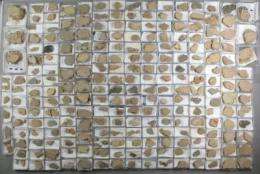
Erwin Emmerling, the leader of the team sifting through hundreds of fragments, "considers a reconstruction of the smaller Buddha to be fundamentally possible," the university said in a statement.

"As far as the larger Buddha is concerned, in view of its depth (thickness) of around 12 metres, Professor Emmerling is more sceptical," it said.

Nevertheless, the university cited "political and practical" obstacles to rebuilding the precious statues.
Bamiyan Buddhas once glowed in red, white and blue
Enlarge

Restorers from the Technische Universitaet Muenchen have analyzed hundreds of fragments of the Bamiyan Buddhas. Credit: Catharina Blaensdorf / TU Muenchen

Either a small factory would have to be built in the Bamiyan valley or some 1,400 rocks weighing up to two tonnes each would have to be transported to Germany. Japanese funding could reportedly be used to rebuild the sculptures.

They were once painted a variety of colours, the scientists said, including dark blue, pink, orange, red and white.

"The Buddhas once had an intensely colourful appearance," Emmerling said.

Based on their investigation, the scientists also dated the smaller Buddha to between 544 and 595 AD. The bigger Buddha was built between 591 and 644, they said.
Bamiyan Buddhas once glowed in red, white and blue
Enlarge

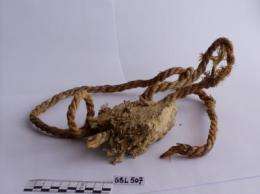
The bottom layer of the Bamiyan Buddhas' plaster was held in place with ropes. Credit: Edmund Melzl / ICOMOS

A conference in Paris to debate the future of the Buddhas is expected to take place next week, the statement said.

The niches where they once stood overlooking Bamiyan city, the eponymous capital of the province, are being restored as a UN .

(c) 2011 AFP

Filter


Move the slider to adjust rank threshold, so that you can hide some of the comments.


Display comments: newest first

YawningDog
Feb 25, 2011

Rank: not rated yet
The Buddha would never have let himself get upset over the destruction of a stone image. Especially of himself.
AdnanAA
Feb 26, 2011

Rank: 5 / 5 (1)
It is be reconstruct,
Approximately 2thousands years old,
Great creature of HAZARA ethnic group of Afghanistan,
Proud of HAZARAJAT,
Rank 5 /5 (6 votes)
Relevant PhysicsForums posts

More news stories

Social welfare cuts ultimately come with heavy price, researchers say

(Phys.org) -- Slashing government funding for Medicaid, food stamps and other programs that serve the poor – while politically popular with some lawmakers and many conservatives – may do more harm ...

Other Sciences / Social Sciences

created May 24, 2012 | popularity 4.1 / 5 (13) | comments 99

Ancient Bethlehem seal unearthed in Jerusalem

Israeli archaeologists have discovered a 2,700-year-old seal that bears the inscription "Bethlehem," the Israel Antiquities Authority announced Wednesday, in what experts believe to be the oldest artifact ...

Other Sciences / Archaeology & Fossils

created May 23, 2012 | popularity 3.5 / 5 (14) | comments 22

Oldest Jewish archaeological evidence on the Iberian Peninsula

German archaeologists of the Friedrich Schiller University Jena found one of the oldest archaeological evidence so far of Jewish Culture on the Iberian Peninsula at an excavation site in the south of Portugal, ...

Other Sciences / Archaeology & Fossils

created May 25, 2012 | popularity 4.3 / 5 (4) | comments 12

Dollars and sense: Why are some people morally against tax?

As the U.S. presidential election campaigns heat up, the economic debate is dominated by bailouts, austerity and, inevitably, taxation. Now a new study published in Symbolic Interaction asks why tax is such an important issue ...

Other Sciences / Social Sciences

created May 23, 2012 | popularity 3 / 5 (2) | comments 12

Oldest art even older

New dates from Geißenklösterle Cave in Southwest Germany document the early arrival of modern humans and early appearance of art and music.

Other Sciences / Archaeology & Fossils

created May 24, 2012 | popularity 5 / 5 (2) | comments 6


SpotterRF debuts Radar Backpack Kit (w/ Video)

(Phys.org) -- SpotterRF has announced a special radar backpack kit designed to enhance situational awareness for soldiers on the ground. The company says its special radar is designed for warfighters as part ...

Australia hails surprise super-telescope decision

Australia has hailed a surprise decision giving it a role in a radio telescope project aimed at revolutionising astronomy, vowing to draw on its decades of experience in space science.

Astronomers seize last chance in lifetime for Venus Transit

Astronomers are gearing for one the rarest events in the Solar System: an alignment of Earth, Venus and the Sun that will not be seen for another 105 years.

Thousands of shellfish found dead in Peru

Thousands of crustaceans were found dead off the coast of Lima following the mystery mass death of dolphins and pelicans, the Peruvian Navy said Friday.

SpaceX capsule has 'new car' smell, astronauts say

SpaceX's Dragon cargo vessel smells like a new car, said astronauts at the International Space Station after opening the hatches Saturday following the spacecraft's landmark mission to the orbiting lab.

Family history of Alzheimer's affects functional connectivity

(HealthDay) -- Cognitively normal individuals with a family history of late-onset Alzheimer's disease (AD) may display lower resting state functional connectivity in the default mode network (DMN) of the brain, ...